|
 |
 |


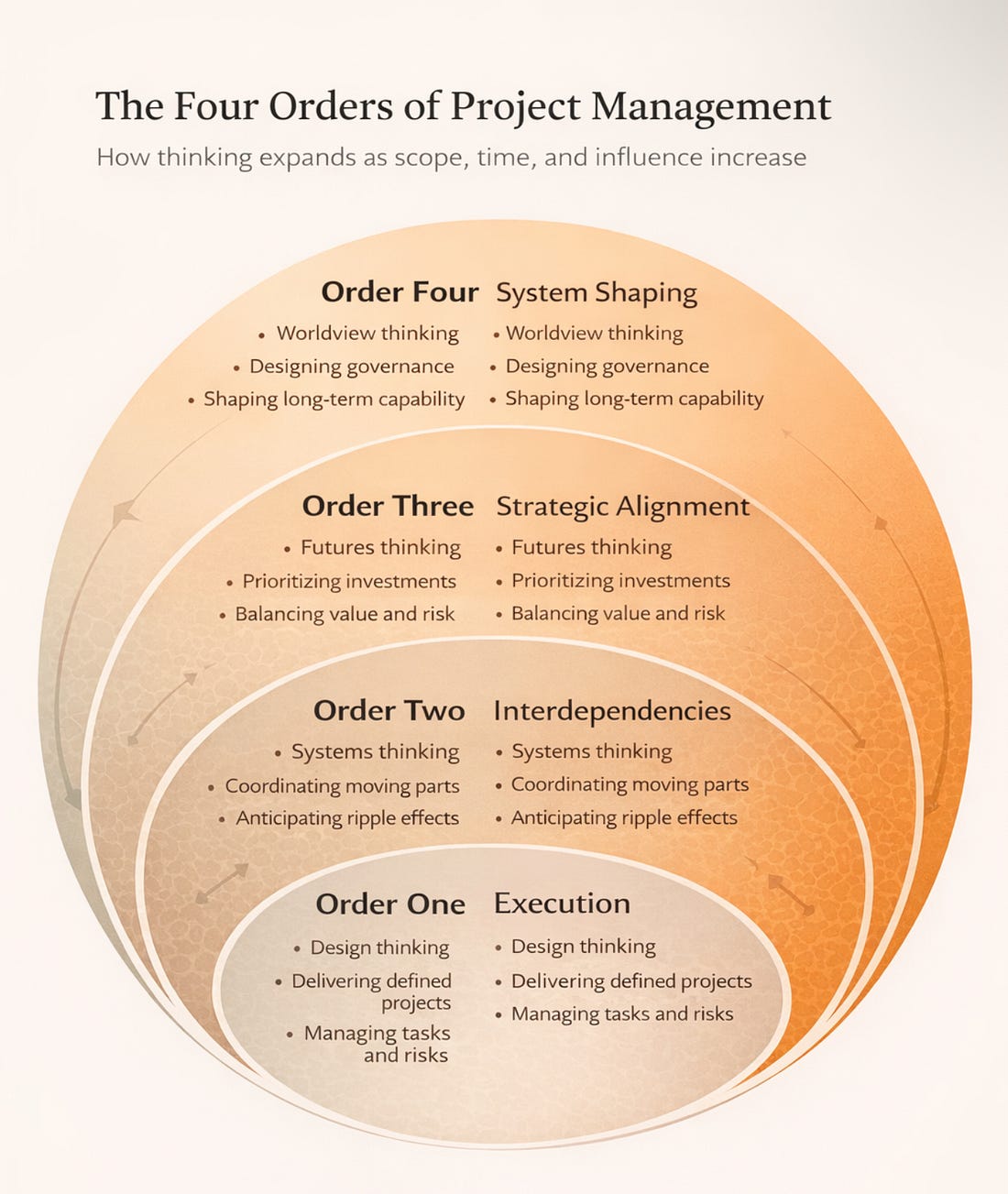
Project management does not become more advanced because projects get larger. It becomes more advanced because the way a project manager understands change evolves.
Early in a career, the work is concrete. There is a scope to deliver and a plan to follow. Over time, the work expands outward. Projects start interacting with other projects. Decisions begin to affect strategy. Eventually, the work moves upstream, shaping how projects are conceived, governed, and sustained.
These shifts are not about hierarchy or job titles. They are about orders of thinking. Each order represents a different way of seeing the work and a different relationship to time, complexity, and impact.
You do not leave earlier orders behind. You carry them with you.
First-Order Project Management: Designing and Delivering the Work
First-order project management is grounded in execution. The goal is clear. The outcome is defined. The work is to translate intent into reality.
This is where most people enter the profession, and where disciplined craft is developed.
What the work looks like
At this level, the project is treated as a bounded effort. It has defined inputs, outputs, and constraints. The project manager is close to the work and deeply involved in how it unfolds.
The focus is on:
Clarifying scope and deliverables
Breaking work into manageable components
Sequencing tasks correctly
Tracking progress and risks
Keeping commitments
Tools and frameworks used
This is the domain of foundational tools:
Work Breakdown Structures
Gantt charts and schedules
RACI matrices
RAID logs
Status reports
Used well, these tools are not bureaucratic. They are design instruments that shape how work moves.
How thinking works at this level
First-order thinking is intentional and linear. You assume that if the work is framed clearly and executed carefully, results will follow.
There is also an implicit design mindset at play. You are taking an abstract need and making it tangible. Plans, schedules, and reports are not neutral documents. They are artifacts that influence behavior.
A strong first-order project manager designs these artifacts thoughtfully. They make the work legible to others.
An analogy
This level is like skilled craftsmanship.
You are building something with your hands and your attention. Precision matters. Preparation matters. If the foundation is weak, nothing above it holds.
Why this level matters
First-order mastery builds trust. It establishes credibility. It proves you can deliver.
Every higher order depends on this competence. Without it, strategy remains theoretical.
 |
Second-Order Project Management: Working With Systems and Interactions
Second-order project management begins when the project stops behaving like a closed system.
Dependencies appear. Stakeholders pull in different directions. Changes ripple across teams. The project manager’s role expands from executing tasks to managing interactions.
What the work looks like
At this level, the project manager starts paying attention to relationships.
The focus shifts to:
Interdependencies between teams, systems, and decisions
How changes propagate across the project
Stakeholder expectations and influence
Feedback loops that amplify or dampen issues
The work becomes less about pushing tasks and more about maintaining balance.
Tools and frameworks used
Second-order work relies on visibility and awareness:
Dependency maps
Integrated schedules
Change impact analyses
Stakeholder maps
Risk heat maps
These tools help you see how the system behaves rather than just what it produces.
How thinking works at this level
Second-order thinking is systemic.
You stop assuming that problems live where they appear. You start asking what conditions produced them. You recognize that small changes can have outsized effects.
Instead of asking, “Is this task late?” you ask, “What does this delay affect, and why?”
An analogy
This level is like managing traffic rather than driving a single car.
You are watching flow, congestion, timing, and coordination. Success is measured by how smoothly the whole system moves, not just one lane.
Why this level matters
Second-order project managers prevent complexity from turning into chaos. They absorb volatility so teams can stay focused.
They are translators, stabilizers, and sense-makers.
Third-Order Project Management: Choosing the Right Work Over Time
Third-order project management marks a fundamental shift. The unit of concern is no longer the project. It is the portfolio.
Here, the central question becomes whether the work should exist in its current form and how it fits into a broader direction.
What the work looks like
At this level, projects are treated as investments.
The focus includes:
Strategic alignment
Portfolio balance and sequencing
Capacity and funding constraints
Long-term value and benefits
Not every project can move forward. Not every initiative deserves equal attention.
Tools and frameworks used
Decision-making tools become central:
Portfolio scoring models
Strategic roadmaps
Benefits realization frameworks
Capacity planning models
OKRs and KPIs tied to strategy
These tools support choice, not control.
How thinking works at this level
Third-order thinking is forward-looking and plural.
You stop planning for a single future and start preparing for multiple plausible ones. You evaluate decisions based on how they perform under uncertainty.
You think in horizons rather than deadlines.
An analogy
This level is like managing an investment portfolio.
Individual projects matter, but only in relation to the whole. You care about timing, diversification, risk exposure, and long-term return.
Why this level matters
Third-order project management protects the organization from overcommitment and drift. It ensures effort is directed toward outcomes that matter over time.
This is where judgment, restraint, and executive communication become critical.
Fourth-Order Project Management: Shaping the Conditions for Change
Fourth-order project management operates upstream of projects and portfolios.
Here, the work is not to deliver initiatives, but to shape the system that produces them.
What the work looks like
At this level, the focus shifts to:
Governance structures
Decision rights and incentives
Organizational learning
Long-term capability and resilience
You are no longer managing work. You are designing how work enters the system and how decisions are made.
Tools and frameworks used
Fourth-order tools are architectural:
Governance models
Operating model design
Policy and standards frameworks
Knowledge management systems
Feedback and learning loops
These tools shape behavior indirectly, but profoundly.
How thinking works at this level
Fourth-order thinking is reflective and generative.
You pay attention to:
The assumptions embedded in rules and processes
The behaviors rewarded by current structures
The patterns that repeat across projects
Rather than fixing outcomes, you redesign the conditions that produce them.
An analogy
This level is like city planning rather than construction.
You are deciding where roadsgo, how neighborhoods connect, and what rules shape development for decades.
Why this level matters
Fourth-order work creates durability. It allows organizations to adapt without reinventing themselves each time conditions change.
Its impact is often invisible, but long-lasting.
Projects as Transitions, Not Endpoints
As project managers move through these orders, one idea becomes unavoidable.
Projects are not endpoints. They are mechanisms for transition.
Each order expands the time horizon:
First order focuses on delivery
Second order focuses on interaction and adaptation
Third order focuses on strategic evolution
Fourth order focuses on systemic transformation
Success at higher levels cannot be measured by completion alone. It is measured by whether the work moves the organization toward a more capable future state.
As project managers grow, they expand:
The timeframes they consider
The systems they account for
The consequences they anticipate
The definition of success they apply
At its highest expression, project management becomes a form of stewardship. It shapes how organizations learn, decide, and change over time.
Hope this helps.
Nicole
Invite your friends and earn rewards
| ||||||||||

