|
 |
 |



Most projects do not start with full clarity. They start with intent. A problem that needs solving. A direction the organization wants to move in. A sense that something must change.
What they usually do not start with is stable requirements, settled constraints, or complete information.
That is normal.
What creates problems is not uncertainty itself. It is the expectation that certainty should exist before it realistically can.
As a project leader, you will be asked for answers early. Dates. Scope. Cost. Precision.
Those requests are reasonable. Leaders are accountable for outcomes and need a way to orient themselves.
The skill is not resisting those questions. The skill is answering them without pretending you know more than you do, and having the confidence to explain why and how a project will develop. This is the skill.
This is where progressive elaboration and rolling wave planning matter. Not as textbook concepts, but as everyday thinking tools that let you move forward without overcommitting, overexplaining, or backing yourself into a corner.
This article explains how these two approaches actually work, how they support project teams when requirements and complexity are still forming, and how to use them to respond calmly and credibly when pressure for certainty shows up early.
Why pressure for certainty shows up so fast
Early certainty requests are not a sign of mistrust or poor leadership. It’s expected. They are a response to risk.
Executives want to know what they are approving. Stakeholders want to understand what they are signing up for. Teams want direction so they can start moving.
When a project begins, people are trying to reduce anxiety by increasing clarity.
The problem is that clarity and precision are not the same thing. Clarity can exist early. Precision often cannot.
Good project leaders understand the difference and know how to provide one without falsely claiming the other.
Progressive elaboration
What it actually means in practice
Progressive elaboration is often described as refining plans as more information becomes available. That definition is technically correct, but it misses the point.
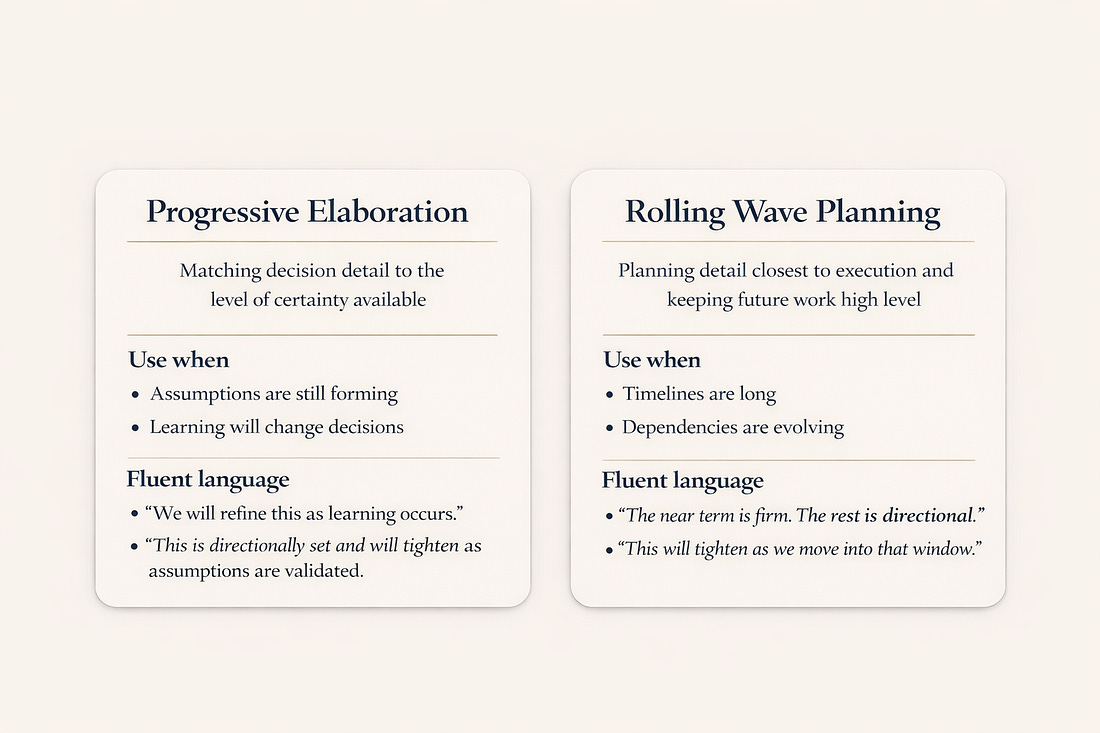
Progressive elaboration is really about decision timing. It is the discipline of making decisions only as precise as the information allows, then tightening them as learning occurs.
Early in a project, some things can be decided well. Others cannot. Progressive elaboration gives you a way to separate those two and treat them differently. This is not about being vague. It is about being honest.
You are clear about direction, outcomes, and constraints, while acknowledging that some details will mature later.
What progressive elaboration looks like on real teams
On teams that use progressive elaboration well, planning feels steady not rigid. Early requirements focus on outcomes and boundaries, not full specifications. Assumptions are written down instead of buried in schedules. Decisions are framed as provisional when they should be, with a clear understanding of when they will be revisited.
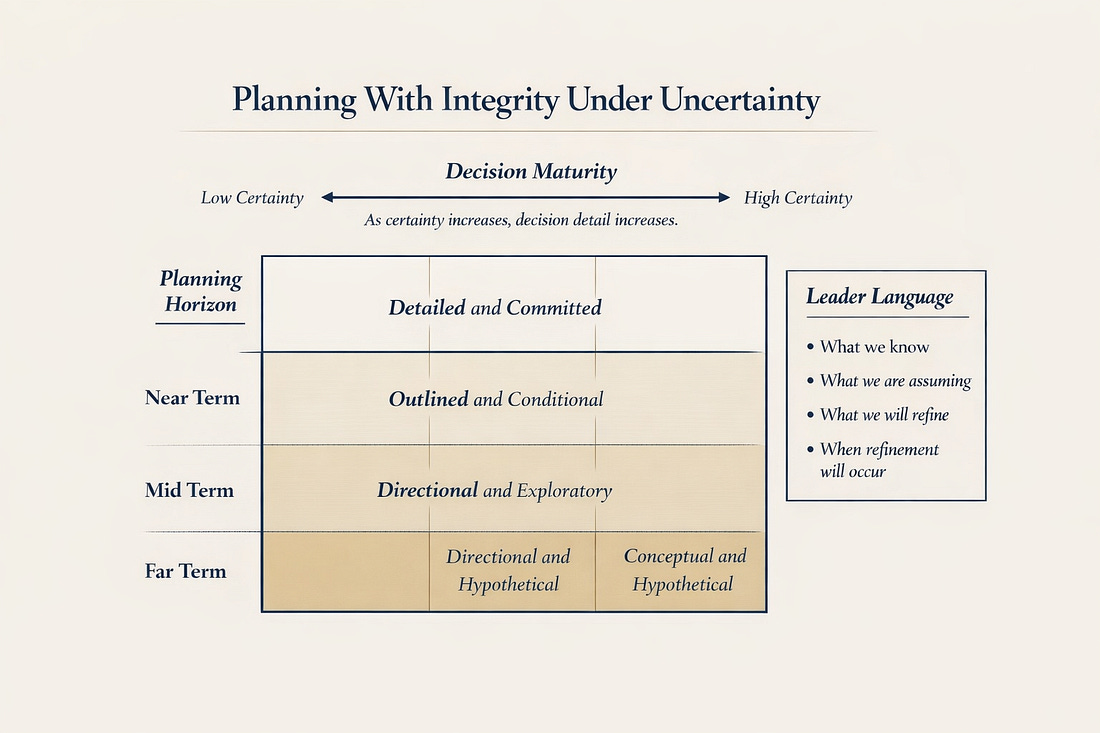
As uncertainty decreases, detail increases. Requirements become more specific. Estimates narrow. Plans tighten. Nothing is left to chance, but nothing is forced before it is ready.
The leadership discipline behind it
Progressive elaboration only works when leaders are willing to hold a certain posture.
First, assumptions have to be visible. If a plan depends on approvals, interpretations, or decisions that have not happened yet, that needs to be stated plainly.
Second, refinement points need to be intentional. Teams should know when clarity is expected to increase and when decisions will be firmed up. That predictability builds confidence even when outcomes are not fixed yet.
Third, teams need cover. Someone has to make it acceptable to say, this is not knowable yet, without being labeled unprepared.
Without these conditions, progressive elaboration turns into either guesswork or avoidance. With them, it becomes a strength.
 |
Rolling wave planning
Planning at the right distance
If progressive elaboration is about how decisions mature, rolling wave planning is about where that maturity shows up in the plan.
Rolling wave planning means planning near-term work in detail and keeping future work higher level until it is ready to be planned well.
The idea is simple. Detail is only useful when it can be acted on.
Planning sixor twelve months out with the same level of precision as next month usually creates false confidence. Too many assumptions are still in play.
Rolling wave planning prevents teams from spending time locking in details that are likely to change.
How rolling wave planning actually stabilizes projects
This approach often sounds risky to people who equate detail with control. In practice, it does the opposite.
Near-term work is planned thoroughly because it can be executed with confidence. Teams know exactly what they are doing now.
Future work is outlined directionally. Phases, dependencies, and decision points are visible, but details are not forced too early.
As time moves forward, the planning horizon moves with it. What was once high level becomes detailed at the right moment.
The result is fewer rewrites, less churn, and more reliable commitments.
Why these two methods belong together
Progressive elaboration and rolling wave planning reinforce each other.
Progressive elaboration governs how precise decisions should be. Rolling wave planning governs where that precision should live in time.
Together, they create a planning system that adapts without losing credibility.
One answers how much detail is appropriate. The other answers where that detail should exist right now.
Used together, they allow you to move forward without pretending certainty exists before it does.
How this helps your project team when things are still unclear
When requirements and complexity are not fully defined, teams face predictable pressure points.
They worry about being held to guesses. They worry about appearing indecisive. They worry about losing trust when plans change.
These methods help in very practical ways.
 |
They let you give clarity without overpromising
Progressive elaboration and rolling wave planning give you language and structure to explain what is known, what is still forming, and how clarity will increase.
Instead of presenting one definitive plan, you present a staged view of certainty.
Stakeholders can see that planning is active, not stalled.
They make change feel expected, not chaotic
When refinement is built into the planning approach, change stops being framed as failure. Adjustments are understood as part of how the project is meant to work. This lowers defensiveness on all sides and improves decision quality.
They reduce wasted effort
Detailed planning done too early often has to be undone.
Rolling wave planning keeps detail focused where it can be used. Progressive elaboration ensures effort spent refining plans aligns with real learning. Teams spend less time reworking and more time executing.
They support better conversations with leadership
These approaches naturally surface tradeoffs and assumptions. Instead of debating whether a plan is right or wrong, leaders can discuss what is firm, what is conditional, and what decisions matter next. That leads to better decisions and fewer surprises.
What to say when asked for certainty too early
One of the most useful benefits of these approaches is how they shape your responses in the moment.
When someone asks for certainty before it exists, the goal is not to push back. The goal is to explain your thinking clearly.
Here is how that sounds.
When asked for a fully detailed plan:
“We have detailed the work we can execute confidently. The remaining areas depend on decisions and information that are still forming. We will refine those pieces at defined points so the plan stays accurate.”
When asked to lock requirements:
“We have defined the core requirements and decision criteria. Some details will become clearer once priorities and constraints are confirmed. We are planning to refine those intentionally rather than guessing now.”
When asked for firm dates far in advance:
“The near-term milestones are firm. The later dates are directional and will tighten as assumptions are validated. That gives us more reliable commitments overall.”
Each response signals control without overstatement.
When these methods are the right choice
Progressive elaboration and rolling wave planning are especially effective when requirements depend on stakeholder decisions, approvals, policy interpretation, or evolving technology.
They are also well suited to long projects where early learning changes downstream work.
They are less useful when work is repetitive, tightly regulated, or requires fixed definitions early for compliance or coordination reasons.
Judgment matters. These are leadership tools, not defaults.
Common mistakes to avoid
These approaches are sometimes misunderstood. Progressive elaboration is not an excuse to avoid decisions. Rolling wave planning is not an excuse to avoid planning.
Detail must increase when uncertainty decreases. Plans must be revisited when promised. Communication must stay clear.
Used with discipline, these methods increase credibility. Used loosely, they do the opposite.
What changes when you truly internalize this
When you stop pretending certainty exists and start managing it deliberately, your presence changes. You sound calmer because you are explaining reality.
You gain trust because your commitments hold. When things change, people understand why.
Over time, you stop being seen as someone who tracks tasks and start being seen as someone who helps others think.
That is when people ask for your perspective, not just your status report.
Planning as professional integrity
Progressive elaboration and rolling wave planning are about honest planning.
They let you say what is known, what is still forming, and how learning will shape the path forward. In complex work, that honesty is not a weakness. It is competence.
The strongest project leaders are not the ones who promise certainty early. They are the ones who guide clarity into existence, step by step.
When you know these approaches deeply and speak them naturally, project management stops feeling like something you do. It becomes the way you think. And people notice.
Hope this helps,
Nicole
Invite your friends and earn rewards
| ||||||||||

