|
The Career Equation Most People Get Wrong
How to choose a job that looks good on paper — but also makes you happy
|

| |||||||||||||||


Last week I was reading a children’s book with my six-year-old about professions and earnings.
At one point he said:
“I want to do the work that’s most important. Not what’s most paid.”
He gave me his two options:
Cardiologist — helping sick babies and children
Mountain rescuer — saving people in the mountains
That conversation stayed with me, because there was an important career lesson in this.
Many adults do the reverse.
They start with salary, title, or status first — and only later confront the reality: they’re unhappy, constantly stressed, or burning out under expectations they can’t sustainably meet.
The Adult Mistake
Salary is measurable. Titles are visible. Promotions are socially rewarded.
So adults do what seems rational: aim for the bigger title, the higher package, or join the “hot” company. This is how they define success.
And somewhere down the road they face the reality: a role that doesn’t match their personality, a culture that wears them down, or a mission that doesn’t motivate them.
A bigger title doesn’t fix a bad fit. It just makes the misfit louder.
The Career Equation I Trust
If you want to make career decisions that are both meaningful and sustainable, I trust this simple equation:
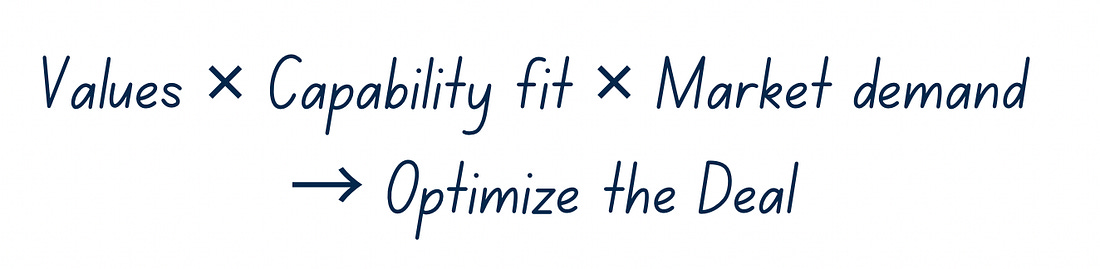 |
Here’s what that means.
Values & Principles (what you can’t compromise on)
Values and principles are your non-negotiables.
This is not about the list of values on a company website. It’s about what the company actually stands for in practice.
Values and principles show up through the mission a company pursues, the behaviours it encourages, and the trade-offs it makes to achieve its goals.
Your happiness at work depends heavily on whether you’re surrounded by behaviours that align with — or violate — what you personally consider acceptable.
To be clear: you don’t need to fully align with everything. If the company loves big parties — and you don’t — that’s fine.
But if the company normalizes behaviours you dislike or oppose (continuous overtime, politics, cutting corners on safety, treating customers poorly), that misalignment will slowly wear you down.
Strategy is part of this, too.
If the company competes on too many fronts while you value focus — or constantly shifts priorities while you prefer a stable operating rhythm — that mismatch will drain you over time.
So watch reality:
What trade-offs get made to meet deadlines?
What behaviour gets encouraged — and what gets ignored?
Who gets promoted, and why?
What keeps getting prioritized — and what always gets deprioritized?
That’s the values-and-principles system you’ll be living in every single day.
Capability Fit (how you’re wired to work)
This is the part many of us fail to answer honestly — and then wonder why a “great” job feels heavy.
You can build knowledge over time. You can learn a domain. You can stretch into new responsibilities.
But how you’re wired to work — the kind of work that gives you energy and focus — doesn’t change easily. It can change, but it usually requires openness, intention, and time.
A simple way to describe it is three work modes:
Builder (often: individual contributor): you enjoy doing tasks on your own. You thrive when you go deep and build — solving, designing, shipping, writing, becoming expert at a craft.
Enabler (often: people manager): you like to guide others and help them do great work — coaching, aligning, setting direction, removing blockers.
Visionary (often: accountable leader): you thrive when you set a vision, design a system others can execute, make decisions under uncertainty, and carry accountability.
This isn’t a hierarchy. You can be highly successful in any of these.
It’s also not black-and-white. Most roles include some building, some enabling, and some decision-making. What matters is which mode consumes most of your week. If 70–80% of your time sits in a mode that drains you, your happiness will eventually suffer — even if the remaining 20–30% is enjoyable.
But watch out. Titles can be misleading.
A role’s title suggests a mode, but the environment and culture often determines the real one: the company size, operating model, manager expectations, and how ownership is distributed.
Misplacement can be hard.
For example: if you love building, but your role is mostly chasing alignment, reporting, managing others who build — you might be “successful” on paper and still feel depleted every week.
If you have a strong drive to lead, own vision, and make decisions, but your role keeps you in a space with little ownership, you’ll feel constrained.
This matters regardless of where you are in your career. If you’re junior but feel a strong need for ownership and vision, look for environments where you can own something, even a small scope, or managers who value autonomy.
Market Demand (where your fit is rewarded)
The first two factors are internal. But there’s also external reality: market demand.
You can have a strong internal fit — values and capability fit — but if the market doesn’t value that combination right now (in your geography, level, and industry), you’ll feel stuck, underpaid or you’ll struggle to find the next job opportunity.
Market demand doesn’t replace your values or identity. It answers a practical question:
Where can my work be actually valued today?
A few signals to look for:
Are there many roles that match your profile?
Are multiple companies willing to pay well for this combination of scope and capability?
Is demand increasing or slowly declining?
A concrete example: over the last years, Security has repeatedly gone through waves where it moved from “nice to have” to “board-level priority”. In those moments, the same person with the same capability fit suddenly has more options, stronger bargaining power, and faster career progression.
Market demand works like that across many areas (e.g., cloud migrations, data/AI, privacy, sustainability). Follow this trends. Because it’s not just what you can do — it’s when and where the market urgently needs it.
The Intersection (where you should optimize the deal)
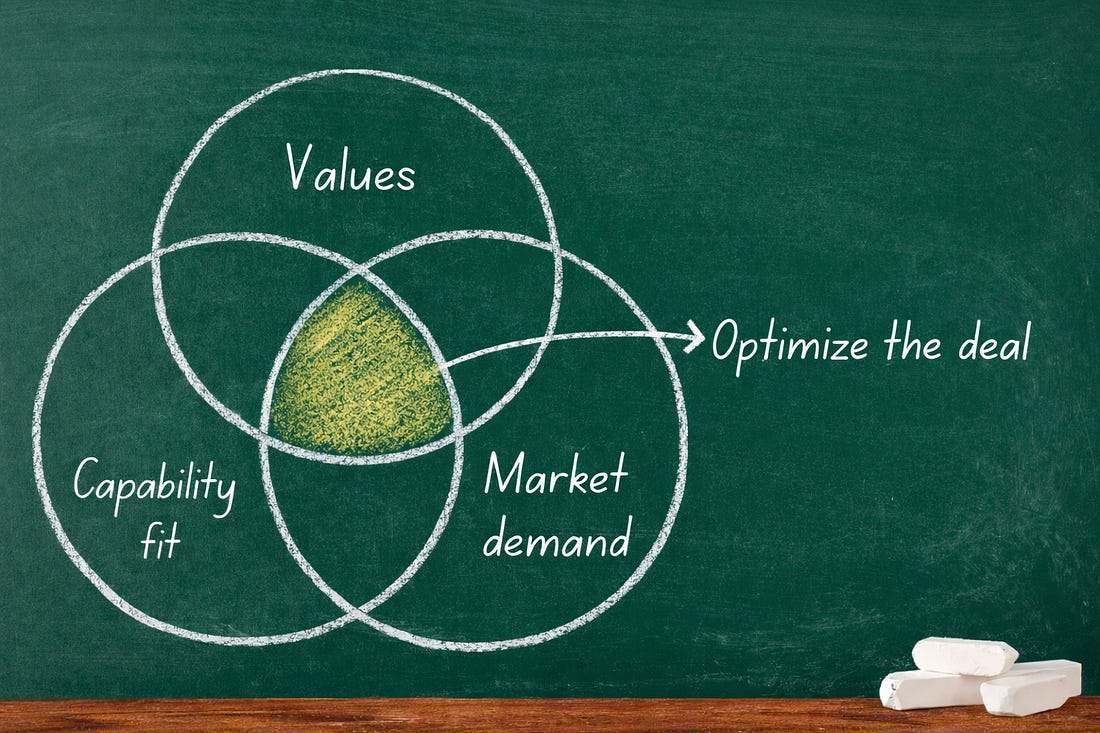 |
Once you’ve found a role that fits your values and capability fit — in a market where that combination is in demand — you’re in the right place to optimize the deal.
This is the part many people get backwards. They start with compensation.
Compensation is a powerful lever, but it’s a terrible compass.
So here’s the order I recommend:
Get the fit right first.
Then negotiate inside the fit.
Inside the overlap of the three factors, you can negotiate confidently because you’re not trying to “buy” motivation — you’re pricing your contribution.
If you optimize the deal while forgetting the rest, you may win the offer — but pay for it in happiness, health, or time.
Why This Works: Flow Wins Force
This equation isn’t just a career advice. It’s also a performance strategy.
When your values and capability align with the work you do — and the market rewards it — you’re much more likely to spend time in Flow.
A flow is a state in which people are so involved in an activity that nothing else seems to matter. The experience is so enjoyable that people will continue to do it even at great cost, for the sheer sake of doing it.
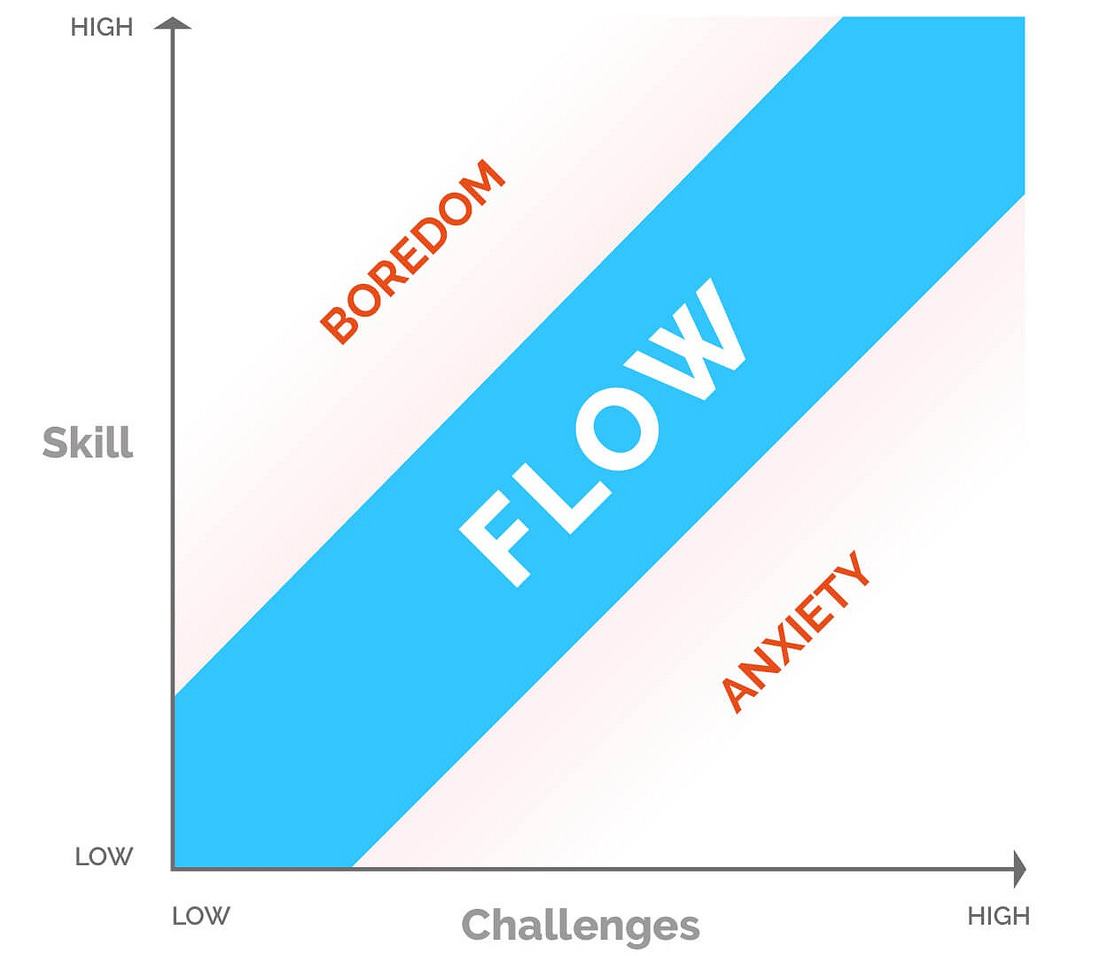 |
When you operate in flow, productivity is highest.
It’s also where your next opportunities come from. When you’re operating in flow, your output improves, your confidence grows, you build a stronger track record, and people notice.
Even in a saturated market, this is where you tend to stand out — because you’re not just “doing the job,” you’re getting better at a much higher tempo than the rest.
When you’re misaligned, you can still perform — but it often takes force. And force is expensive and takes time.
Facing Reality (and choosing consciously)
There is an important nuance to be added. Often life doesn’t allow for the perfect overlap.
At the end of the day, you need to pay the bills. Often you need to take a role that’s not ideal.
That’s fine.
What makes it mentally heavy is not the imperfect choice — it’s the confusion about why you made it.
If you’re clear with yourself (“I’m taking this role for stability for the next 12 months,” or “I’m building a skill that will open doors,” or “I’m buying time while I search for a better fit”), you gain peace of mind and you can make a plan instead of silently resenting the job.
Try a Small Exercise
If you want to make this practical, assess your current role (or the one you’re aiming for) using this simple framework.
Write down:
Your non-negotiables: what you won’t tolerate. Do you see any mismatch? If yes, your best fit is probably elsewhere.
Your dominant work mode: what energizes you most — being a Builder (deep work and craft), an Enabler (helping others do great work), or a Visionary (vision, decisions, and outcomes). Then ask: what does your role actually require most of the week?
Market direction: is the domain you’re in growing, stable, or shrinking? Are there roles you’d want in 1–2 years — or is it narrowing?
Then answer one question:
What’s the smallest change I can make in the next 30 days to move closer to the overlap?
That might be choosing a different team, reshaping your scope, changing how you spend your week, or even targeting a different type of company.
Back to The Story of My Son
My son is currently prioritizing value. He wants to do what’s “most important.”
But over time, I hope he learns something even more powerful:
You don’t always have to choose between what matters and what you enjoy. You can combine both.
Maybe he won’t become a mountain rescuer or cardiologists.
Maybe he’ll build robots that rescue people in the mountains. Because he genuinly enjoys building robots. Or maybe he’ll work on medical technology that helps children live longer.
The adult version of that lesson::
Start with Values & Principles. Understand your Capability Fit. Respect market demand.\
Then — inside that intersection — optimize for salary.
That’s how you grow a career that looks good on paper and feels good in your body.
You're currently a free subscriber to Lean Product Growth. For the full experience, upgrade your subscription.
| ||||||||||

