From: Intern Pierre <internpierre@substack.com>
Date: Mon, 27 Apr 2026 at 06:24
Subject: LVMH ($MC.PA) 2026 AGM: Alexandre Arnault's Africa Pitch & the Currency Excuse
To: <conradq@gmail.com>

LVMH ($MC.PA) 2026 AGM: Alexandre Arnault's Africa Pitch & the Currency ExcuseA Continent Away From the Cycle - AGM Notes & Short Thesis Update
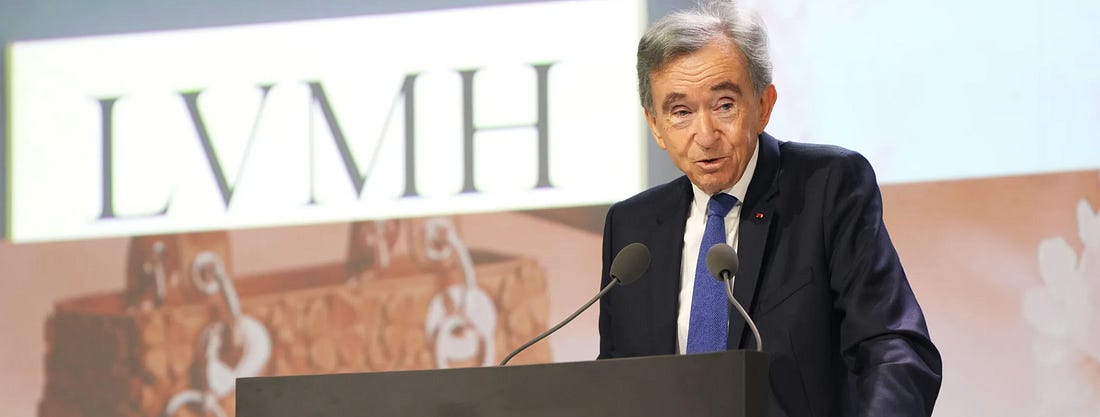
“Imagination is more important than knowledge.” – Albert Einstein Imagine a continent where the average household income ranges anywhere from $700-$800 each month, 44% of its inhabitants living in poverty and only 71% of the people have access to clean drinking water. You don’t need to imagine this, the continent exists and it’s called Africa. To provide some context, to qualify as a Top 1% earning household in Africa’s wealthiest country Nigeria, you need to earn a household income of approximately €30,300 annually. This can be compared to €121,000 in France, $659,000 in the US and €250,000 in Germany. Why is this data important? On Thursday April 23rd, LVMH held its Annual General Meeting at the Carrousel du Louvre, and the queue stretching through the corridors had nothing to do with the Mona Lisa. Shareholders came to hear Bernard Arnault, flanked by deputy CEO Stéphane Bianchi and CFO Cécile Cabanis, explain a year in which group revenue fell 5% to €80.8bn, profit from recurring operations dropped 9% to €17.8bn, operating margin compressed from 23.1% to 22.0%, and net profit slid 13% to €10.9bn. Q1 2026 came in at -6%, with Arnault openly conceding the Middle East crisis had cut expected first-quarter growth in half. But the headline numbers were not what made this AGM unusual. For the first time, all five Arnault children took the stage, Jean on La Fabrique du Temps, Frédéric on Loro Piana, Alexandre on Africa, Delphine on Dior, Antoine on LIFE 360, and the patriarch deflected every succession question with a smile and a reminder that his contract had been renewed at 99% the year before. Beneath the choreography of family, an €11.3bn free cash flow figure delivered by capex cuts, and an outlook slide where the operative word was “vigilance,” this was an AGM that worked harder than any in recent memory to project continuity while quietly conceding that the cycle has turned.
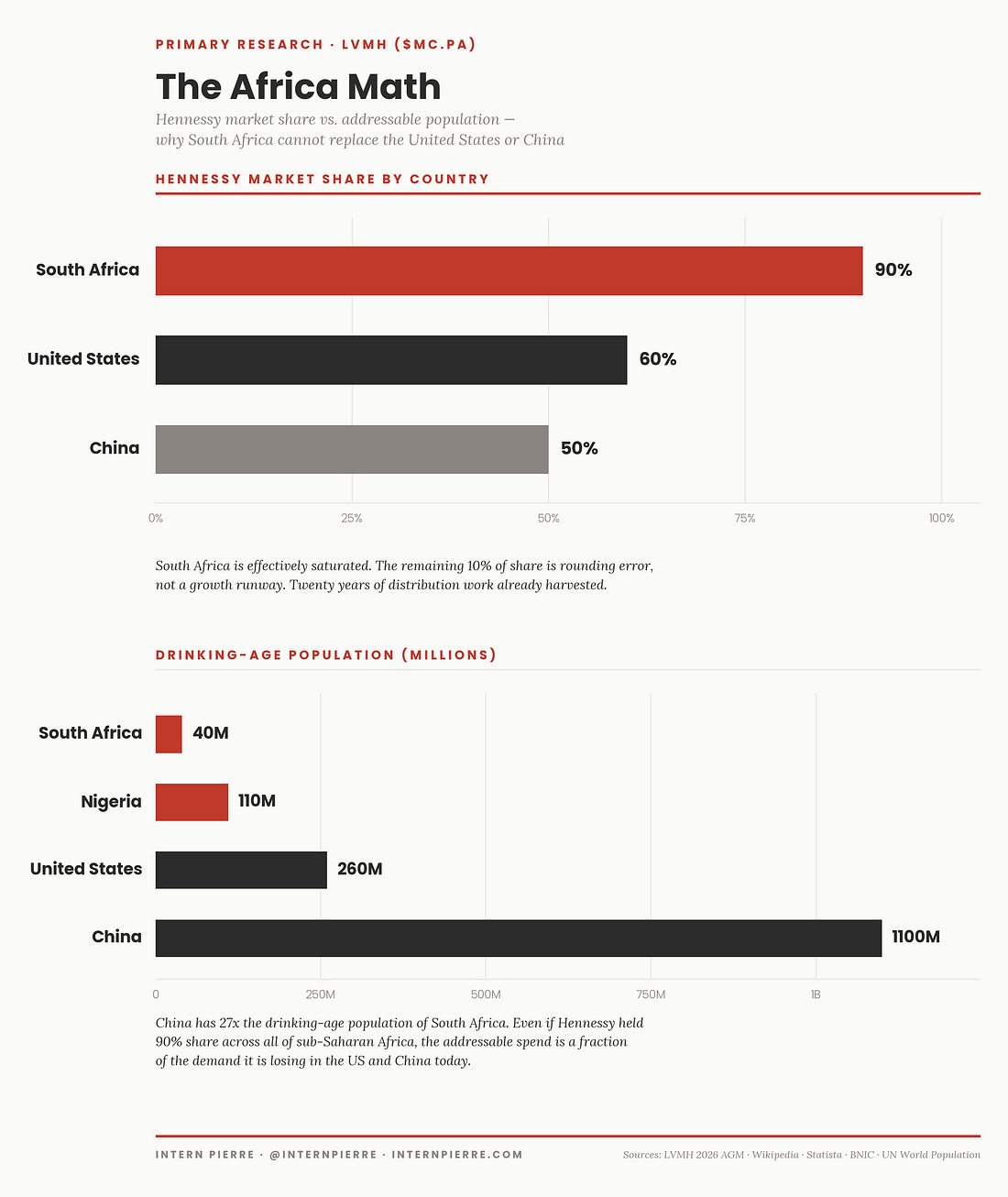
Of the five Arnault children who spoke, Alexandre’s slot was the most strategically distinctive. A year after stepping down from Tiffany to join Jean-Jacques Guiony at the helm of Wines & Spirits, he used his time on stage to make the case for Africa as the most attractive continent for the division, and, by implication, for the rebuilding of his own portfolio inside the group. The numbers he laid out were concrete. South Africa is already Hennessy’s third-largest market globally, behind only the United States and China, with a 90% market share built patiently over twenty years through a local distributor that placed bottles in everything from Johannesburg nightclubs to small-town shops across the country. Per-capita Hennessy consumption among drinking-age South Africans runs at roughly two glasses per year, a striking number for a single brand. Nigeria, with 220 million people today and on track to become the third most populous country in the world by 2050, is another anchor market where the group already holds a leading position.
The continent-level math is what he believes will make the bet interesting. Africa today has 1.5 billion people; by 2050, that number reaches 2.5 billion, an additional billion consumers, most of them young, entering an aspirational economy in which champagne, cognac, and luxury Maisons carry the social weight of arrival. Alexandre framed Hennessy, Veuve Clicquot, and Moët as the entry points, the products that introduce a young African middle class to the group, with the rest of the portfolio following behind once that beachhead is established. I can imagine the meeting went something like this; “We’re losing the African American demographic for Cognac in the US, where can we find more black people to make up for it?” Alexandre Arnault: “Africa!”
Sure, South Africa might be Hennessy’s third-largest market globally, but the question remains how much more can LVMH possibly squeeze from that market? Especially given that South Africa’s economy is facing severe structural challenges, characterized by low growth, high unemployment (approximately 32.1% - 40%), and massive inequality. Things are so bad that, that the IMF has revised South Africa’s 2026 growth down to 1%, with significant poverty, corruption, and slow recovery from the pandemic stifling progress. Even assuming South Africa were to see growth, what is LVMH going to do start opening Louis Vuitton, Tiffany & Co, Fendi, Loewe and Dior stores up in Lagos, Cairo, Harare, Nairobi and Dodoma? It’s above my pay grade as an unpaid intern, however Bernard and Alexandre Arnault may have a plan to open flagship stores in Burkina Faso and Sudan that I don’t know about; or maybe they have an agreement with Al Shabaab to distribute Moët Hennessy products in places like Somalia since they are an Islamist military group and won’t steal or drink the product 🤷🏻♂️. Jokes aside, claiming that Africa will be a relatively near-term solution to replacing declining demand from the US and China is an asinine statement and if I was a long-term shareholder I’d be questioning Moët Hennessy’s leadership and direction. A recurring rhetorical move throughout the AGM was the invitation to look past the currency. Cecile Cabanis opened the financial review by noting that revenue fell 5% reported but only 1% on an organic basis, the gap explained almost entirely by an FX headwind. The same framing carried into the profit walk: of the €1.8bn drop in profit from recurring operations, €1.07bn was attributed to exchange rate fluctuations and only €740m to organic decline. The slide title was explicit, “Decrease in operating profit mainly related to exchange rate fluctuations.” Q1 2026 received the same treatment: -6% reported, but +1% organic once the 7-point currency drag was stripped out. Arnault himself opened his remarks by calling 2025 “very good results in a difficult geopolitical and monetary environment, as the euro has continued to appreciate.” For fuck’s sake, that’s like saying “well the missile would’ve missed the city if the wind was blowing in the other direction.” The fact is that regardless, the missile still hit the city and destroyed it. Currency cuts both ways over time, and a luxury group whose pricing power is supposedly its defining feature should, in theory, be able to recover FX through price, which has been the playbook for the last decade. The fact that LVMH is now leaning on translation effects to explain a 9% profit decline and a margin compression from 23.1% to 22.0% is itself a signal: the group is no longer pricing through the cycle the way it did between 2020 and 2023, when FX moved against them and margins kept expanding anyway. When organic growth was running double-digit, currency was a footnote in the appendix. When organic growth turns negative, currency moves to the title slide. The other quiet detail in the FX framing is that operating margin compressed even on the organic numbers. Strip out the currency entirely and profit was still down €740m on revenue that was barely lower, that is negative operating leverage, not a translation issue. The euro doing what euros do is a real headwind, but it is not the explanation for why a 1% organic revenue decline produced a 9% profit drop. The explanation for that is in the cost base, the channel mix, and the volume deleverage in Fashion & Leather Goods, where profit fell 13% on revenue that was down only 5%. Lastly, the Middle East was the single most-discussed topic of the AGM, and the framing was unusually candid by LVMH standards. Arnault told shareholders directly that the crisis had cut expected first-quarter growth in half, meaning the underlying organic trend, absent the regional disruption, would have been closer to +2% rather than the +1% the group reported. The Middle East accounts for roughly 6% of group sales on paper, but the actual demand impact is larger because the region’s clientele travels, GCC nationals are a meaningful share of luxury spend in Paris, London, and Milan, and when they stay home, the tourist line in European boutiques takes the hit alongside the regional one. I’ve written about this here. Arnault sketched two scenarios from the stage and refused to handicap them. In the first, the conflict resolves in some form over the coming months, and business gradually returns to normal, in which case he expects a return to growth across the group’s various activities in the second half of the year. In the second, the crisis escalates into what he called a global catastrophe with serious negative economic consequences, in which case “who can say how 2026 will play out.” His exact framing, “it’s quite unpredictable,” (yeah no shit) is unusually direct from a CEO who normally projects unshakeable confidence. The fallback line was that LVMH has been through crises before, and the group is likely to gain market share again as it did in 2025, regardless of which scenario unfolds. What is striking is what was not said. There was no quantification of the regional revenue decline beyond the Q1 directional comment, no breakdown of which Maisons are most exposed, and no commentary on how the group is reallocating inventory or marketing spend away from the region. The Watches & Jewelry division, which has the heaviest Middle East concentration through Bulgari and the high-jewelry side of Tiffany, was discussed only in terms of its +7% Q1 organic growth, the regional headwind inside that number was not isolated. Fashion & Leather Goods, where Q1 was -2% reported, was attributed to “tourist trade negatively impacted” without naming the source of the tourists. The Middle East has now become a recurring line item in the LVMH narrative, last year it was tariffs and the cognac trade tensions; this year it is the regional conflict, and the pattern across both years is the same: an external macro factor is doing increasingly heavy lifting in explaining decelerating organic growth. At some point the question becomes whether the explanations are layered, or whether they are accumulating, I believe it’s the latter and the company is flip-flopping on the issue. Oddly, they’ve mentioned that the conflict in the Middle East isn’t really something they’re worried about, and now Bernard Arnault is out there pitching doom porn about the conflict. Which is it? If I were a long-term shareholder like Charles-Edoaurd Luquet I would be very concerned about the direction of the company. If you can’t get a straight answer when you ask the CEO about succession planning, there is a problem. This is an extremely fair question for investors to be asking given Bernard Arnault’s age and with the fact that none of the kids have really shown that they can lead a company of this size. I will have details from US site visits in the next few days along with thoughts on the F1 sponsorship when I’m at the Miami Grand Prix. Still short: LVMH *I am an unpaid intern and an idiot. The article is my opinion and none of this writing should be considered investment advice. I may currently have or may take an investment position in the companies discussed. As always feel free to share your thoughts as I’m happy to discuss
Invite your friends and earn rewardsIf you enjoy Intern Pierre, share it with your friends and earn rewards when they subscribe.
© 2026 Intern Pierre
|