In partnership with |  |
|
“Very little is needed to make a happy life; it is all within yourself, in your way of thinking." | | | | Marcus Aurelius |
|
|
Date: Monday, April 20, 2026 |
|
Hey AI Visionaries, |
In this 101st edition we stray a bit into Quantum computing and its impact on Bitcoin and other Cryptos. |
Also, we dive into the new agentic harness in town - Hermes. |
Table of Contents |
|
Thank you for being an engaged reader and helping us cross 5,500 subscribers over 100 editions! As usual, please send in your feedback and suggestions - it helps me to improve. |
-Renjit |
PS: If you want to unleash the power of OpenClaw and Hermes AI agents for personal and business productivity, you can setup time speak to me here» |
|
|
Google's Quantum Development puts Bitcoin on Notice |
Future quantum computers might be able to crack the cryptographic foundations of the blockchain much sooner than we anticipated, thanks to a massive 20-fold reduction in the hardware resources required to break standard encryption. |
|
Google Research recently revealed that elliptic curve cryptography—the very thing securing your crypto wallet—could be compromised by a quantum machine using just 500,000 physical qubits, a far cry from previous multi-million qubit estimates. It was earlier esitmated that we had till 2027/28 to find a way to secure our cryptos from a post quantum world. |
To handle this discovery responsibly, the team used a novel zero-knowledge proof to substantiate their findings without handing a practical roadmap to bad actors, verifying the vulnerability while keeping the specific attack circuits private. |
They are now calling on the blockchain community, including major players like Bitcoin, Ethereum and Coinbase, to accelerate the shift toward post-quantum cryptography and implement stricter standards like discouraging wallet address reuse. |
Takeaway: This matters because the long-term viability of the digital economy hinges on proactive migration. The math protecting your assets can be solved in mere minutes by future hardware, the time to build a quantum-resistant moat around your digital wealth is today, not when the first large-scale quantum computer actually arrives. |
|
Someone just spent $236,000,000 on a painting. Here’s why it matters for your wallet. |
|
Late last year, a Klimt sold for the highest price ever paid for modern art at auction. |
An outlier sure, but it wasn't a fluke. U.S. auction sales grew 23.1% in 2025. The $1-5mm segment even grew 40.8% YoY. |
Now, the S&P, teetering on all time highs, just posted its worst quarter since 2022, oil was up 94% (briefly), and Moody's puts recession odds at 48.6%. |
So, that's where it gets interesting. |
Each environment is unique, but after dot-com, post war and contemporary art grew about 24% annually for a decade. After 2008, about 11% for 12 years. |
It’s also had near-zero correlation with the S&P 500 since ‘95.* |
Now, Masterworks lets you invest in shares of artworks featuring legends like Banksy, Basquiat, and Picasso. |
$1.3 billion invested across over 500 artworks. 28 sales to date. Net annualized returns on sold works held 12 months+ like 14.6%, 17.6%, and 17.8%.
|
Shares can sell quickly, but my subscribers can skip the waitlist: |
Skip waitlist |
*Investing involves risk. Past performance is not indicative of future returns. See important Reg A disclosures at masterworks.com/cd. |
|
Hermes Agent has better memory features than OpenClaw and is finding users rapidly |
Imagine an AI agent that doesn’t just answer questions but actually evolves alongside your workflow, building a library of custom skills and persistent memories the longer it runs. No, I am not talking about OpenClaw! |
Hermes Agent is a powerful new open-source tool that moves beyond the limitations of standard IDE copilots and simple API wrappers by living directly on your server and integrating into the communication platforms you already use daily, including Slack, Discord, and even Signal. |
Unlike ephemeral chatbots that lose context the moment a session ends, this system features natural language cron scheduling for automated briefings and a sophisticated delegation architecture that spins up isolated subagents to handle complex data pipelines without overwhelming your primary context window. |
It prioritizes security through five distinct sandboxing backends—ranging from Docker to Modal—while providing full browser control and multi-model reasoning to handle everything from deep web research to image generation. |
Takeaway: This matters to you because it represents the shift from disposable AI interactions to a truly personalized, compounding digital asset. One that retains institutional knowledge and automates the heavy lifting of your technical life while you sleep. |
From my personal experience with Hermes, I find that it is breaking less often and memory issues are fewer. |
Right now I'm using it to grow my X account, both in followers and engagement and I will report back on the progress in a subsequent edition. |
|
Opus 4.7 is less powerful than Mythos but still packs a punch |
|
Anthropic just dropped Claude Opus 4.7, and the most striking feature isn't just the raw power—it’s the model’s newfound ability to catch its own mistakes and verify its work before reporting back. |
This update marks a significant leap in advanced software engineering, specifically designed for long-horizon autonomy where the model can push through complex, multi-step coding tasks for hours without needing a human to hold its hand. |
Early testers are reporting double-digit gains in task success rates and a massive jump in vision capabilities, with one benchmark seeing visual acuity soar from 54% to a staggering 98.5%. |
While it sits just below the upcoming Mythos model in terms of raw scale, Opus 4.7 introduces critical new cybersecurity safeguards under Project Glasswing that proactively block high-risk requests while still supporting legitimate red-teaming and vulnerability research. |
It also brings a more opinionated and creative edge to professional work, producing higher-quality UI designs and technical docs that feel less like a template and more like something a senior colleague would actually ship. Canva stock dropped when its design capabilities were announced! |
So what? This matters to you because the era of AI as a simple chat interface is ending; we are entering the era of AI as a self-correcting teammate that can be trusted with your hardest, unsupervised engineering workflows. |
|
Your competitors already read this every morning. |
The AI Report keeps 400,000+ executives ahead of every major AI move — in 5 minutes a day. Trusted by leaders at the world's top companies. The question isn't whether AI is changing your industry. It's whether you'll see it coming. |
Get the edge free |
|
|
OpenAI just turned Codex into a full-blown autonomous agent |
OpenAI just turned Codex into a full-blown autonomous agent that can literally drive your computer, moving it far beyond a simple coding assistant into the realm of a digital co-worker. |
|
With the latest update, Codex can now see your screen, click buttons, and type in any app—even those without APIs—allowing it to handle everything from frontend testing to complex multi-day workflows while you work in parallel on other tasks. |
The system is also getting a massive intelligence boost with built-in image generation, a native in-app browser for instant design iteration, and a new memory feature that lets it remember your specific preferences and project context across different sessions. |
By integrating over 90 new plugins and supporting remote devboxes via SSH, the tool is positioning itself as the central command center for the entire software development lifecycle rather than just a plugin in your IDE. I have started playing around with it and although it is no Antigravity (IDE from Google), it is a handy backup for those times when Antigravity is not working! |
So what? This matters because it shifts the developer's role from manual labor to high-level orchestration. Automating the tedious glue work like managing JIRA or reviewing PRs so you can focus entirely on the creative act of building. |
|
AI Startup to watch: Holo3 |
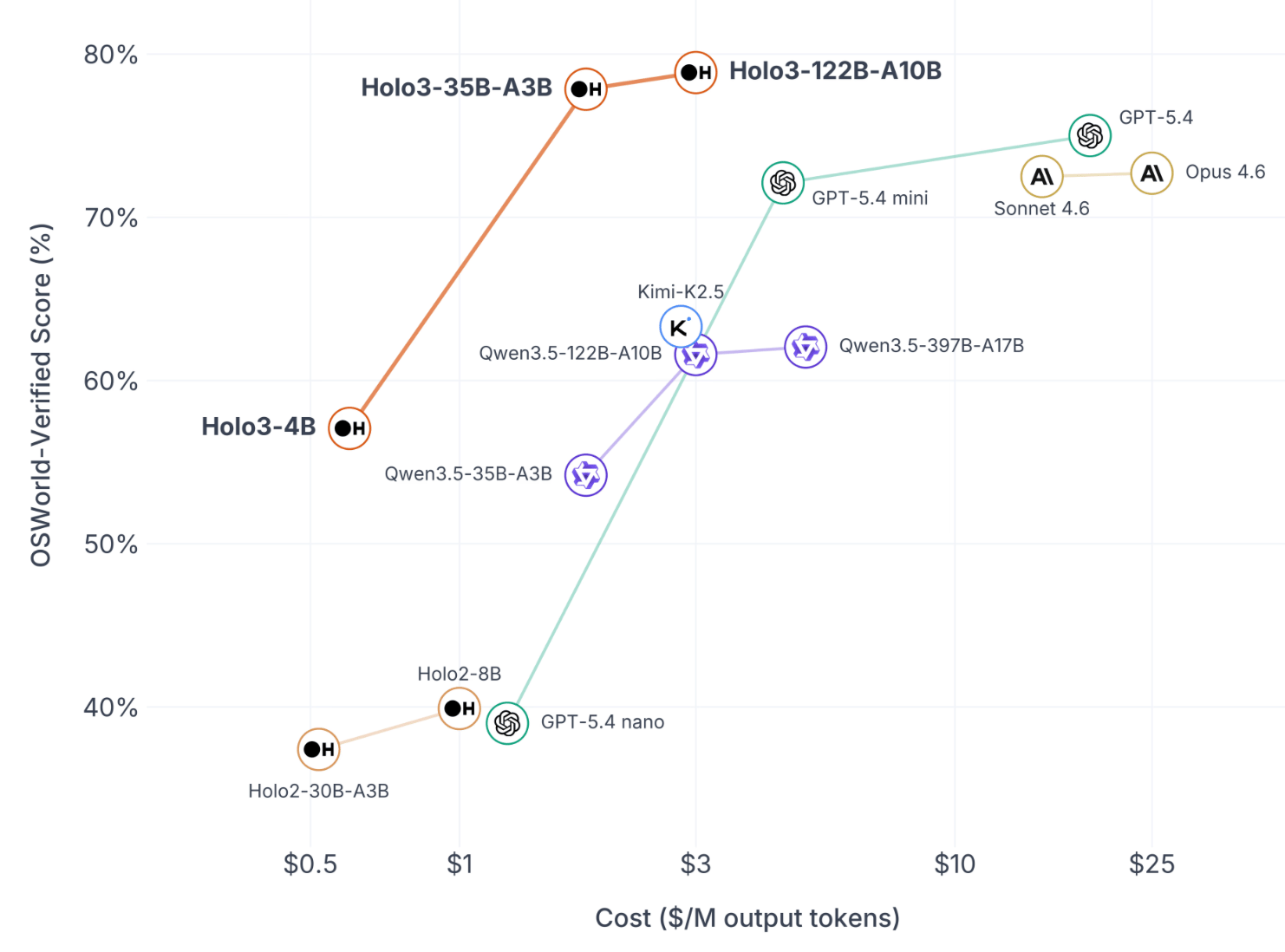
Holo3 just shattered the ceiling for autonomous computer use by proving that efficiency beats brute force when it comes to navigating complex digital workflows. |
By clocking a record-breaking 78.85% on the OSWorld benchmark, this model outperforms heavyweights like GPT 5.4 while operating on a fraction of the active parameters, making high-level agency both faster and significantly cheaper. |
|
The secret sauce is a proprietary training flywheel that uses a Synthetic Environment Factory to programmatically generate entire software landscapes, allowing the agent to master everything from simple navigation to complex, multi-app reasoning like cross-referencing PDFs against live budgets. |
Instead of just predicting the next word, Holo3 is optimized for action, achieving state-of-the-art results through specialized reinforcement learning and curated enterprise scenarios. |
This release, which includes open weights for the 35B version, signals a major shift toward the Autonomous Enterprise where AI does not just chat—it executes. |
Takeaway: For anyone building in the agentic space, this means the era of the AI intern capable of handling the mundane clicking and scrolling of your daily stack is finally arriving, and it is doing so with a level of precision that makes proprietary frontier models look bloated. |
|
|
📚 Sources & Further Reading |
|
|