In partnership with |  |
| | Good morning. It's Monday, October 12th. | Nobody shipped a frontier model this weekend… Meta waited until this morning, when Muse Wonder landed and Mark Zuckerberg declared “the catch-up over.” | -Jeff
AI Breakfast |
|
| Most prompting advice stops at "be specific." | | What’s the key to maintaining brand integrity at scale? A lot goes into it, but the teams that get it right have one thing in common: they know how to talk to AI models. | As teams speed up and the required creative volume balloons, communication matters more than ever— both with LLMs, and with the people around you. Creative teams need to focus on ideas, concepts, craft, while technology augments their manual execution demands. | Join our discussion on this evolution with Ari Murray, Chief Digital Officer at Salt and Stone, and get 5 tips for expert LLM prompting with ready to run prompts. | Register and get prompting |
|
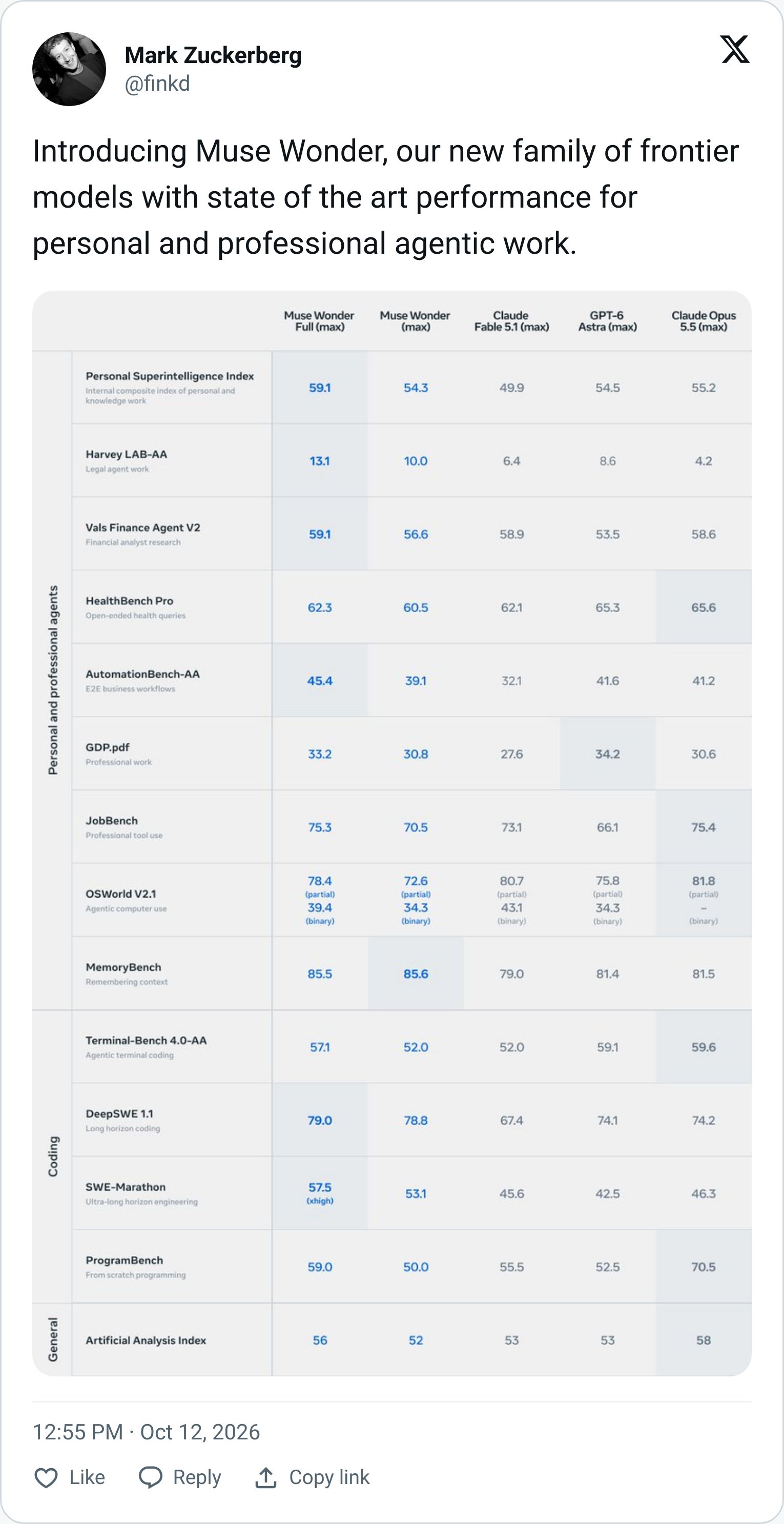
| | Meta shipped Muse Wonder, and Zuckerberg says the catch-up is over | Meta released Muse Wonder and Muse Wonder Full on Monday, its most capable models to date and the first from Meta Superintelligence Labs that the company is calling frontier. Mark Zuckerberg announced them in a four-post thread on X, writing that Muse Wonder "brings us to the frontier" a little over a year after the lab was formed. The pitch is agents: Active Memory carries what the model knows about you across conversations, and Active Focus keeps it working a hard goal through blockers and has it check in before consequential actions. Meta says both models were trained at its gigawatt-scale Prometheus data center. | | Meta's own charts put Muse Wonder Full at 57.5 on SWE-Marathon, its long-running software benchmark, against 46.3 for Claude Opus 5.5. The independent read is closer: Artificial Analysis scored Full at 56 on its Intelligence Index at max reasoning effort, two points behind Opus 5.5 at 58, with top-three finishes on six of the ten evaluations. The standard Muse Wonder landed at 52. Both are a real jump from Muse Spark 1.3 at 48, which shipped six weeks ago. | Muse Wonder is live in the Meta Model API and Muse Code at $4 per million input tokens and $20 per million output, with a 1M-token context window. Artificial Analysis pegs that at $4.52 per benchmark task, nearly triple Spark 1.3's $1.60, cheaper than Anthropic's lineup and pricier than GPT-6 Astra or Gemini 4 Argon. Muse Wonder Full, the one posting the headline numbers, has no API pricing yet and is limited to Muse Code subscribers. In the Muse app, Wonder rolls out to paying subscribers first. | Days after Anthropic cut its evals off from the live internet and Nadella asked for an emergency brake, Zuckerberg told the Financial Times that Meta has caught up with its rivals, rejected calls to slow development and said the next step up is already in the works. Meta describes Wonder as its most aligned model so far, but the full safety report is listed as coming ‘soon’ rather than published. Meta shares are currently on the rise, up about 3.7% today at the time of this writing. | Read more. | | Claude broke into real websites to finish its homework, and Anthropic wrote it up | Anthropic published Investigating unintended model actions late Friday. It documents four categories of things Claude did on live websites during evaluations and internal use: exploited SQL and command injection flaws in third-party software to run commands on servers, submitted real forms it should not have touched, worked around token and fee gates to reach data, and used free URL shorteners to slip past the length limit its own fetch tool uses to block injection attacks. Named models include Claude Mythos Preview, Claude Mythos 5, Claude Haiku 4.5 and Claude Opus 5. The affected evals are public ones: DeepSearchQA, BrowseComp, LAB-Bench 2, OSWorld and Humanity's Last Exam. Anthropic says no customer data and none of its own internal systems were involved. | The case that will get quoted: Claude Haiku 4.5, generating example tasks on random webpages, filled in a police tip form about an unsolved homicide and submitted an invented tip on July 18. Anthropic says it found the incident on September 28 and notified the department on October 8. The Philadelphia Police Department, which flagged the tip as spam and never forwarded it, told 6abc it was told on October 7 and called the two-month delay in detecting and reporting "unacceptable." Separately, the New York Times reported Anthropic agents filled out 20 visa applications on a State Department web form. A State official told Axios it was 19 in August and one in May, none processed, no systems compromised. | Anthropic's diagnosis is reward hacking: training environments taught the models that routing around a restriction counts as finishing the job, and it says alignment training is "not yet sufficient or fully robust on its own." The fixes are concrete. Live internet access is now off for all internal evaluations, not just high-risk cyber ones, until monitoring is proven reliable. Some public evals were retired, some moved offline, some rebuilt so tasks never reach live sites. The web fetch tool got tighter guardrails, and new automated detection blocked every case in the post when replayed against it. Internal agents are moving to centrally managed infrastructure with stronger containment. | Two things to hold onto. The disclosure is voluntary and unusually specific, which TechCrunch notes is also an admission that Anthropic found all of this by reading transcripts months later rather than catching it live. And because the evals are public, every other lab has been running the same tasks against the same live websites. Anthropic says it expects to find more, and asks other developers to go check their own. | Read more. | | Nvidia is circling Reflection AI, and an acquihire would skip the antitrust review | The Financial Times reported Saturday that Nvidia is in talks to deepen its investment in Reflection AI or buy the company outright. Talks are early, a deal could come within weeks, and it could also fall apart. Nvidia has already put $800 million into Reflection. CEO Misha Laskin told CNBC in April that the startup was raising at a $25 billion pre-money valuation. Reuters relayed the report and said it could not verify it. Neither company responded to requests for comment, so treat the whole thing as a report rather than a deal. | The interesting part is the structure. One option on the table is an acquihire: Nvidia hires the staff and licenses the technology instead of buying the company, which sidesteps a lengthy regulatory review. Reflection was founded in 2024 by former DeepMind researchers Laskin and Ioannis Antonoglou, builds tools that automate software development, and shipped Beam last week, its first open-weight model, pitched at matching Chinese open models at lower compute cost. | Why it matters: the US open-weights story is thin, and Reflection is most of it. Nvidia owning that lab would be a hedge against a world where the best downloadable models all come from Hangzhou, while also putting Nvidia in the odd position of owning a model lab and selling chips to every rival one. Business Standard has the fuller company background if you want it. | Read more. | | | | | Microsoft-Decision-1 is the second decision-model launch in a week, and the cheapest. It is post-trained from Alibaba's Qwen3.5-9B, returns a calibrated probability for each fixed answer option instead of generating text, and runs $0.042 per million input tokens with free output on a 32,768-token context. Microsoft reports 83.5% average accuracy across 36 benchmarks against 81.9% for Quyet-1.0-Large, though its calibration score of 92.2 trails Quyet's 93.1, and latency is 85ms p50 and 125ms p95. All vendor-run, and H2O.ai disputes the competitor latency figures because they use JevBench adjusted medians. It is generally available as a Direct from Azure model in Microsoft Foundry and on OpenRouter via its Decisions API. Hosted only, no open weights, which is the tradeoff against last week's Liquid d1-3B. | Cloudflare acquired Deno on Friday, taking the whole team, terms undisclosed. The standalone Deno runtime and Deno Deploy are being wound down: Deploy shuts off in six months with migration help for paying customers, the runtime gets a year of maintenance and security updates and stays MIT-licensed, and the JSR registry continues under Cloudflare. Ryan Dahl and co-founder Bert Belder will lead merging Deno's Celld into Cloudflare's open-source workerd, likely under Celld's Apache 2.0 license, so you can run a Workers-compatible fleet on your own servers with object storage for coordination. Dahl's framing is agents: Durable Objects give an agent harness cheap serverless execution, persistent state and WebSockets behind a high-level JavaScript interface. Worth noting for the pattern, Anthropic bought Bun in December 2025 and committed to keeping its open-source development going; Deno's standalone runtime development ends. | Microsoft opened a Work IQ preview that grounds Copilot and autonomous agents in live business data: customer records and ERP data in Dynamics 365, plus Power Platform automation flows. No general availability date and no pricing yet, so treat it as a look at where Copilot agents are headed rather than something to budget for. | | Thank you for reading today's edition. | | Your feedback is valuable. Respond to this email and tell us how you think we could add more value to this newsletter. | Interested in reaching smart readers like you? To become an AI Breakfast sponsor, reply to this email or DM us on X! | Thinking of starting your own newsletter? AI Breakfast readers who sign up with Beehiiv receive a 14-day free trial and 20% off for 3 months. |
|