| | Key senator warns US risks falling behind China in innovation race, business leaders see a US AI adv͏ ͏ ͏ ͏ ͏ ͏ |
| |  | China |  |
| |
|
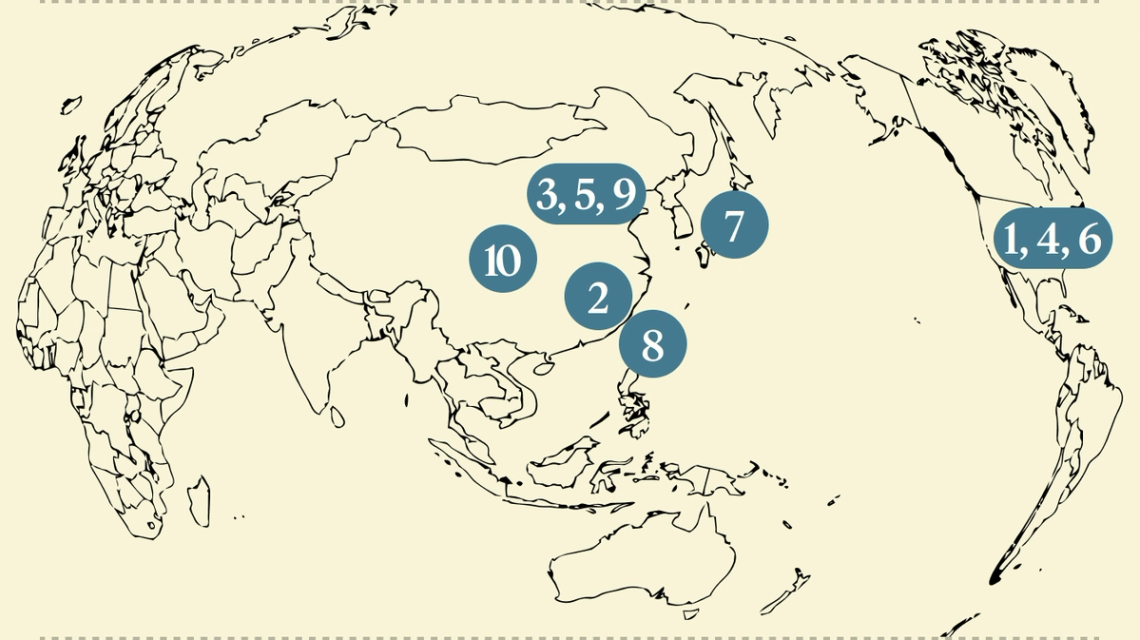 - US losing innovation race
- China catching up on AI
- Shaky economic figures
- Headway in US strongholds
- Dim prospects on AI safety
- The broken US flywheel
- Bessent’s tricky balance
- Taiwan’s arms package
- Lessons from 2019 deal
- Working at ‘China speed’
 We watch the China watchers, and look into how a World Cup boom is playing out. |
|
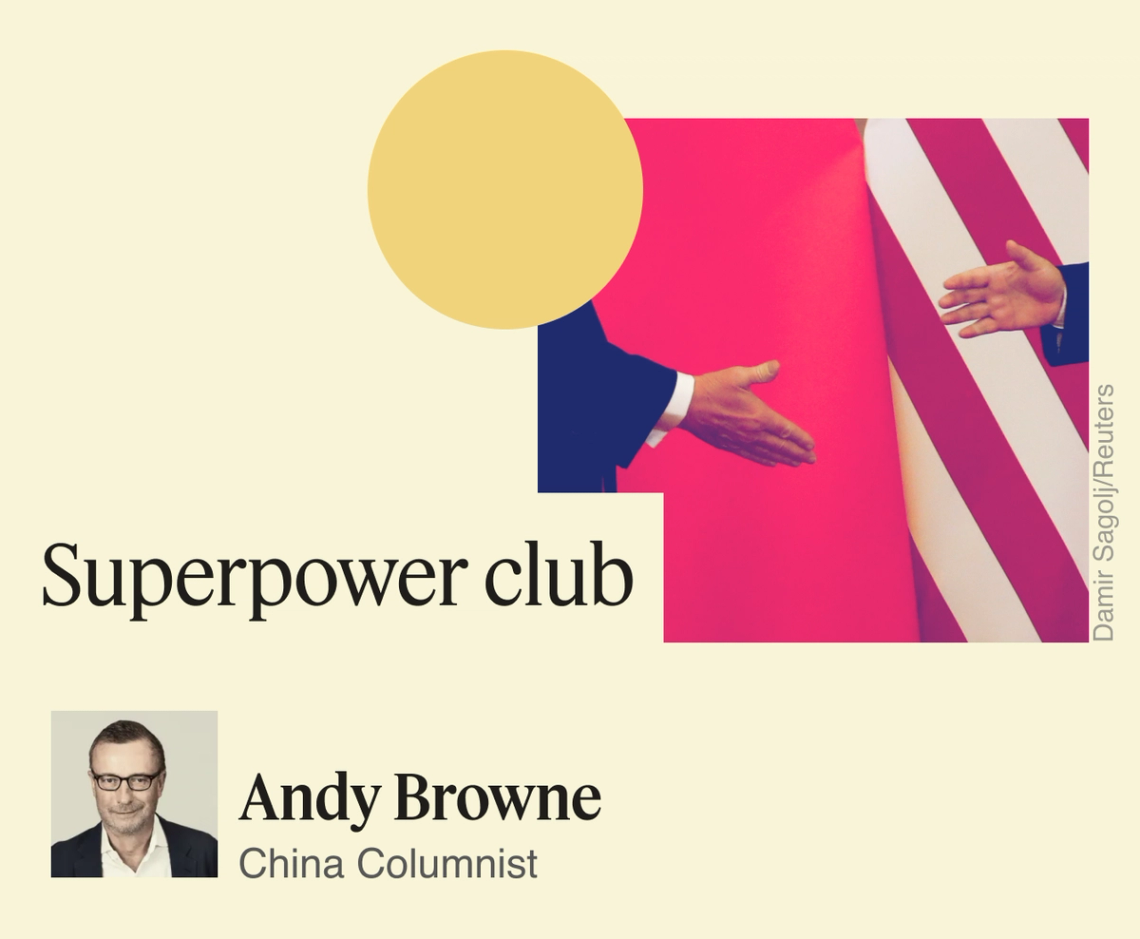 If there’s one thing that Asia-Pacific economies fear more than a US-China showdown — forcing them to choose sides — it’s the opposite: a world in which the superpowers club together to cut bilateral deals, leaving everyone else out in the cold. US President Donald Trump’s visit to Beijing this week has crystallized those anxieties. As he seeks to nail down agreements with Chinese leader Xi Jinping — on technology, trade, Iran — American friends and allies are feeling abandoned. National leaders are “nervous about what’s going to come out of this,” Edgard Kagan, the US ambassador to Malaysia during the first Trump administration and now an expert at the Center for Strategic and International Studies, told reporters. “All of a sudden it’s going to look like all the important decisions for the region are made in Beijing and Washington, rather than their own capitals.” In fact, that seems to be Trump’s game plan. He’s revived language about a G2, the idea that a superpower condominium will take charge, running the affairs of the globe, with the implication that smaller countries should just fall into line. Trump has made it clear there’s not much he won’t concede to get the “big deal” he wants from Xi. Often described, accurately, as the most China-friendly member of his administration, Trump has purged China hawks from his team, dropped language from a defense white paper labeling China a “strategic competitor,” and even greenlit exports to China of advanced microchips — a technology where the US still holds a wide lead over China. Writing in the Financial Times, Ely Ratner, a security adviser in the Biden administration, scathingly referred to Trump’s efforts to build goodwill with Xi as “strategic deference.” A little over half a century ago, after the fall of Saigon, Southeast Asian countries responded by scrambling to Beijing to set up diplomatic relations, hedging their bets on America. There’s a similar dynamic at work today. “In capital after capital,” writes Ratner, “the question being asked is not whether China is a threat, but whether the US will show up.” |
|
US risks innovation catchup |
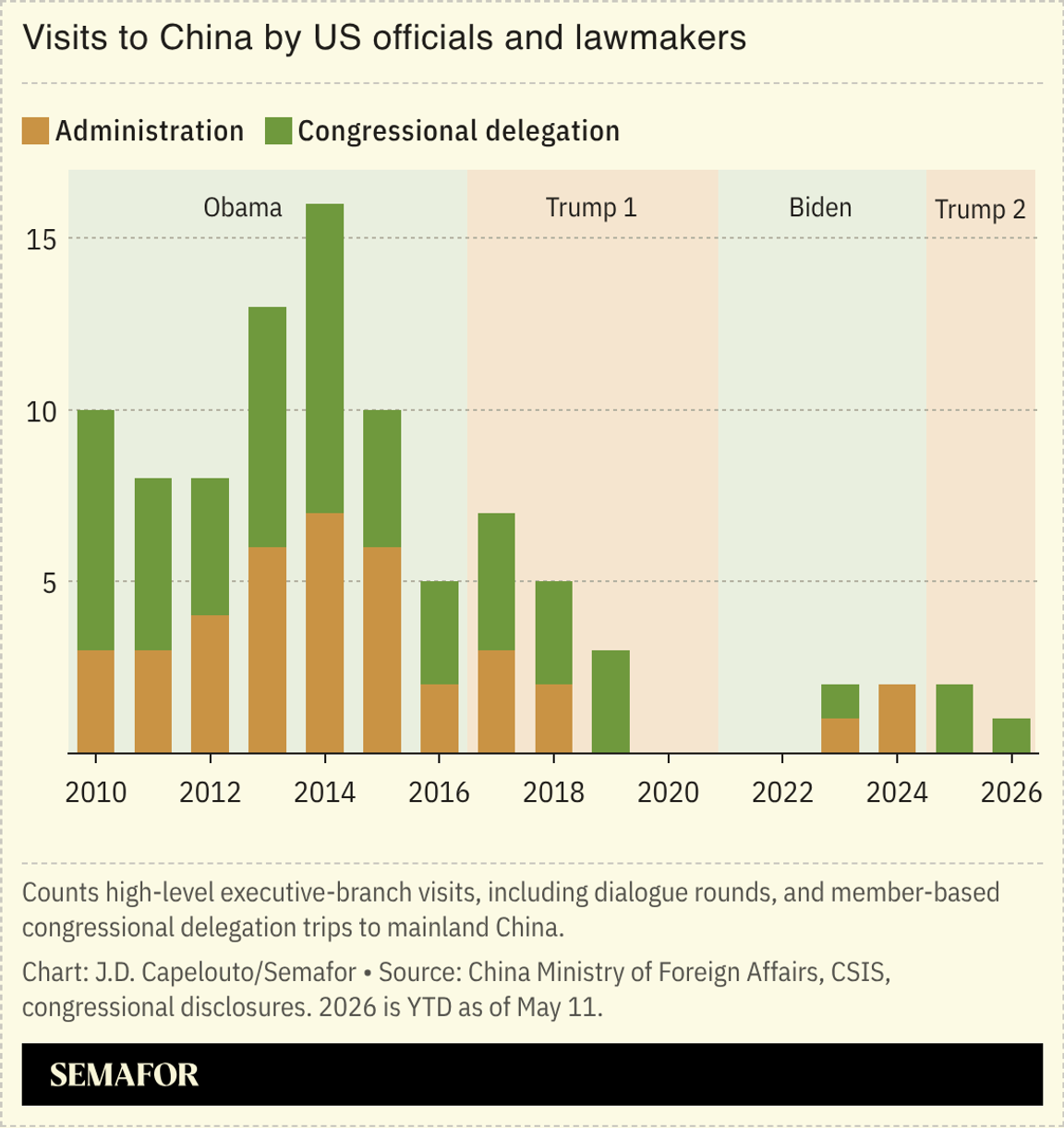 The US risks falling behind China on innovation and must compete with the country rather than decouple, a leading American lawmaker warned following a rare Congressional visit. Sen. Steve Daines, a Republican, said he wanted to make fellow lawmakers aware of the “best-in-class operations and the innovation ecosystem that China is building out,” suggesting that Capitol Hill may be ignoring the extent of Beijing’s advancement, and underlining GOP worries about Washington’s long-term strategy in its faceoff with China. Though US President Donald Trump is taking more than a dozen CEOs to Beijing for this week’s summit, indicating a level of engagement, his administration has only invited firms “that would benefit, broadly, from an open door to China,” Semafor’s editor-in-chief wrote. |
|
Business leaders see US AI advantage |
 The US remains ahead of China in AI models and chips, but less expensive Chinese models are rapidly catching up: That’s the consensus according to Semafor Intelligence, which parsed hundreds of onstage conversations across five days at Semafor World Economy in Washington last month, using our proprietary AI tool to examine nearly 5,000 distinct claims. The analysis also found there was virtually no support for the argument that selling China advanced chips would ensure Beijing built its AI future on an American tech stack, thereby creating long-term dependency. “You must maintain export controls because it is the fundamental resource we use to build this technology,” Anthropic’s co-founder said. |
|
China buys time to revive economy |
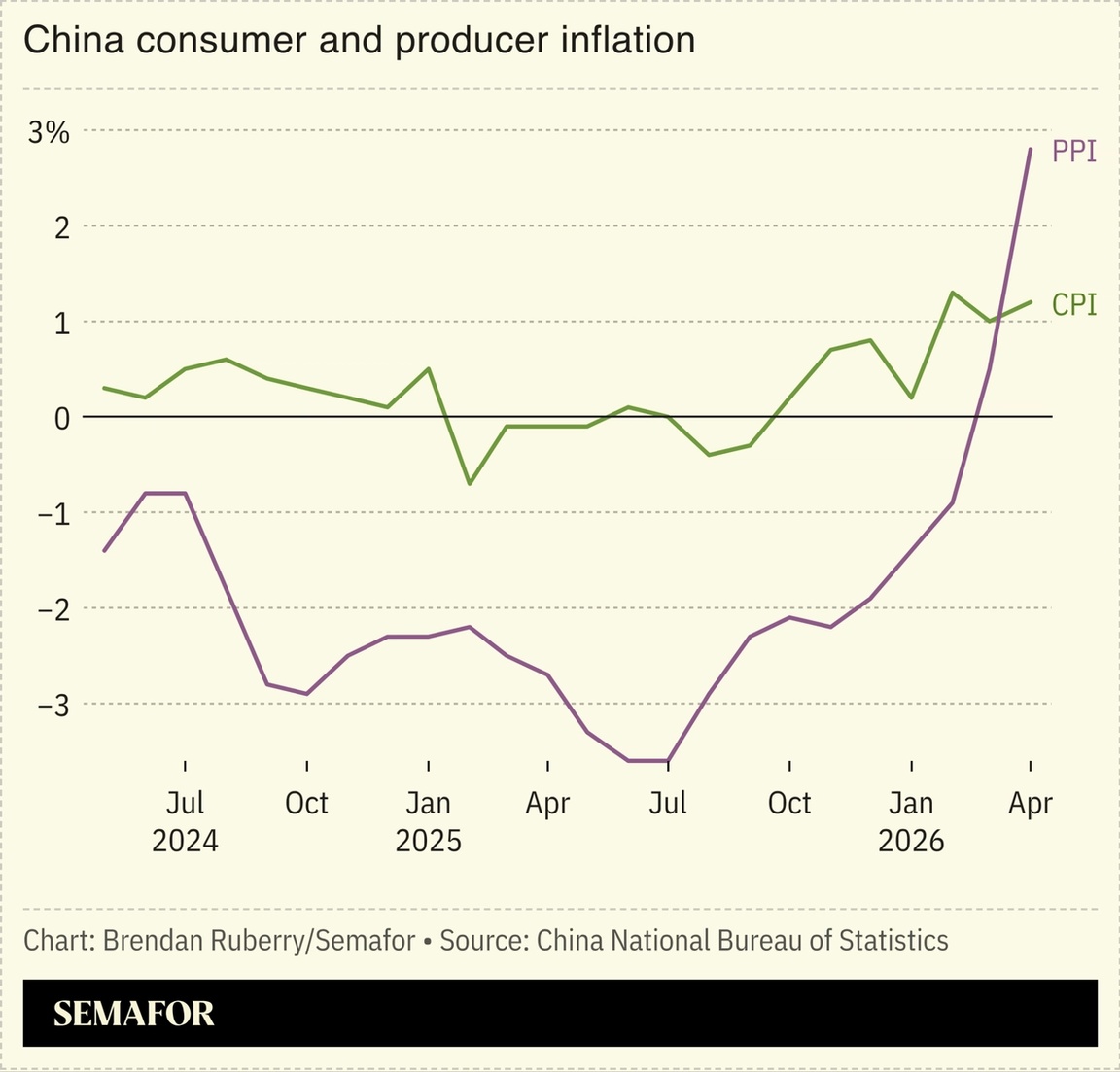 China’s economy remains on shaky ground ahead of this week’s high-stakes leaders’ summit. New data showed inflation beat forecasts in April, with producer prices rising at their fastest pace in years because of the Iran war. The end of deflation may seem like good news for Beijing, but supply-side price hikes don’t represent the kind of consumer demand boost policymakers are hoping for; if anything, they could further dampen demand. Beijing has prioritized high-tech development, but its efforts “aren’t generating enough jobs or investment to keep overall economic growth from slowing,” The Wall Street Journal wrote. In the US talks, China will aim to “buy more time to … reignite its faltering economy,” a Council on Foreign Relations expert predicted. |
|
China’s inroads in US strongholds |
 Joyce Zhou/Reuters Joyce Zhou/ReutersChina is making inroads in regions and sectors long dominated by the US but left vulnerable by the Iran war. President Donald Trump appears to have leverage thanks to China being the world’s top oil importer and the US being the world’s biggest fossil-fuel producer, but Beijing’s “influence as a buyer of oil affords it nearly the same level of ‘dominance’ over global prices that Trump is fixated on achieving as a producer,” Semafor’s climate and energy editor wrote. Washington, meanwhile, remains dominant in the Gulf, but as the region’s biggest trading partner, China is deepening its foothold there thanks to its role as a source of foreign direct investment, infrastructure financing, and industrial partnerships, Semafor’s Saudi Arabia bureau chief noted. |
|
Little hope for US-China AI treaty |
 Go Nakamura/Reuters Go Nakamura/ReutersAI safety is on the Trump-Xi summit agenda, but analysts say it’s unlikely Beijing will cave on agreeing to significant guardrails around the technology. Although China has long sought such a dialogue, it won’t “negotiate in good faith,” argued one official who led US-China AI policy under the Biden administration: Beijing wants to catch up with Washington in the AI race, and the only way to shift its calculus is a “narrowly scoped dialogue paired with maximum pressure on export controls,” he continued. AI safety advocates are hopeful, but China “is throwing gobs of money and talent at beating the US in AI, and it has little incentive to slow down,” Semafor’s tech editor noted. |
|
China wins with US playbook |
 Carlos Barria/Reuters Carlos Barria/ReutersDonald Trump’s deepest challenge in talks with Xi Jinping this week isn’t to do with trade or Taiwan, but that China has mastered the innovation model that the US invented, Semafor’s Clay Chandler argues in a new column. The US has long capitalized on a security flywheel in which its dominance in commercial technology has driven new military capabilities, but the flywheel has seized since the end of the Cold War, and it is China carrying out that playbook. Beijing now generates military capability at industrial scale, by letting billions of civilian consumers bear the R&D and manufacturing costs of robots, drones, and satellites. Washington may struggle to catch up before new technologies reshape the terms of the next conflict. |
|
Bessent’s Tokyo balancing act |
 Eugene Hoshiko/Pool via Reuters Eugene Hoshiko/Pool via ReutersUS Treasury Secretary Scott Bessent has a delicate mission this week in Tokyo, where he will try to soothe nerves ahead of the US-China summit while delivering sharp messages about Japanese monetary policy. Bessent is the lead US negotiator with China, the first Treasury secretary to take on that role since Hank Paulson in the George W. Bush administration. But while Paulson was a China hand, Bessent is a Japan expert. In the past, US presidents have looped through Tokyo alongside a visit to China to reassure Japan that it won’t be sacrificed for improved Sino-US relations. Bessent is clearly conflicted. “He understands the country well,” one analyst told Bloomberg. “But that doesn’t mean he will take a friendly stance.” |
|
Taiwan approves arms budget |
 Ann Wang/Reuters Ann Wang/ReutersTaiwanese lawmakers approved a pared-back special defense budget to fund US arms purchases following pressure from Washington to ramp up military spending to deter China. The plan fell short of an originally proposed $40 billion package largely because of opposition from the Kuomintang; critics have previously accused the party’s chair Cheng Li-wun of holding up the program to appease Beijing. In an interview with the South China Morning Post, Cheng — who met with Chinese leader Xi Jinping last month and is a vocal supporter of closer cross-strait relations — said there were “significant problems” with recent US arms purchases. While hailing the upcoming US-China summit, Cheng warned that “Taiwan must not become a bargaining chip in the games of great powers.” |
|
Failed 2019 deal holds summit lessons |
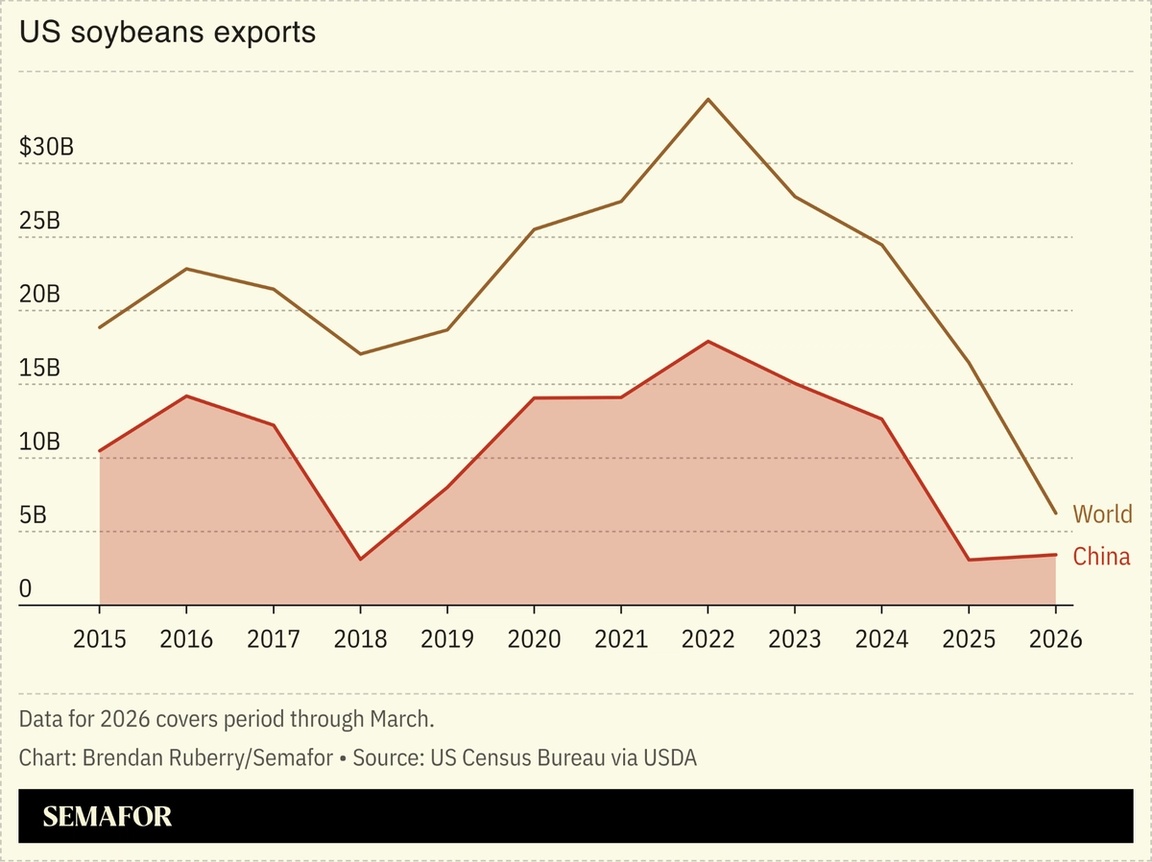 The 2019 trade deal agreed by the US and China saw few concrete outcomes, offering lessons for this week’s summit, a prominent economist told Semafor. Beijing and Washington must “establish something that is achievable” to avoid the pitfalls of the prior pact, the Peterson Institute’s Chad Bown said: China committed to buying $200 billion in additional US exports, but ultimately purchased none of what it agreed to. The 2019 deal halted a trade war, but the commitments were “completely unrealistic,” Bown said. Still, he isn’t dismissing this summit as purely political theater: A Board of Trade mechanism, for example, could improve communication and ensure the transactions actually happen, he said. |
|
Reckitt pushes for ‘China speed’ |
 Reckitt livestream. Alexander Marrow/Reuters Reckitt livestream. Alexander Marrow/ReutersThe surge of social-media-driven commerce in China has remade Reckitt’s business in the world’s second-largest economy, and is an “early sign of where the rest of the world may go,” the CEO of the British consumer goods company said. China’s 800 million consumers watch an average of 1.5 hours of online videos each day, often buying goods after watching demonstrations. Reckitt, which makes Durex condoms and Lysol detergents, is pumping out such videos at “China speed,” Kris Licht told Semafor’s Andrew Edgecliffe-Johnson. The company’s e-commerce and social commerce sales combined now make up 80% of its China business, in what Licht called “the most profound channel shift I have seen in my career, in any market.” |
|
Every week, we ask a different expert what they’re focused on. Today, we’re talking to Ken Moriyasu, Senior Fellow at the Hudson Institute. 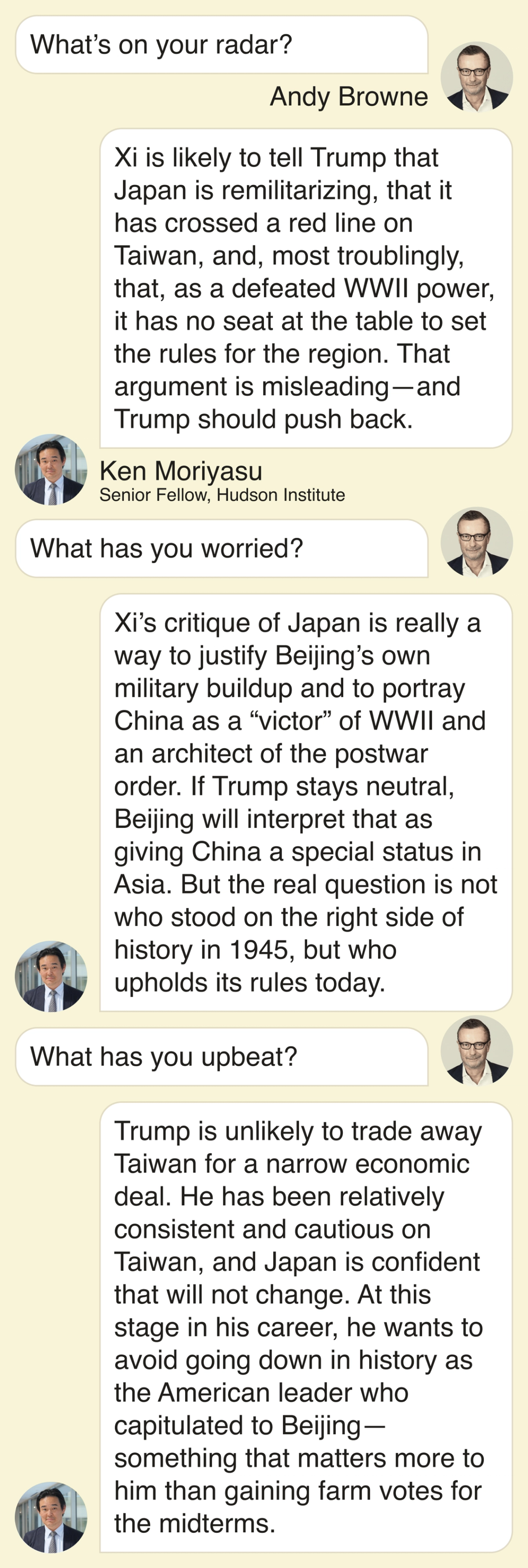 |
|
| Watching the China-Watchers |
 Every week, we dig through China-focused newsletters and podcasts, and bring you key takeaways from the Sinologist community. - Beijing released its first policy framework for AI agents — treating the technology as its own digital infrastructure component, rather than simply an add-on to large language models. The approach aims to “acknowledge the risks, but make absolutely clear that China does not intend to miss the industrial opportunity.” — Geopolitechs
- US and Chinese youth are both using the same memes to express economic and social despair. “Chinese Gen Z was sold a simple contract: study hard, pick a useful major, and earn a stable life. That future has vanished.” — 百花 Baihua
- Hanoi isn’t “swinging” in China’s direction after Vietnamese leader To Lam traveled to China last month. A closer look at the joint statement from that summit — compared to a readout from Xi Jinping’s visit to Vietnam last April — reveals there “isn’t a lot of anything new,” a Vietnam scholar said. — China-Global South Podcast
|
|
 - Chinese tech giants Alibaba and Tencent report earnings on Wednesday, as AI remains investors’ main focus.
- China P&E 2026, a major photography and imaging trade show, begins in Beijing on Friday.
- A batch of macroeconomic indicators is released on Monday, including industrial production, unemployment, and retail sales.
|
|
 Stringer/Reuters Stringer/ReutersThe FIFA men’s World Cup may not be shown on Chinese TV, but manufacturers in the country are nevertheless benefiting from the global soccer tournament. FIFA is still negotiating a China broadcast deal for the World Cup — the global soccer body is reportedly offering to slash its asking price for the rights — but the world’s largest wholesale market, located in Yiwu, is spilling over with World Cup merch, the South China Morning Post reported. Among the items on offer are officially licensed souvenirs and gear like pillows bearing the likeness of Lionel Messi. Sales are “definitely higher than the last tournament,” one merchant said, reflecting the heft of China’s export economy despite global trade volatility. |
|
| |



