
|
This media startup is trying to reach readers exhausted by political noise
How Straight Arrow News is trying to build a national news brand around trust instead of outrage
| |||||||||||||||


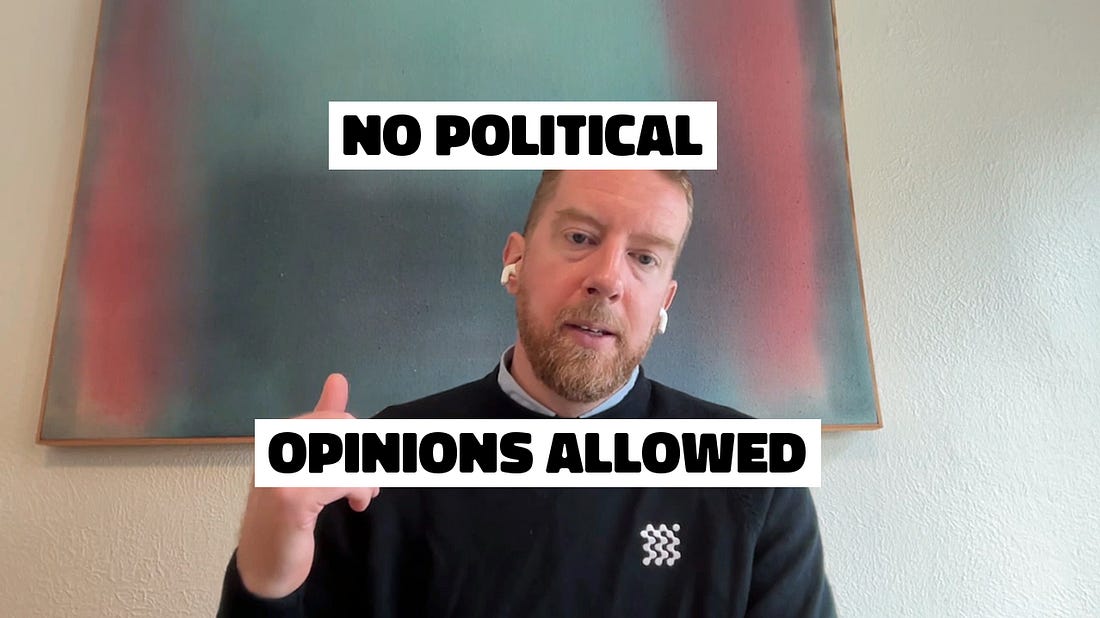 |
Straight Arrow News was founded around a simple observation: a growing number of Americans feel alienated from modern news coverage. Depending on where they get their information, people can walk away with completely different understandings of the same event — a dynamic that founders Joe Ricketts and Jonathan Harding saw firsthand despite coming from different political viewpoints themselves. Their answer was to launch a digital news outlet built around politically unbiased reporting, a stricter separation between news and opinion, and a less combative relationship with audiences. Over the past year, that mission has increasingly been shaped by chief content officer Derek Mead, the former Vice executive who joined the company to help evolve it beyond a high-volume aggregation model and into something more ambitious.
That transition reflects a broader shift happening across digital media. For years, publishers chased scale through SEO, social traffic, and programmatic advertising, often producing massive volumes of interchangeable content in the process. But as ad economics deteriorated and platform algorithms became more volatile, many media companies found themselves trapped in a cycle where audience attention mattered more than audience loyalty. Straight Arrow News is trying to build a different kind of news organization — one centered on habitual engagement, original reporting, video distribution, and eventually reader revenue.
In a recent interview, Mead explained why the company is investing more heavily in original journalism, how it’s using social video and mobile products to reach audiences fatigued by partisan news, and why he believes there’s still room for a new national media brand built around trust instead of outrage.
Building a News Brand Around “Unbiased” Reporting
The core premise behind Straight Arrow News is straightforward but difficult to execute at scale. The company wants to provide politically unbiased news coverage in a media environment where audiences increasingly perceive nearly every major institution as ideologically aligned.
That doesn’t mean the organization believes traditional journalism is fundamentally broken. In fact, Mead was careful to emphasize that many legacy publications still produce exceptional reporting, regardless of their perceived ideological leanings.
“I think there’s not enough credit given to how good the media is,” he said. “If a publication that’s clearly on the right or the left is doing great reporting, there’s no problem with that.”
But Straight Arrow News believes there is still a meaningful gap in the market for audiences who feel exhausted by highly polarized news environments or disconnected from institutional media brands altogether. The company’s approach is less about pretending journalists can operate without any perspective whatsoever and more about creating reporting processes that consistently prioritize fairness, transparency, and clarity.
“We spend an enormous amount of time thinking through everything from how we phrase headlines to how we’re writing stories to what our sourcing is,” he said.
That editorial mission has become increasingly central to the company’s identity as it tries to distinguish itself in an overcrowded digital news market.
Why Straight Arrow News Is Moving Away From Aggregation
When Mead joined the company in early 2025, Straight Arrow News already had a sizable editorial footprint covering politics, business, technology, energy, and culture. But much of the newsroom’s output leaned heavily on aggregation and rapid-turnaround news production.
Like many digital publishers built during the peak SEO and Facebook traffic era, the company had experimented with publishing large quantities of short stories tied to the news cycle. The strategy was familiar across the industry: more content generated more pageviews, which in turn generated more advertising revenue.
But Mead believed that approach no longer made economic or editorial sense.
“I think there was a reflex here before: if we just produce more stories, we’ll get more pageviews, that’ll increase ad rates,” he said. “We all know that’s a pretty dated approach.”
Over the past year, the company has increasingly shifted resources toward original reporting and more distinctive editorial coverage. Reporters are being encouraged to pursue deeper sourcing, focus on subjects they are genuinely passionate about, and build recognizable beats that can foster repeat readership.
Part of the reasoning is economic. Digital advertising has become increasingly concentrated among platforms like Google and Meta, while search traffic has become dramatically less stable for publishers. But Mead also believes the old volume-driven model created unhealthy incentives throughout the industry.
“Your product isn’t your storytelling,” he said of purely ad-supported media businesses. “It’s the audience you can capture.”
That mindset increasingly pushed publishers toward sensationalism, outrage, and endless reactive coverage — dynamics Straight Arrow News is explicitly trying to avoid.
Instead, the company is now prioritizing audience loyalty over sheer scale.
“We have really succeeded when we have really strong word of mouth,” Mead said. “People who find us really like what we’re doing.”
A National Newsroom Built Around Regional Perspectives
One of the more unusual aspects of Straight Arrow News’ strategy is its attempt to bridge the gap between national and regional journalism.
The company operates as a remote-first newsroom with reporters spread throughout the country rather than concentrated entirely in New York or Washington. Mead sees that structure as editorially advantageous because it allows the organization to identify conversations and trends before they fully break into the national media cycle.
“How do we take those issues that feel like they don’t necessarily hit the national stage yet,” he said, “and start to raise that conversation around how something happening in California or Alabama starts to influence conversation elsewhere in the country?”
That regional lens has become increasingly important to the company’s broader editorial strategy. Rather than trying to compete directly with institutions like The New York Times or Bloomberg on sheer reporting scale, Straight Arrow News is trying to identify under-covered conversations that resonate nationally before they become dominant stories everywhere else.
Mead believes smaller organizations can sometimes move more organically than larger institutions because they are not burdened by rigid newsroom structures or the pressure to cover every major headline equally.
“I’d rather have 10 really good journalists that really care about something,” he said, “and then figure out how to make a publication out of it.”
That philosophy has shaped hiring, editorial planning, and even the company’s approach to personal brands. Straight Arrow News encourages reporters to build followings on social platforms and speak directly to audiences in their own voices, provided they remain aligned with the company’s editorial standards.
Video Has Become One of the Company’s Biggest Growth Drivers
While Straight Arrow News still publishes a large amount of written journalism, video has increasingly become central to its audience strategy.
The company now produces a daily morning news show called “Unbiased Updates,” an eight-minute briefing hosted from the company’s Omaha headquarters that intentionally resembles traditional broadcast news programming. Mead described the show as an attempt to recreate the old habit of sitting down with the morning paper or local TV news before starting the day.
The company has found that the show drives unusually strong loyalty among viewers, particularly on YouTube. Some audiences even consume it primarily as audio during commutes.
At the same time, Straight Arrow News has expanded aggressively into short-form social video across TikTok, YouTube Shorts, and Instagram. Those videos tend to be more conversational and explanatory in style, often helping audiences understand complex stories already dominating public conversation.
Mead sees that distribution strategy as essential in a fragmented media environment where audiences increasingly consume news inside platform ecosystems rather than on publisher homepages.
“The worst thing to do would be to say, ‘You’re on TikTok, please come over somewhere else and then we’ll give you the information,’” he said. “Let’s give it to you there.”
The company has also experimented with influencer partnerships and platform-native collaborations. One particularly successful partnership has involved fact-checking content for Jubilee Media, the YouTube company known for politically charged debate formats that pit opposing ideological groups against each other.
The partnership has helped expose Straight Arrow News to younger audiences who may not otherwise seek out traditional news products.
Betting on Reader Loyalty Instead of Traffic Scale
Although Straight Arrow News still relies partly on advertising revenue, the company increasingly sees subscriptions and premium products as the long-term business opportunity.
Mead said the company is actively developing registration systems, premium offerings, and subscriber-focused editorial products that could include topic-specific newsletters, deeper reporting projects, and community-driven experiences.
Importantly, the company does not appear interested in building a fully closed paywalled ecosystem. Mead repeatedly emphasized accessibility and broad reach as core parts of the company’s mission.
Instead, Straight Arrow News is pursuing a hybrid strategy increasingly common among modern digital publishers: maintain wide distribution for general news while layering premium products and deeper engagement opportunities on top.
The company’s app strategy reflects that same philosophy. Rather than aggressively locking users into subscriptions immediately, the app is designed primarily to encourage habit formation and repeat engagement. According to Mead, app users spend an unusually high amount of time with the product each month compared to typical news consumers.
That focus on habit and loyalty may ultimately become the company’s most important differentiator.
For years, much of digital media optimized for transient traffic arriving through search engines and social feeds. Straight Arrow News is instead trying to build something closer to a recurring relationship.
“If we can get an audience,” Mead said, “they tend to stick with us.”
What Straight Arrow News Represents in the Broader Media Landscape
Straight Arrow News’ evolution mirrors a larger transformation happening across the publishing industry.
The traffic-driven media model that dominated much of the 2010s is steadily weakening as platform algorithms become less reliable and advertising economics continue deteriorating. In its place, publishers are increasingly focusing on loyalty, personality-driven journalism, subscriptions, and direct audience relationships.
What makes Straight Arrow News interesting is that it is applying those lessons to a broad national news product rather than a narrowly defined niche publication.
That creates both opportunity and risk.
Building a scalable “unbiased” news brand is inherently difficult in an era where audiences increasingly sort themselves into ideological media ecosystems. But the company is betting that there remains a large audience for journalism that feels less combative, less sensationalized, and more grounded in explanation and service.
Importantly, the company is not trying to replicate the institutional scale of legacy giants like The Associated Press or the Times. Instead, it is trying to build a more flexible digital newsroom optimized around trust, distribution, and audience connection.
Three years from now, Mead said he hopes the company has grown large enough to deepen its reporting capabilities while still maintaining the agility and human focus that currently define the organization.
“I don’t think our trajectory is to try to compete directly with the AP or the New York Times,” he said. “The human side of this is much more important.”
Invite your friends and earn rewards
| ||||||||||

