Dear friends,
I think most people still underestimate the data center build-outs that will be required to meet demand. In 2024, I predicted that we would need more compute infrastructure for inference because of the large number of tokens consumed by agentic workflows. This remains true today. But many people still underestimate the compute infrastructure that will be necessary because agents, as well as people, increasingly use computers. We are in the early stage of agents causing demand for compute, storage, and networking to skyrocket.
Take web search. On a typical day, just one of my agents (paperreview.ai/, which reviews research papers) makes around 5-10K web search calls — dramatically more than I do manually. Similarly, when you use a consumer chatbot, a prompt can lead to multiple web search calls to produce a result. As agentic workflows grow, demand for web search will grow.
Or take analytics workloads. I've used coding agents to add analytics instrumentation to multiple applications. I further use agents to help me analyze this data and draw conclusions. Agents will store, retrieve, and analyze far more data than humans manually do. This increases demand for memory and for long-term storage.
Or for an industry-sector example, take banking. Before online banking, consumers could query their bank balances only by asking a bank teller or (later) using an ATM. Online banking caused the number of transactions to grow significantly, and many banks had to rearchitect their infrastructure to support this growth. As we move toward allowing agents to carry out financial transactions for us, the number of transactions will grow, and banks again will have to scale up their infrastructure to support this increased volume.
Agents will drive significant transaction volume across many applications, transaction types, and sectors of the economy. Many businesses will have to redesign their systems to handle this increased scale. And to make this possible, we will need significantly more data centers that provide compute, storage, and networking.
Many teams have been looking for ways to speed up LLM token throughput to speed up agentic workflows. However, we also have to speed up the tools that LLMs use. For some applications, tool calls, rather than tokens, are the bottleneck. For example, some of my data-analytics agents can quickly generate code to retrieve and process data, and the actual retrieval and processing then takes much longer. It often takes less time to generate a web search query than to carry out that web search and scrape the selected page(s).
I'm excited about the work that lies ahead to optimize the entire software stack for new agentic workloads. Building data centers — which are incredibly energy- and water-efficient for the work that they do — will be a key part of this effort. Unfortunately, the anti-data center movement, which has become a rallying point for a large number of people that distrust AI technology, do not like its impact, and want to slow it down, is making it much harder to build capacity. But I am optimistic that as the reality of AI's benefits become better understood, the tide will turn, and increasing data center capacity will lead to benefits for everyone.
Keep building! Andrew
A MESSAGE FROM DEEPLEARNING.AI
AI Dev brings together developers who build with AI every day. You’ll hear from engineers at the companies shipping agents, models, and infrastructure, then meet them in person on the demo floor. Along with DeepLearning.AI’s Andrew Ng, this year’s event features a keynote by Yann LeCun. Join us in New York City on November 30 and December 1. Purchase Tickets
News
Sol Nearly Eclipses Astra
OpenAI’s latest mid-tier model lands within a point of its flagship at less than a quarter of the cost per task on Artificial Analysis’ Intelligence Index. OpenAI upgraded Sol one week after that model's debut, but its Astra model’s upgrade was withdrawn days before its planned launch.
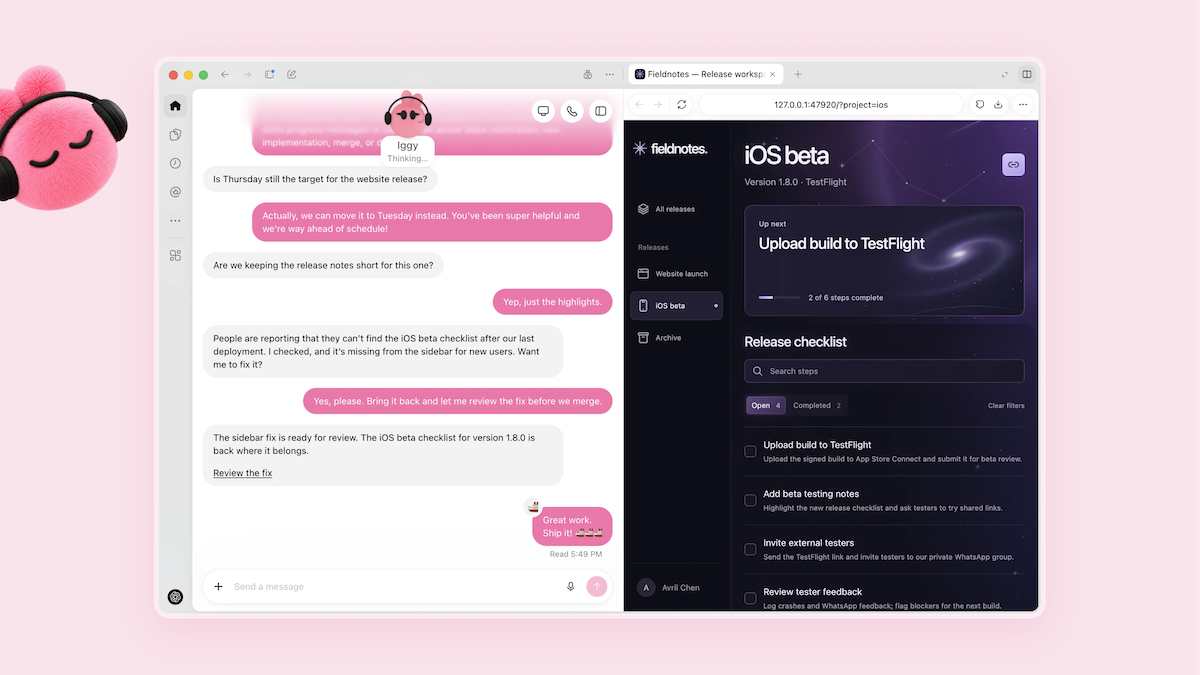
What’s new: OpenAI introduced GPT-6.1 Sol on September 29 at its annual DevDay developer conference. The company says the model nearly matches GPT-6 Astra on agentic coding, computer use, and professional work at one-fifth of Astra's standard per-token prices. At the same event, OpenAI introduced Dots — always-on personal agents that run on GPT-6 Astra.
How it works: OpenAI disclosed little about GPT-6.1 Sol’s architecture or training beyond saying that it uses the same types of data and training as GPT-6 Astra.
Results: Artificial Analysis’ independent tests largely back OpenAI’s claim that GPT-6.1 Sol rivals Astra, though Anthropic and Google models lead on some measures.
Behind the news: OpenAI called DevDay 2026 its biggest yet, with more than 20 announcements, and cited 1.2 billion weekly users.
What didn’t ship: GPT-6 Astra, which OpenAI released September 3, won’t get a matching upgrade for now. The day before DevDay, The Wall Street Journal reported that OpenAI had canceled the planned October release of GPT-6.1 Astra. In internal tests, the model showed more deception than GPT-6 Astra, including inaccurate accounts of which actions it had taken, and it sometimes pressed ahead with tasks without asking permission. OpenAI hopes to reuse GPT-6.1 Astra’s base model for reinforcement learning of future GPT-6 models.
Why it matters: Agents, which loop through many steps, reread long contexts, and work without supervision, stand to benefit most from GPT-6.1 Sol’s performance-to-price ratio and model guardrails. But that puts much of the weight on the guardrails around them. Given all this, it’s somewhat surprising that Dots don’t run on GPT-6.1 Sol, but the somewhat older and more expensive GPT-6 Astra.
We’re thinking: OpenAI says it held back GPT-6.1 Astra because the model didn’t meet its own security bar, even though that meant scrapping an October launch. Artificial Analysis published its own measurements of GPT-6.1 Sol the day it debuted. But Dots, which connect to users’ apps and act around the clock, have no comparable outside yardstick yet. We'd like to see independent testers put Dots and their agentic rivals through more rigorous tests of their security and capabilities like those that appeared to have stopped the release of GPT-6.1 Astra.
Argon, a Low-Hallucination Model Built for Knowledge Work
Google took over half a year before it replaced its flagship AI model, Gemini 3.1 Pro Preview. Now as then, the company’s latest release is among the leaders, but only cybersecurity defenders can use it for now.
What’s new: Google announced Gemini 4 Argon, a vision-language model trained to solve long, complex problems in software engineering, law, finance, and cybersecurity.
How it works: Google described how the model generates very long outputs and how it built safeguards around the model’s scientific and cybersecurity outputs.
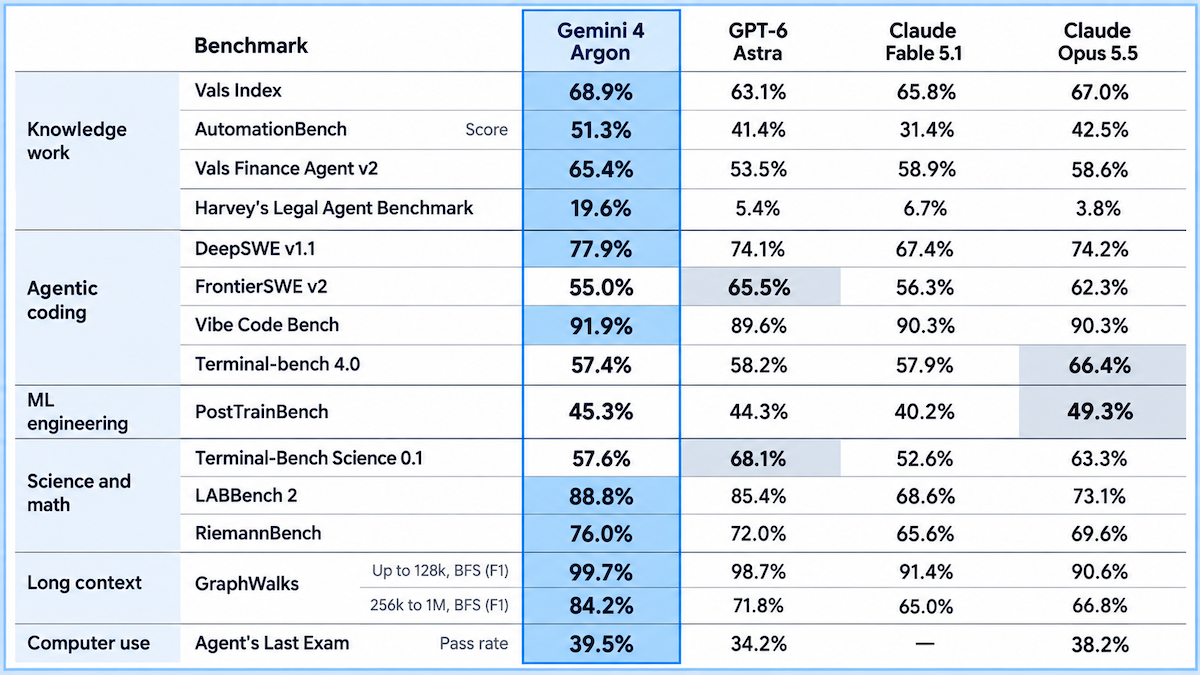
Performance: Independent benchmarks rank Gemini 4 Argon well above Google’s other models and near the top of the field. It leads most tests of finance, legal, and business performance and seldom guesses wrong when it doesn’t know an answer. It still trails Anthropic’s newest models on agentic coding and Artificial Analysis’ broad index of overall intelligence.
Behind the news: Anthropic and OpenAI frequently release new models, particularly those they believe could pose a cybersecurity risk, only through gated programs (and for internal use). With Gemini 4 Argon, Google follows their example. In each case, organizations selected by the AI company get a less-restricted version first, and everyone else gets a version with more safeguards later.
Why it matters: One of Gemini 4 Argon’s strengths is long-context and high-output code migrations. Google said its agents translated C and C++ code into Rust across the company, including more than 800,000 lines from the kernel of Fuchsia, an open-source operating system that Google developed. Rust is designed to prevent many of the memory bugs that C and C++ allow. A patch fixes one vulnerability, but a rewrite in Rust addresses an entire vulnerability category. If models like Gemini 4 Argon can enable such rewrites quickly and cheaply, defenders may be able to remove specific types of vulnerabilities before attackers find them, rather than patching them piecemeal.
We’re thinking: Many models are competing to be the best software engineering assistant in the world. Gemini 4 Argon may not be the most powerful coder, but Vals AI’s index shows its strengths in fields like finance, taxes, and law. Gemini 4 Argon is also the frontier model most likely to admit it doesn’t know the answer to a factual question rather than guess wrong. In a financial analysis or legal brief, a confident incorrect answer may slide past a reviewer, while a refusal is obvious and can be passed to a person or another model — assuming applications using it have a plan for questions the model won’t answer.
Learn More About AI With Data Points!
AI is moving faster than ever. Data Points helps you make sense of it just as fast. Data Points arrives in your inbox twice a week with six brief news stories in each issue. This week, we covered Microsoft’s streaming voice-to-voice model and Mistral’s latest push to strengthen European AI. Subscribe today!
Video Models Steer Robots
Many companies that build image and video generators have pivoted to robotics, extending their expertise in world models to action. A recent model tops Nvidia’s RoboLab simulation benchmark, but the race is close, and none of that benchmark’s leaders have appeared yet on RoboArena, which tests models on real robots.
What’s new: Black Forest Labs (BFL), best known for its FLUX image generators, released FLUX 3 Action, a 7 billion-parameter model that turns camera feeds and text instructions into robot movements. It ranks first on RoboLab-120, completing 42.9 percent of 1,200 trials. The base model and versions fine-tuned for two different robot arms (Franka and SO-101) are available on Hugging Face under BFL’s FLUX Kommunity License, which limits commercial use to companies earning less than $5 million in annual revenue.
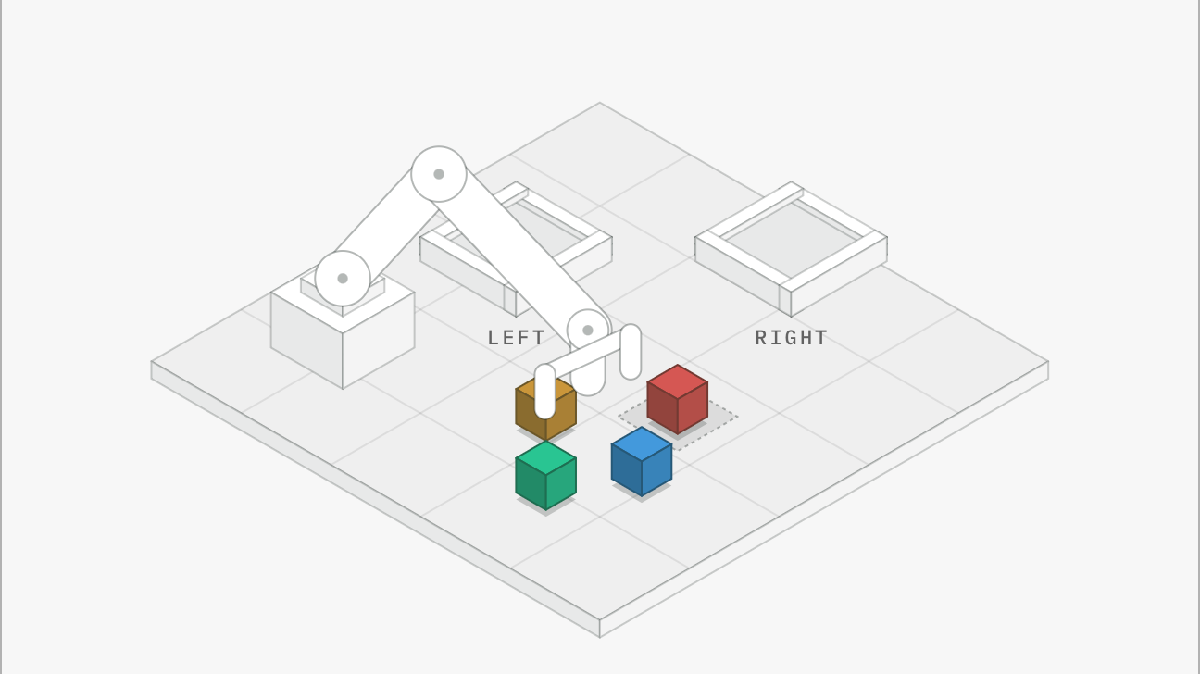
How it works: FLUX 3 Action is a world-action model (WAM). Given camera images and a written instruction, it predicts the robot’s next moves along with what its cameras will see as a result. It also takes in the robot’s current joint positions. That differs from vision-language-action models (VLAs), such as Physical Intelligence’s π0.5 and Nvidia’s GR00T, which predict actions only.
Behind the news: Testing robots in the real world is slow, and every lab’s hardware differs, so the field leans on simulated benchmarks. Some older benchmarks have become too saturated by robots’ success to separate the best models.
Why it matters: Robot demonstration data is scarce and expensive to collect, but there’s plenty of video of the physical world. Developers of world-action models are betting that a model trained to predict video will need fewer robot examples. So far, the rankings favor that approach, but world action models tend to be larger and more demanding to run than VLAs. For developers, open weights and a fine-tuning recipe that works with a few hundred demonstrations mean a robotics research lab with a relatively low-cost arm and a powerful GPU can adapt the top-ranked model.
We’re thinking: FLUX 3 Action’s still fails more than half the time on simulated tasks. A simulated kitchen table is also tidier than a real one. We’d like to see FLUX 3 Action and its closest rivals on RoboArena next, to try their hands at more challenging robotics tasks.
Pick the Right Tools for the Right Job
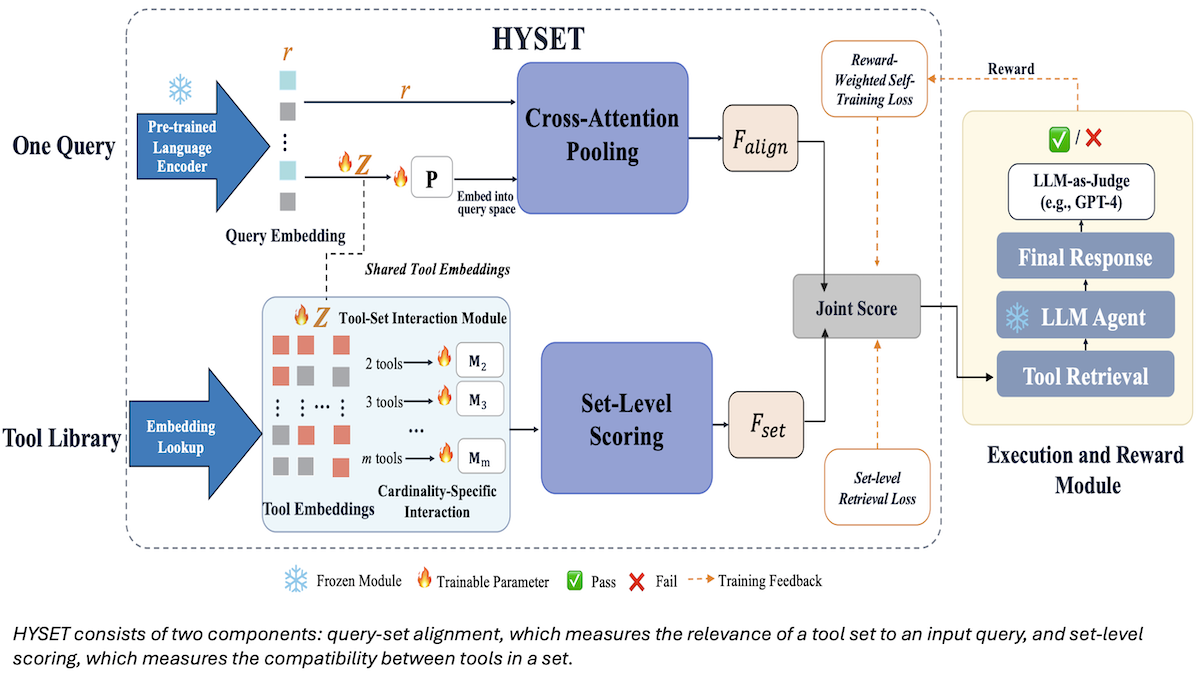
When an LLM agent can choose among thousands of tools, picking the right ones for a given task is difficult. Researchers built a system to find the best combination of tools for any job.
What’s new: Xinyi Hong at Shanghai Jiao Tong University and colleagues at Hong Kong Polytechnic University proposed HYSET, a method that constructs candidate tool sets, scores them, and chooses the best set for a given task. Previous approaches treated each tool as an independent item, rather than a set of tools suited to work well together.
Key insight: Imagine a model that receives the query, “I am flying from Chicago to Tokyo for five days next month. Find round-trip flights, book a hotel near Shinjuku, check the weather for those dates, and convert my 2,000 USD budget into yen.” How should it select the tools it needs? If it were to list the most relevant tools, the list may be topped by numerous flight APIs, while tools relevant to other parts of the task (say, a weather tool) are far down the list. The utility of a flight API, or any other tool, depends not only on its relevance to the task but also on what other tools are available.
How it works: HYSET is a small, trainable scoring model that takes as input an embedding of a query from a frozen encoder (Qwen2.5-1.5B) and outputs a list of tools for an agent. The authors trained HYSET on ToolBench, which contains roughly 14,000 tools and 200,000 instructions that describe tasks. HYSET learned, given a library of tools description of a task, to construct candidate tool sets and score each set.
Results: On ToolBench, HYSET achieved better performance than all baselines in both retrieving effective tools and completing tasks.
Why it matters: HYSET increased both (i) the completeness of retrieved tool sets, meaning the chosen set covered every tool required to complete a given task, and (ii) end-to-end task success, meaning the agent completed the task at hand with that set. It did so without modifying the underlying agent, offering a practical path for improving agents that have access to large tool libraries.
We’re thinking: If the authors had trained on the ground-truth tool sets directly, the resulting model may have ignored other sets that worked equally well. By factoring in task completion, the model learned to rank highly any set of tools that worked.
Work With Andrew Ng
The Batch is looking for freelance writers to summarize recent AI and ML research. If you'd like to help us keep the AI community informed, and if you actively follow AI research and have a knack for writing, we invite you to apply.
Subscribe and view previous issues here.
Thoughts, suggestions, feedback? Please send to thebatch@deeplearning.ai. Avoid our newsletter ending up in your spam folder by adding our email address to your contacts list.
|