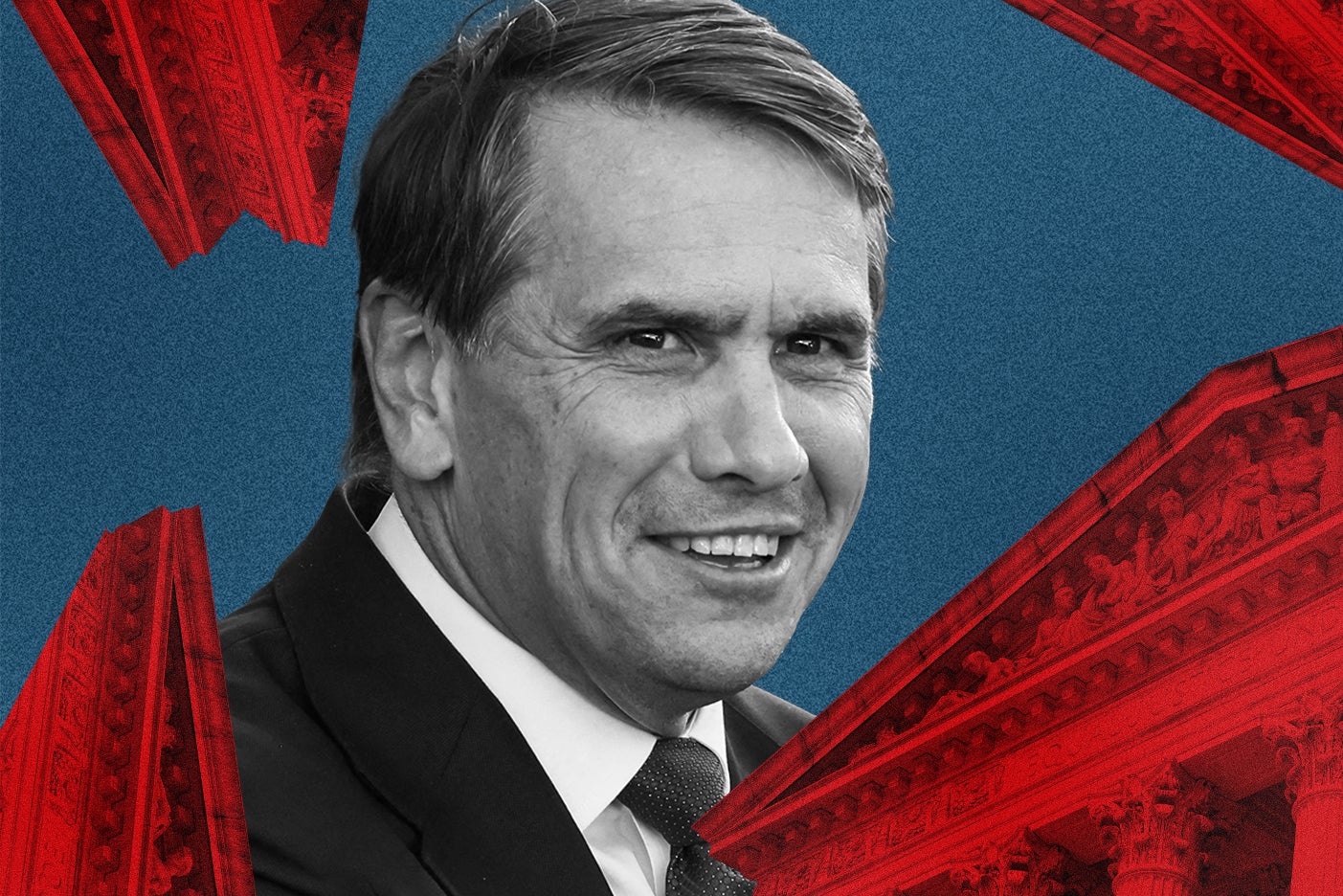
Todd Blanche has been vying to be the next attorney general of the United States for quite some time now. During his time as deputy AG last year, serving in the Justice Department under former Attorney General Pam Bondi, Blanche went to disturbing new heights to prove his fealty to his boss, President Donald Trump—and it finally paid off. In April, after firing Bondi, Trump elevated Blanche to acting AG. Then, last month, he finally nominated Blanche for the top job. But the president’s loyal bulldog faced a glaring problem: In his efforts to win over Trump, he lost the support of some Republican senators whom he desperately needs to secure the confirmation. He’s spent the past month attempting to justify his work at the DOJ and assuage the concerns of key GOP holdouts. In a few days’ time, we’ll find out if it worked.
Next Wednesday, the Senate Judiciary Committee will kick off a two-day confirmation hearing for Blanche’s nomination; he’ll need every single Republican member to vote for him before his nomination can go before the full Senate. And even if he manages to scrape by in committee, Blanche can afford to lose only three Republican votes in the Senate. The most critical holdouts so far are two outgoing senators, Thom Tillis of North Carolina and John Cornyn of Texas. Tillis has been the most vocal about his concerns, particularly over Blanche’s settlement with the president in his lawsuit against the IRS. The attorney brokered a sweetheart deal—an arrangement I detailed in this newsletter last month—that would ban the federal government from ever pursuing tax enforcement against Trump, his family, and their businesses over past tax returns. It would also establish a nearly $2 billion “anti-weaponization” fund to be paid out to individuals who had been politically targeted by the Biden administration, namely Jan. 6 rioters.
“This is beyond the pale,” Tillis said in May after details of the settlement first came to light. “There’s not one positive thing that could be spun out of this between now and November. This is bad policy, it’s bad timing and it’s bad politics.” A few weeks later, after having a private meeting with Blanche, Tillis told CNN that if he catches “even a whiff” that the DOJ would not be independent under Blanche, that will influence his vote.
Blanche’s settlement was not well received by basically anyone in Congress, and it led to a contentious meeting during which the attorney failed to adequately address lawmakers’ questions. Shortly thereafter, Blanche was called to a House Appropriations Committee hearing, where he told lawmakers, “We are not moving forward with the fund, period.” But he refused to put his promise into writing. And a federal judge has reopened Trump’s IRS lawsuit under suspicions that it was brought not to legitimately pursue legal action but to secure a benefit for the president.
Meanwhile, Cornyn’s concerns echoed back to Blanche’s connection to Trump, as he served as his personal attorney in at least three criminal cases in the years and months leading up to the 2024 election. “I’m interested in hearing how he [Blanche] would approach the job, because he was President Trump’s lawyer at one time, but if he’s AG, he won’t be the president’s lawyer,” Cornyn told reporters. The Texas senator similarly held a private meeting with Blanche, a conversation he described simply as “positive,” without elaborating which direction he’s leaning on Blanche’s confirmation.
Sen. Bill Cassidy of Louisiana, who, like Cornyn, was primaried out of his job by a Trump-backed challenger, voiced similar concerns about Blanche’s impartiality. “I have to be convinced that Todd is not the president’s personal attorney who happens to be attorney general, but that Todd is the attorney general who used to be the president’s personal attorney,” Cassidy told Punchbowl News.
To answer the question of whether Blanche will truly represent the American people over the president’s wishes, senators could simply refer to court records that reveal what exactly he has been up to over the past year. In addition to the unprecedented, maybe-aborted IRS settlement, Blanche was responsible for overseeing the DOJ’s unequivocally disastrous release of the Epstein files. A sloppy redaction job resulted in dozens of victims having their identities revealed; Blanche also refused to meet with any of Jeffrey Epstein’s victims—instead interviewing his convicted partner in crime Ghislaine Maxwell before securing her transfer to a minimum-security prison.
Then we have the case of Kilmar Abrego Garcia, the Maryland father who federal prosecutors admitted was mistakenly (and unlawfully) deported to El Salvador and sent to the CECOT megaprison. After doubling down on this case, Blanche oversaw a highly dubious indictment that accused Abrego Garcia of human smuggling. By late May, a judge declared the indictment a bad-faith effort that reeked of vindictive prosecution and dismissed it. Not to mention all of the other DOJ cases that went after Trump’s political enemies, including James Comey, New York Attorney General Letitia James, and (reportedly) E. Jean Carroll.
If these egregious acts of partisan loyalty to Trump weren’t convincing enough, senators could also refer to the letter over 1,200 former DOJ employees sent this week to Senate Judiciary Committee Chairman Chuck Grassley and Ranking Member Sen. Dick Durbin. In no uncertain terms, it lays out how damaging Blanche has already been to the department and how it can only get worse with him in charge of the entire agency. “Under Blanche’s leadership, approximately 16,000 employees have left, and departures aren’t slowing down,” reads the letter, arguing that hundreds were fired just for working on cases Trump didn’t like, being relatives of the president’s enemies, adjudicating immigration cases in accordance with due process, declining to participate in vindictive prosecutions, and refusing to lie in court.
Liz Oyer served as a DOJ pardon attorney under the Biden administration and, two days after Blanche was confirmed as deputy AG, was fired. In her own letter to the Senate Judiciary Committee, Oyer states that she was fired after refusing to use her official position to facilitate a political favor for a friend of the president, “specifically, restoring the federal firearm rights of a convicted domestic abuser.” That unnamed abuser was actor Mel Gibson. On top of firing her, Oyer claims, Blanche prevented her from informing Congress of his actions and subjected her family to retaliation by delivering an intimidating letter to their home.
Oyer, in her own Substack, notes just how obvious Blanche’s conflict of interest has become since his appointment as deputy AG—and how much worse it could still get. “The interests of Blanche’s former client, Donald Trump, are frequently in conflict with the interests of Blanche’s current client, the United States,” she writes. “When he assumed the role of Deputy Attorney General, Blanche swore an oath to support and defend the Constitution of the United States. Trump’s demands are often contrary to the Constitution, which has created an untenable situation for Blanche.”
Taken together, Blanche’s actions over the past 12 months make abundantly clear that he’s prioritizing the president’s agenda. On the other side of the ledger, what work does he have to show on behalf of the American people? Well, the DOJ froze its civil rights litigation; closed more than 23,000 criminal cases involving terrorism, white-collar crime, drugs, and other offenses to pursue immigration cases; and has been charging protesters with serious crimes that have largely been dismissed or ended in not-guilty verdicts. Oh, and he has vehemently defended Trump’s ballroom project in court, an endeavor that, it turns out, is being funded by taxpayer dollars.
We can’t predict how Congress will vote on Blanche's confirmation next week, but it’s worth noting that every Republican in the Senate voted to confirm him as deputy attorney general last year. And despite knowing the problematic pasts and damning behaviors of many other Trump Cabinet nominees, Senate Republicans successfully confirmed nearly every single one of them.