Amid the smoldering ruins of the Voting Rights Act (VRA), the race to gerrymander continues across the South. In South Carolina and Louisiana, Republican lawmakers are taking key votes to eliminate majority-Black districts for 2026. Meanwhile, voting advocates are fighting in court to block the gerrymanders that GOP-controlled Southern states have rushed into law. And if you’re starting to wonder when the 2028 redistricting war will begin, the answer is: it already has.
As always, thanks for reading.
Jen Rice, Reporter
The state of redistricting across the nation
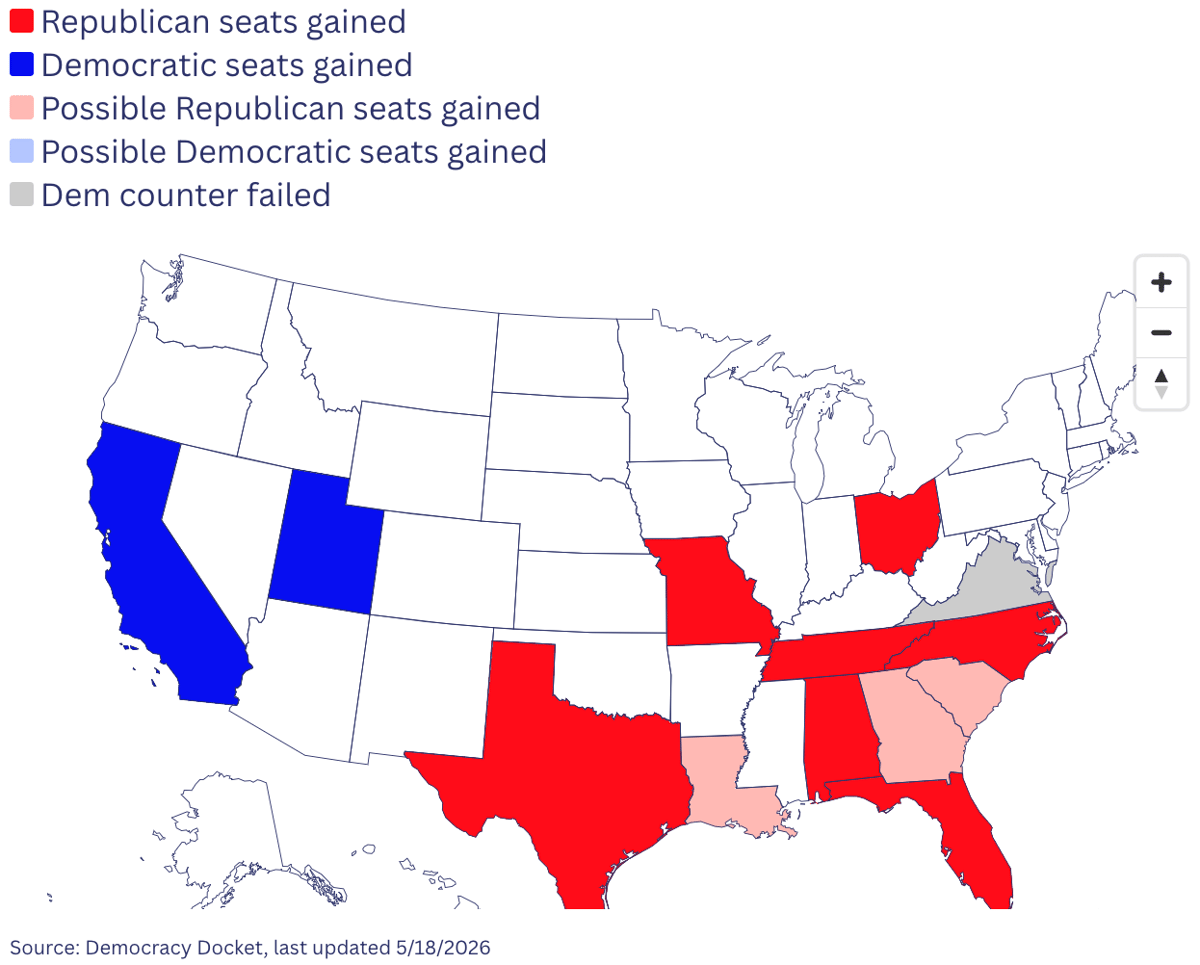
Thanks to President Donald Trump’s redistricting arms race to rig the midterm elections and the Supreme Court’s recent ruling in Louisiana v. Callais, which gutted the VRA, the nation’s congressional district lines remain in flux, even with midterm primary elections already underway. For now, Republicans have potentially gained up to 13 seats this year — five in Texas, four in Florida and one each in Missouri, North Carolina, Tennessee, and Alabama. Democrats have potentially gained up to six seats — five in California and one in Utah. (Litigation is ongoing in Florida, Tennessee and Alabama.)
Southern states passing new gerrymanders
In Louisiana and South Carolina, Republicans are in the final stages of dismantling each state’s lone majority-Black district.
The Louisiana map packs Black voters into one district, pitting the state’s two incumbent Black Democrats against one another. The state already held its primary elections last week. But Gov. Jeff Landry (R) — who appears to be as unpopular in Greenland as he is in Louisiana — suspended the congressional races in a last-minute bid to redraw maps. Despite multiple lawsuits challenging the suspension, the courts so far appear to be allowing Landry to stop an active election, even after absentee ballots were already sent out.
And South Carolina Republicans continue to rush through their own gerrymander. The House passed the new map this week, and the Senate is now taking it up. As in Louisiana and Alabama, the last-minute move is causing election turmoil. With early voting in the June primary about to begin, South Carolina lawmakers are scrambling to approve a measure pushing it to August.
Where the ongoing legal battles stand
With Missouri’s Aug. 4 primary getting closer, local election officials are growing increasingly concerned that they don’t have a final answer about which congressional map is in effect. One county clerk in Missouri says she won’t update the voter lists until the Show-Me State’s GOP Secretary of State Denny Hoskins — ahem — shows her what he’s going to do: either certify or reject a referendum on the redistricting plan.
If you’re a regular reader, you already know: Gerrymander opponents gathered enough signatures to put the new map to a statewide vote. But Hoskins says he won’t decide whether to approve their petition until the legal deadline, which happens to be the same day as the primary election. It’s another move many say aims to stall until it’s too late for Missourians to halt the gerrymander. Referendum organizers filed another lawsuit in the months-long legal saga, demanding Hoskins expedite the process.
If you’re confused about Alabama, you’re not alone. The state held its primary election Tuesday. But Black voters are still trying to stop the gerrymander — and a court could still agree with them and block the map. After all, it previously deemed that map an illegal violation of the 14th Amendment. The state has postponed the primary in four congressional races until August. At that point, it will be too late to hold a runoff, so the candidate who earns the most votes in each race will be declared the winner.
And in Florida, voters and advocates are challenging the Florida gerrymander, asking a court to block the map for 2026. But they’re at the mercy of a judge appointed by Gov. Ron DeSantis (R), so it’s unclear whether the court will stop a map that blatantly violates the state’s partisan gerrymandering ban — or grant Florida Republicans’ request to declare the voter-approved ban unconstitutional altogether.
The attacks on democracy are coordinated — our response must be too. Become a premium member for $120/year and fuel the investigative work that reveals the far right’s playbook.
Republicans showed their cards this week during a Senate Judiciary subcommittee hearing, discussing further plans to redistrict in response to the Callais ruling. Sen. Eric Schmitt (R-Mo.) urged the Department of Justice to “move immediately, review maps drawn or defended under the old regime, identify districts built on unconstitutional racial sorting, intervene where appropriate, file statements of interest where appropriate, and support plaintiffs enforcing Callais in court.”
And House Democratic Leader Hakeem Jeffries made it clear that Dems are preparing for the next cycle. Speaking at a Center for American Progress conference, he said at least seven Democratic-controlled states are laying the groundwork to redistrict by 2028: Virginia, New York, New Jersey, Illinois, Washington, Oregon and Maryland.
How can Dems defeat Trump’s undemocratic erosion of the electoral system? Jeffries had a few thoughts: “massive campaign finance reform, massive electoral reform, and yes, massive Supreme Court reform, as well.”
Odds and ends
The Texas Supreme Court handed a big L this week to Gov. Greg Abbott (R) and Attorney General Ken Paxton (R), rejecting their attempts to remove Democrats from office after they left the state last summer to block a vote on the GOP gerrymander. If you recall, Abbott and Paxton literally fought over which of them could get Dems removed from office, because each wanted credit for meting out the most severe punishment. Now we have the answer: Neither can put a notch in his belt.
We’re also watching a curious Indiana recount, where a Trump-endorsed GOP primary challenger is seeking a recount in the race she lost by just three votes to an incumbent state senator who opposed Trump’s redistricting. The recount is being overseen by Indiana Secretary of State Diego Morales (R), an election denier whose own party is asking him to drop his reelection bid.
What we’re doing
We’re starting to contemplate our July 4 plans and wondering what’s the best way to mark 250 years of a democracy that is, quite unmistakably, unraveling. Please send any suggestions. Meanwhile, we’re here to tell you: If you’re worried about the November election, the time to get involved is now. Find your state and/or local chapters of democracy organizations (i.e., Common Cause, the League of Women Voters, etc.). Sign up for updates. Attend trainings. If you need some inspiration, listen to a remarkable episode of This American Life that chronicled the lengths ordinary people went to in Venezuela to preserve a record of the vote count in their 2024 presidential election.
This is one of our free weekly newsletters. If you were forwarded this email, you can subscribe to our newsletters here. For questions or help with your subscription, please visit our Help Center.







.png?height=50&upscale=true&name=Bluesky_Logo-grey%20(2).png)


