President Donald Trump’s Department of Justice (DOJ) has now lost 15 times — and won zero (!) times — as it battles in court for access to states’ voter rolls. And the majority of those rulings are coming from judges appointed by Republicans.
Plus, we’re keeping an eye on redistricting news, including an upcoming hearing in Alabama and some new reporting that suggests Democrats are facing an uphill battle to pass their New York redistricting referendum at the ballot box this year.
As always, thanks for reading.
Jen Rice, Reporter
Most of Trump’s DOJ voter roll losses have come from GOP-appointed judges
The Trump DOJ hasn’t won any of its voter roll lawsuits, and this week brought even more losses. Judges dismissed cases in Virginia, New Mexico and West Virginia. Cue the “sad trombone” sound effect.
Notably, the Virginia case was dismissed by a Trump-appointed judge. And the New Mexico and West Virginia lawsuits were tossed out by judges appointed by former President George W. Bush.
“Given the lack of an adequate basis or purpose, one is left to wonder what the real purpose was for the Justice Department to go to the trouble of filing civil actions like this one all around the nation,” U.S. District Judge Thomas Johnston, who heard the West Virginia case, wrote in his ruling.
In our era of extreme polarization, at least judges appointed by both parties so far agree: Trump’s unrelenting quest for voter rolls is unlawful.
An Alabama redistricting win is now at risk after recent Supreme Court rulings
A lower court already found evidence that an Alabama county engaged in racial gerrymandering. But now the 11th Circuit may be forced to vacate that win for Alabama Black voters after the U.S. Supreme Court’s (SCOTUS) conservative majority made it all but impossible for federal courts to block race-based redistricting.
Last year, a district court found that the Jefferson County Commission map violated the 14th Amendment’s prohibition on racial gerrymandering. The county appealed the decision to the 11th Circuit.
Next week, the court will hear arguments on whether recent SCOTUS redistricting rulings impact the lower court’s findings. Given the intentional, racially-motivated redraw we saw in Alabama alone this year, we aren’t holding our breath that the answer will be “no.”
It’s just the latest example of how the high court’s decision to enable gerrymandering and take a legal chainsaw to the Voting Rights Act will continue to have consequences at every level of government.
Democrats face uphill battle in New York redistricting referendum
New York lawmakers voted last month to approve a constitutional amendment that would allow them to redistrict for 2028. After the next general election in November, the state legislature will need to pass the measure again before sending it to the voters for final approval.
But they’re facing a problem. Next year, New York will likely have the least favorable electorate for Democrats of any year in the past decade, Politico reported this week. With virtually no high-profile races on the 2027 ballot to draw New York City voters to the polls, the party will need to contend with higher GOP voter turnout thanks to local contests in other parts of the state.
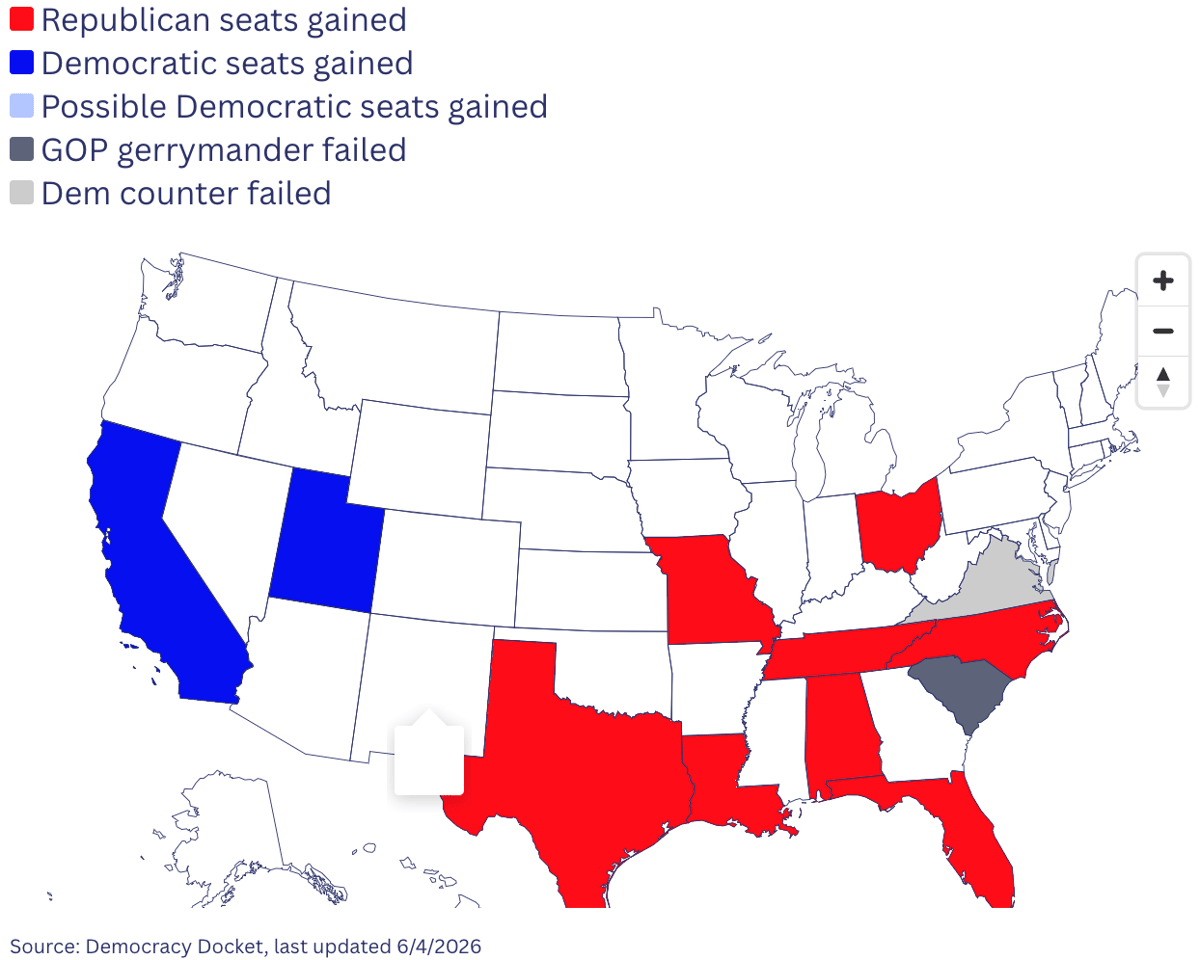
Republicans have potentially gained up to 16 seats for the midterms — five in Texas, four in Florida, two in Ohio and one each in Missouri, North Carolina, Tennessee, Louisiana and Alabama. Democrats have potentially gained up to six seats — five in California and one in Utah.
No one is covering the GOP's redistricting scheme as closely, or with as much context and analysis, as Democracy Docket. Our 30-person team works around the clock to bring you fearless, democracy-focused reporting. Become a member to support our newsroom.
Much like what we’re already seeing in North Dakota, Montana is another state where Native American redistricting wins are now at risk in the aftermath of the SCOTUS ruling gutting the Voting Rights Act.
This summer, Alabama Republicans passed an 11th hour gerrymander aimed at flipping the 2nd District, which is now considered “likely Republican.” But Rep. Shomari Figures (D) is fighting to hold onto his seat, and internal polling shows he could still pull it off.
What we’re doing
We’re looking forward to Aug. 8, the League of Women Voters’ upcoming “Unite & Rise for Voting Rights” day of action — part of their large-scale effort to mobilize voters for the 2026 midterm elections. You can join one of hundreds of events in cities across the country that day, including Phoenix, Berkeley, Atlanta, Detroit and Philadelphia.
This is one of our free weekly newsletters. If you were forwarded this email, you can subscribe to our newsletters here. For questions or help with your subscription, please visit our Help Center.







.png?height=50&upscale=true&name=Bluesky_Logo-grey%20(2).png)


