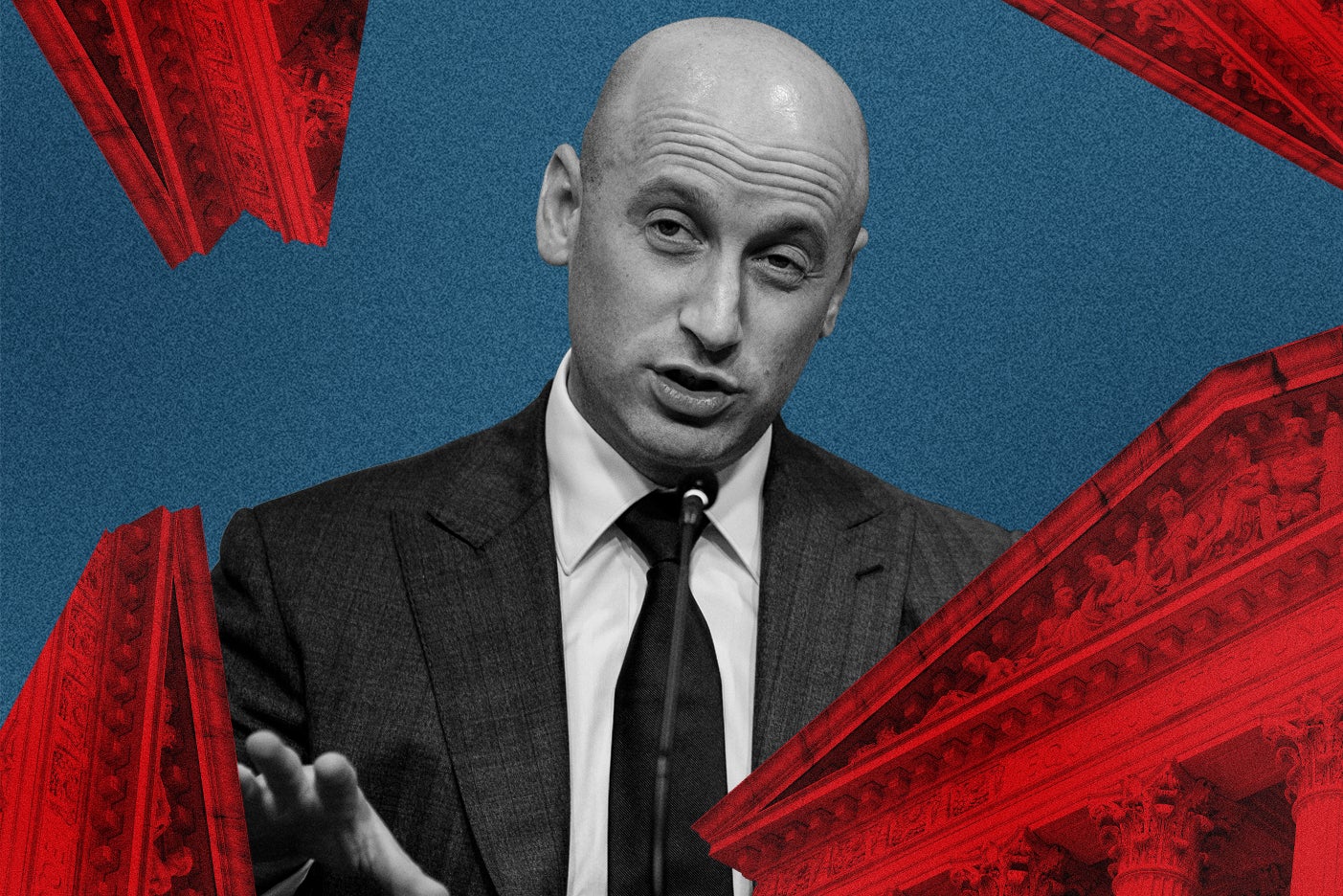
Raging anti-immigrant senior White House adviser Stephen Miller has been back in the news recently, perhaps not coincidentally, as Donald Trump’s mass deportation machine has ramped back up this summer. Predictably, Miller’s approach—attempting to remove as many immigrants as physically possible from the U.S.—has resulted in the Justice Department deporting some people by mistake, revoking hundreds of thousands of people’s legal status, and even killing innocent American citizens who dared protest the administration’s actions. Indeed, in the past two weeks alone, at least three people have been killed in encounters with Immigration and Customs Enforcement, including one who was about to return home from visiting the United States on a tourist visa. Judges up and down the judiciary, meanwhile, have declared that the Trump administration’s deportation machine has been operating unlawfully, but the ensuing retreat has only been temporary. As the president’s immigration agenda has roared back to life with a vengeance, one of his most shocking acts went completely under the radar when it came to light last week. The plan: activate a controversial immigration court that has never once been used by any U.S. president. If it succeeds, Trump will have unlocked an entirely new level of immigration policy that quashes due process rights and will call into question who exactly the Constitution is meant to protect.
On July 15, the Justice Department filed an application with the Alien Terrorist Removal Court, a system that was created by Congress back in 1996 within the Antiterrorism and Effective Death Penalty Act. It was meant to create a pathway for the government to obtain meaningful judicial review in deportation cases while keeping its evidence secret. In practice, this means the U.S. government only has to provide classified evidence to the lawyer representing the subject of the ATRC case, while providing the subject only with an unclassified summary of the evidence.
Up until last week, the ATRC didn’t even have a website. That’s when one was hastily put together, popping up with little to no detail about what it is or how it operates. Because the ATRC process is so secretive, right now it’s not clear who the Trump administration is targeting with its new application to go through the court—the first such effort ever. However, we do know that the judge assigned to the case found the federal government hadn’t sufficiently proven its need to use the ATRC, and ordered the DOJ provide the court with more “factual or legal analysis” to justify its actions. A response was due by Wednesday. The DOJ has to fulfill three elements, all certified by the attorney general or deputy attorney general, in order to have its ATRC application approved: The noncitizen subject needs to be an alien terrorist, physically present in the U.S., and pose a risk to U.S. national security. If a judge denies the DOJ’s request, it can appeal with the U.S. Court of Appeals for the D.C. Circuit.
Because no presidential administration has ever used the ATRC, there’s zero precedent to look to here that might provide a window into what this process could look like, how the ATRC could rule, or who is being targeted and why. However, that’s far from the most troubling part of this story. “This is another Rubicon that the Trump administration is crossing in its assault on basic democratic rights. and it is part of an ongoing strategy initiated before, but especially during the events of Jan. 6, to essentially abolish the Constitution,” Eric Lee, an immigration attorney at Lee & Godshall- Bennett LLP and president of the Consular Accountability Project, told me. Lee was lead counsel on Department of State v. Muñoz, a 2024 case where the Supreme Court ruled U.S. citizens don’t have a fundamental liberty interest in bringing their noncitizen spouses into the country.
Lee believes the ATRC is a tribunal whose constitutionality should be seriously questioned because it allows the U.S. government to violate core liberty interests of people who are unquestionably protected by the Constitution. “The Fifth Amendment protection to due process, the First Amendment protection to free speech, they apply whether you’re a citizen or not,” Lee said. “None of the first 10 amendments reference the rights of citizens. They refer to the rights of the people.”
By allowing classified evidence to be used against noncitizens, the ATRC would also then prevent them from being able to challenge said evidence or confront witnesses used against them. “They can’t engage at all. They can’t even know what they’re accused of having done,” Lee said. There’s a world where Lee could see the Trump administration filing ATRC applications against pro-Palestinian protesters for espousing “terrorist views” or even just attending a protest. Or a noncitizen who criticizes Trump on social media and attends a demonstration against ICE’s actions. These are all things the administration has already been going after people for and which are supposed to be constitutionally protected acts.
Up until this point, the judiciary has often pushed back on the Trump administration for trying to charge and prosecute noncitizens for First Amendment–protected activity, while the media and general public also have had access to the federal government’s court filings. It has created an embarrassing situation for the president, including when a judge issued a scathing order to dismiss the DOJ’s indictment of Kilmar Abrego Garcia for vindictive prosecution, a case that came to define Trump’s mass deportation agenda. By going through ATRC, the Trump administration would be largely shielded from any public disclosures.
We cannot predict how the ATRC court will handle the Trump administration’s most recent application, or if the DOJ will continue to try to use this court. However, it’s worth noting that there are five Article 3 district court judges who sit on the ATRC and each of them also serves on the Foreign Intelligence Surveillance Court. Known as FISC, this court has been mired in controversy for years, as it historically has approved over 90 percent of the federal government’s requests for surveillance warrants against people all over the world. And all five of these judges were selected by Chief Justice John Roberts, with four of them appointed by former President George W. Bush and one by President Donald Trump. “None of these presidents are famous for his love for civil liberties,” Lee noted.
The Trump administration’s use of the ATRC is far from the only controversial piece of immigration policy it has enacted recently. This month, immigration judges suddenly began holding “mega master” hearings after the federal government began rescheduling thousands of immigration hearings with only a few days' notice. In New York City alone, roughly 4,440 people were ordered removed in June by an immigration judge because they missed their hearings, which is more than double the number in May. In July, ICE killed two men just days apart in separate traffic stops in Texas and Maine, prompting the agency to issue a “short pause” on most ICE traffic stops. That was until President Trump abruptly intervened, characterizing traffic stops as one of ICE’s "most important and effective crime-fighting tools.” It’s not clear what ICE officers are being directed to do at this point.
It’s hard not to overstate the seriousness of Trump’s hard-line immigration tactics, as embodied by Miller, particularly around ATRC application. He’s threatened to overturn the results of future elections and disenfranchise millions of voters, has been manipulating federal agencies, and established federal law through executive fiat. These actions make his moves in the ATRC especially worrisome. “New constitutional ground is being tread upon by the invocation of this, and that is recognized by the fact that no president has tried to invoke this for 30 years because they know that is a Rubicon that has not been crossed in this country ever,” Lee said.
“If you take a 1,000-year view of that, it is completely outside the Anglo-American legal tradition in a way that should be the first point that anybody makes about this.”