Some folks find it annoying when people talk about the 2028 election cycle before the 2026 elections have even happened. But, in truth, when it comes to redistricting, we need to know what to expect next. And in some Democratic-controlled states, fighting back on redistricting is truly an all-hands-on-deck, multi-year process. So it has to start now.
This week, the Colorado Supreme Court killed a plan to ask voters to counter GOP gerrymanders in other states for 2028. Having déjà vu, yet? But this time, the ruling might not stop Dems from trying again. Also, the Republican Party’s top mapmaker just gave an interview and dropped some hints about what’s coming for the next cycle. I listened to it so you don’t have to.
The Colorado Supreme Court has blocked a set of proposed ballot measures aimed at drawing a new congressional map to counter GOP gerrymanders in other states. The court found that the measures violated procedural requirements of the state constitution.
Unlike similar initiatives in California and Virginia, this one didn’t come from lawmakers passing legislation and then going to voters for approval. Instead, Colorado redistricting supporters tried to put the measures to voters by gathering signatures for a ballot initiative. If they hadn’t been blocked, the next step would have been to submit signatures to qualify for the ballot.
The group Coloradans for a Level Playing Field wanted to get the proposal on the ballot this November. But the court’s decision means that, if they want to try again, they will need to pass two separate ballot measures, likely requiring multiple successive elections.
Currently, the Colorado House delegation has four Democrats and four Republicans. Former Vice President Kamala Harris won the state in 2024 with 54% of the vote.
In a media landscape full of noise, Democracy Docket cuts through with facts, focus and fearlessness. Join for $120/year and power reporting that holds the line for democracy.
Top GOP mapmaker shares predictions, drops hints for 2028
If you don’t want to listen to all of GOP mapmaker Adam Kincaid’s recent 48-minute interview on former Trump White House press secretary (and Dancing with the Stars contestant) Sean Spicer’s podcast, that’s fair. But I did, and here are the top takeaways.
By Kincaid’s estimation, the GOP has netted 10 U.S. House seats from the redistricting war. And though he previously estimated the Texas gerrymander would net three to five new GOP seats, Kincaid is now confidently saying he believes they can win all five.
The Republican mapmaker also shared some clues about what to expect for 2028.
He thinks Georgia, Mississippi, Alabama and Louisiana will all draw new congressional maps next year. So will Indiana, where the GOP holdouts who blocked it the last time around have now lost their primaries, and South Carolina, where Trump’s redistricting push failed. Kincaid also predicts national Republicans will again ask New Hampshire, Nebraska and Kansas to redistrict.
Last summer, Democracy Docket was closely monitoring a mid-decade redistricting scheme playing out in Tarrant County, Texas. It turned out to be a real canary in the coal mine, coming just before Trump began an unprecedented redistricting war.
The quick recap: Texas Republicans rammed through an unnecessary partisan redraw that dismantled one county-level commissioner seat where minority voters had been able to elect their candidate of choice. Outraged residents argued it was a gerrymander aimed at undermining nonwhite Texans. Minority voters sued. Courts let the map stand.
But here’s the plot twist. Alisa Simmons, the Democratic commissioner whose district was dismantled, decided to run against Republican Tarrant County Judge Tim O’Hare, the county executive who led the redistricting effort. Now, a new poll shows Simmons and O’Hare in a statistical tie — meaning she could have the last laugh in November.
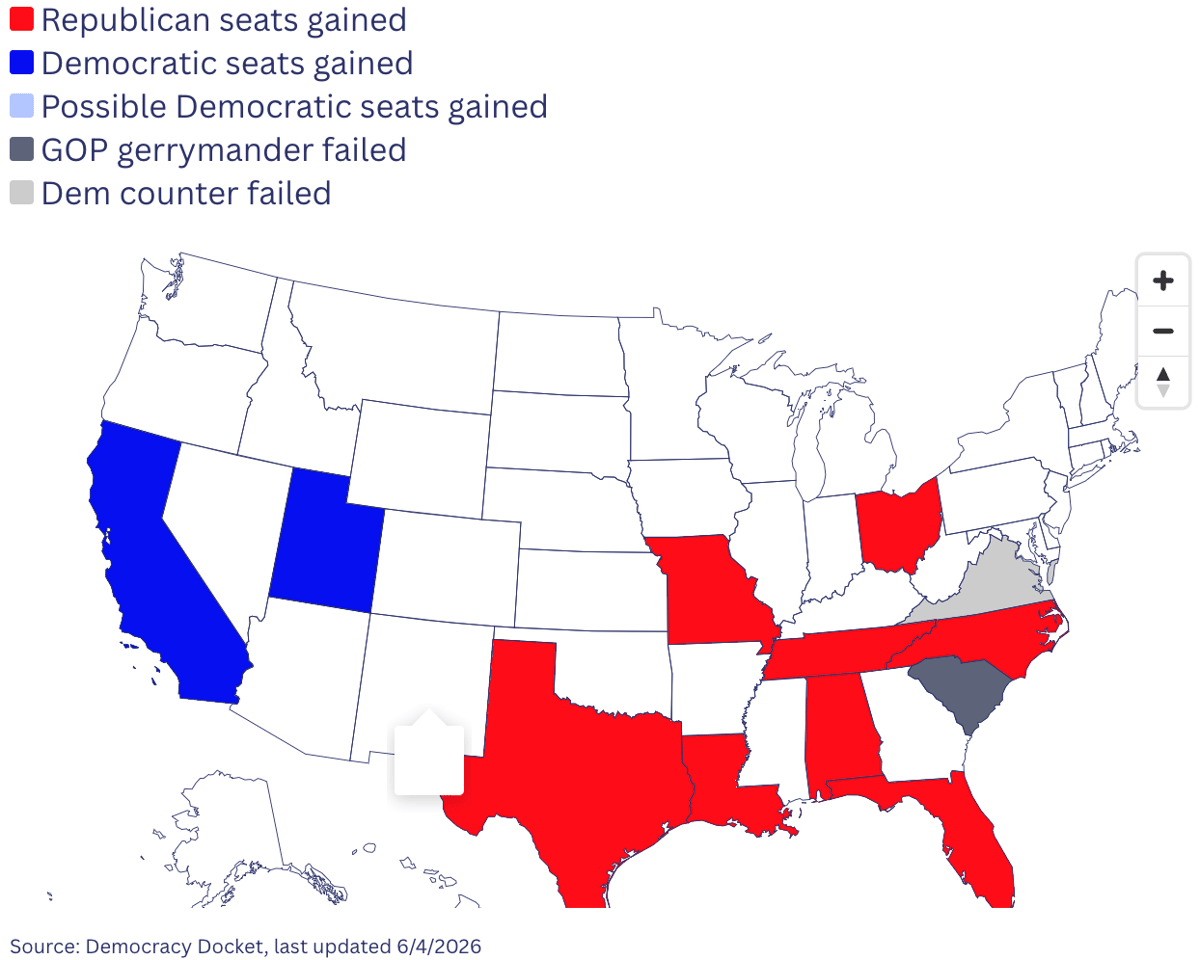
Republicans have potentially gained up to 14 seats for the midterms — five in Texas, four in Florida and one each in Missouri, North Carolina, Tennessee, Louisiana and Alabama. Democrats have potentially gained up to six seats — five in California and one in Utah.
No one is covering the GOP's redistricting scheme as closely, or with as much context and analysis, as Democracy Docket. Our 30-person team works around the clock to bring you fearless, democracy-focused reporting. Become a member to support our newsroom.
We hope you will enjoy the Onion’s redistricting take as much as we did: Supreme Court Upholds Temporal Gerrymander That Would Cost Democrats 1932 Election.
Redistricting made it to the big leagues this week, with John Oliver covering the topic in depth on his show.
What we’re doing
I’m actually going to tell you what we’re not doing this week: Attending Trump’s bleak 250th anniversary July 4th celebration.
I’m sure you’re already aware that Trump has used the semiquincentennial — the 250th anniversary of our nation’s founding — as an opportunity to enrich his pals at the expense of literally everyone else. House Democrats on the Natural Resources Committee actually released an entire report chronicling how Trump derailed long-standing plans for the celebration, turning this major national milestone into yet another opportunity to push his partisan agenda while giving the American people the flimsiest, most cheaply produced celebration possible.
It’s pretty depressing when you stop and think about it. This week could have been something we remembered all our lives. It might still be — but for the wrong reasons.
Democracy Docket Senior Reporter Matt Cohen’s dad, Merrill, attended the 200th anniversary celebration in Washington, D.C., and this is his memory of it: “It was a real party — a post-Watergate, post-Vietnam celebration. And I remember all kinds of people were there having a good time.”
He got to see the Beach Boys perform, for God’s sake! All we were supposed to get was Vanilla Ice — and even that got scrapped due to inclement weather.
This is one of our free weekly newsletters. If you were forwarded this email, you can subscribe to our newsletters here. For questions or help with your subscription, please visit our Help Center.







.png?height=50&upscale=true&name=Bluesky_Logo-grey%20(2).png)


