Dear friends,
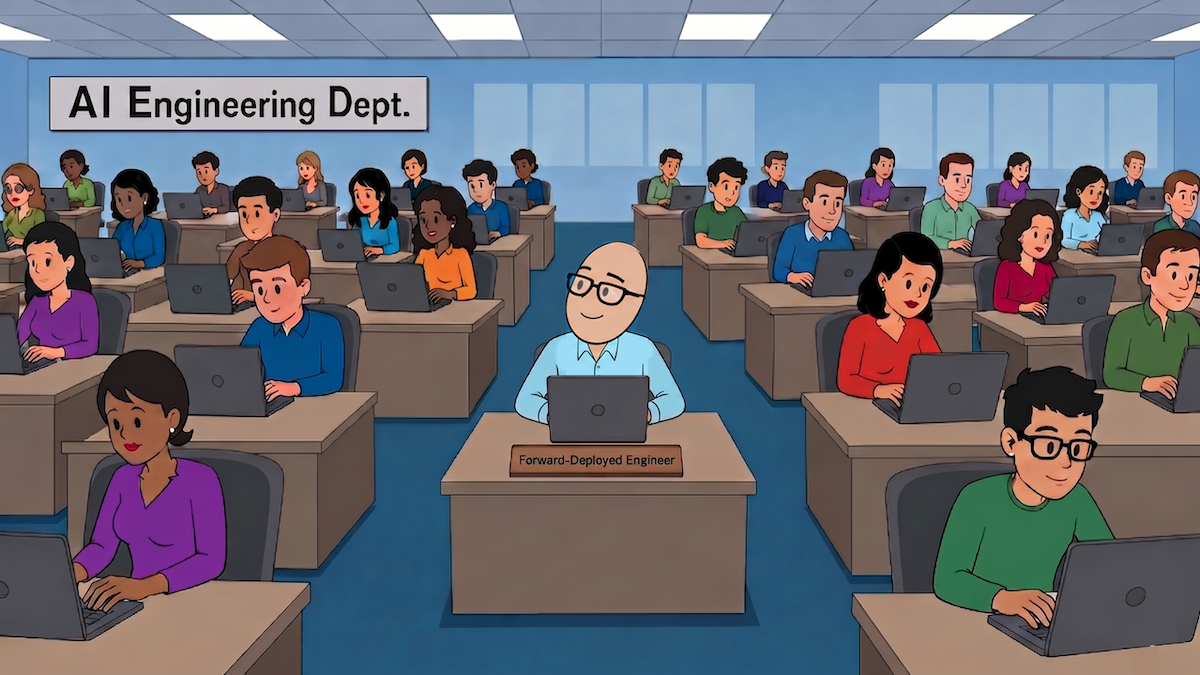
One of the new, buzzy jobs in Silicon Valley is the AI Forward Deployed Engineer (FDE), an engineer who is embedded within a client organization to help customize solutions, such as building and tuning agentic workflows that suit the client’s particular needs. I’ve heard from people who are wondering anew about the FDE career path since OpenAI and Anthropic started building new teams to place FDEs within client organizations.
Right now, I see surging demand for AI Engineers who can build software applications using AI software components (like LLM prompts, agentic frameworks, evals, etc.) and effectively use AI coding agents (like Claude Code, Codex, Antigravity CLI, and OpenCode). As the AI Engineer role matures, I expect it to fragment into more specialized roles, like the generic Software Engineer role from decades ago fragmented into frontend, backend, mobile, data engineering, devops, and so on.
Keep building! Andrew
A MESSAGE FROM DEEPLEARNING.AI
Ambient, from Kian Katanforoosh and Workera, measures your skills in the flow of work. You already measure other things that matter: sleep, steps, stress. Why not your skills? Join the waitlist
News
Gemini 3.5 Flash Pairs Smarts With Speed
Google’s faster model brings substantive gains at a substantially higher price, part of a rising trend in prices per token.
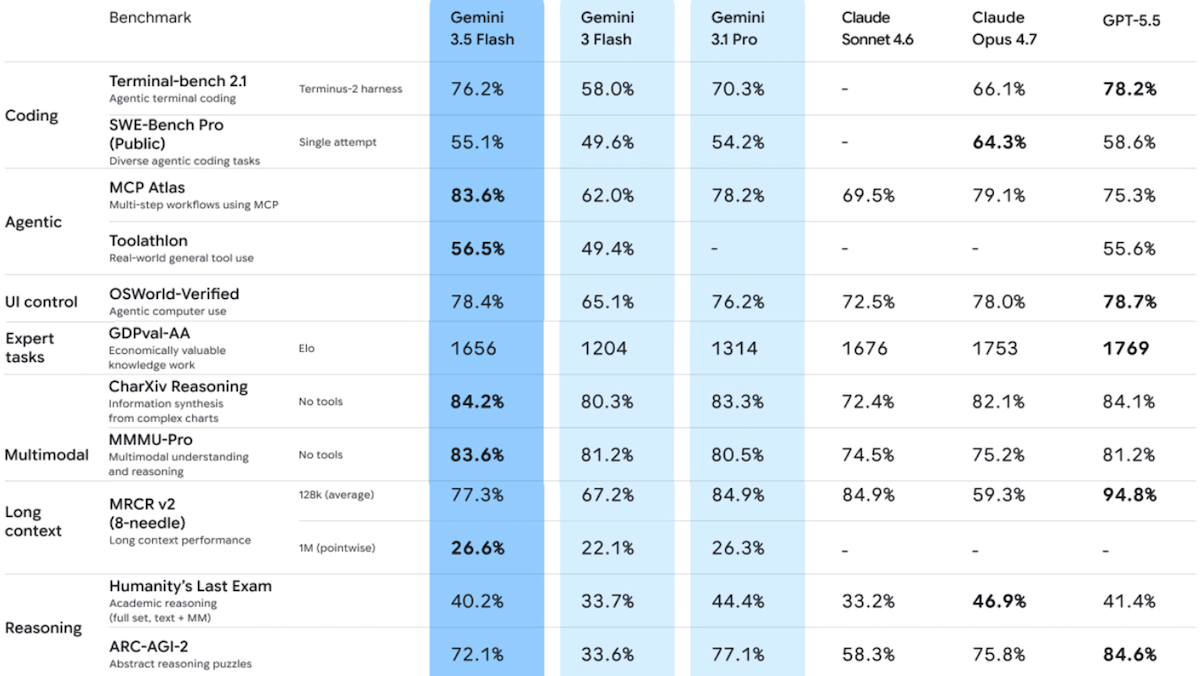
What’s new: Google launched Gemini 3.5 Flash, an update of its mid-tier multimodal model. The new version offers improvements in agentic capabilities, visual understanding, and speed at a price three times that of its predecessor Gemini 3 Flash.
How it works: Google disclosed few details about how it built Gemini 3.5 Flash.
Performance: Gemini 3.5 Flash performs just behind the first rank of multimodal models. It makes substantial gains over its predecessor in agentic capability and speed according to independent tests, including some state-of-the-art measures. On the Artificial Analysis Intelligence Index, it came in either fifth or seventh (depending on the reasoning levels of various models) behind Qwen 3.7 Max set to reasoning (level unspecified), but — except Qwen 3.7 Max, which debuted the same week — every model that scores higher on intelligence runs substantially slower.
Behind the news: Google debuted Gemini 3.5 Flash at Google I/O 2026, its annual gathering for developers. Here are other AI-related announcements from that event:
Why it matters: Gemini 3.5 Flash changes what “Flash” means. Introduced as a smaller, faster model tier after Gemini Ultra, Pro, and Nano, for now, Flash is Google’s mid-tier multimodal model, more akin to Anthropic’s Sonnet than Haiku. The model’s speed may be worth the additional tokens it generates for developers who build agents that require multiple turns as well as low-latency applications like chatbots, search, and image and video analysis.
We’re thinking: Google said Gemini 3.5 Flash often runs at less than half the cost of competing models. But Artificial Analysis found that, running the tests in the Intelligence Index, it actually costs more than Gemini 3.1 Pro. The Flash designation no longer implies a clear cost advantage for developers who run agentic workloads. Anthropic, OpenAI, and Google have raised per-token prices on their newer flagship and Flash-tier models. Gemini 3.5 Flash fits the pattern.
Europe Pauses Some AI Regulations
The European Union weakened some provisions of its landmark AI Act and delayed others after businesses and policymakers argued the law made European companies less competitive.
Behind the news: In 2024, the EU passed the world's most stringent law to regulate AI. The law entered into force the same year, with certain provisions to be phased in over subsequent years. It was criticized as imposing unreasonable burdens without improving safety virtually from the moment the legislative process began.
The public responds: Immediate reaction to the amendments was mixed. The AI industry generally welcomed the added flexibility while consumer groups expressed concern over the potential weakening of safety standards. Some media reports framed them as watering down the law to appease business interests. The European Consumer Organization said the deal makes the digital environment less safe and creates dangerous loopholes for AI companies.
Why it matters: In both its original and updated forms, the AI Act aims to mitigate AI-induced “systemic risks,” a concept borrowed from finance and infrastructure regulation that refers to failures capable of rippling across industries or large parts of the economy. The idea that AI poses systemic risks remains speculative, whereas overregulation poses the economic risk of stifling innovation and blocking beneficial technology. The revisions aim to balance risks and benefits by easing burdens on developers, giving companies additional runway to understand and comply with requirements, and clearing the way for ongoing innovation in critical industries such as manufacturing and semiconductors.
We’re thinking: Many provisions of the original AI Act were unclear, overly broad, or unnecessarily burdensome. These revisions appear to make the law less burdensome while retaining helpful elements. This is a good step for European competitiveness.
Learn More About AI With Data Points!
AI is moving faster than ever. Data Points helps you make sense of it just as fast. Data Points arrives in your inbox twice a week with six brief news stories. This week, we covered a new benchmark claiming to better measure AI coding agents and Pope Leo XIV’s call for AI systems that protect human dignity. Subscribe today!
Agents Surf the AI-Written Web
AI-driven activity on the internet rose sharply last year, a study shows.
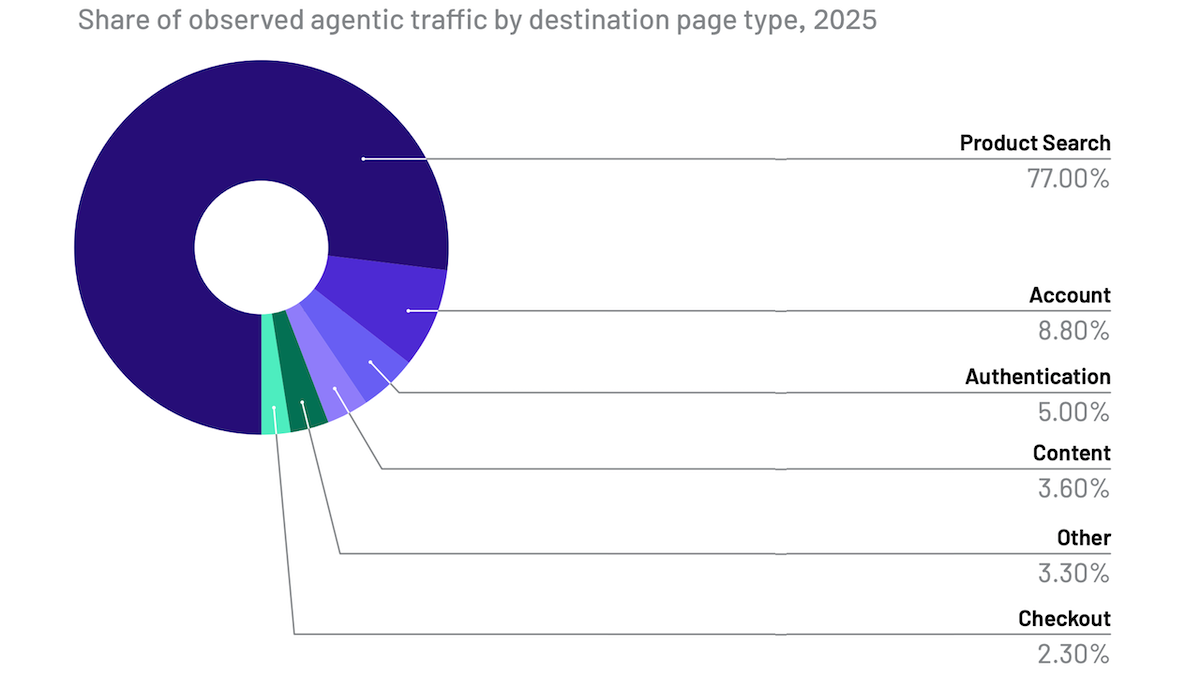
What happened: AI-driven traffic, or internet interactions that were generated by or on behalf of AI systems, nearly tripled in 2025, according to a report by the cybersecurity firm Human Security. The volume of activity by crawlers that collected data en masse to train AI systems and bots that scraped data points such as prices for immediate use multiplied by single digits. Traffic by AI agents and agentic browsers ballooned (although it remained a tiny percentage of the total). More than 95 percent of AI-driven traffic involved activities the authors designated retailing and ecommerce, streaming and media, or travel and hospitality.
How it works: The 2026 State of AI Traffic and Cyberthreat Benchmark Report is based on an analysis of over 1 quadrillion internet interactions observed in 2025 by Human Security, which serves around 1,200 customers in more than 200 countries and territories.
Security implications: The researchers deemed a significant amount of the automated traffic malicious.
Yes, but: The report analyzes only activity on Human Security’s platform, not the internet as a whole. Moreover, malicious traffic often misrepresents its origin, so the researchers’ evaluation of any given data point may be mistaken.
Why it matters: Autonomous systems are flooding the internet with a rising tide of additional traffic, and its likely this trend will continue in the foreseeable future. Infrastructure must be built or upgraded with this in mind. The rise in automated activity also poses challenges for cybersecurity because legitimate AI agents perform many of the same activities — browsing products, creating accounts, and checking out of transactions — that previously signaled malicious bots.
We’re thinking: Agentic traffic on the internet is just getting started. The 80x rise last year is bound to multiply further in coming years as agents become more capable, robust, and trustworthy.
Planning Generated Images In Stages
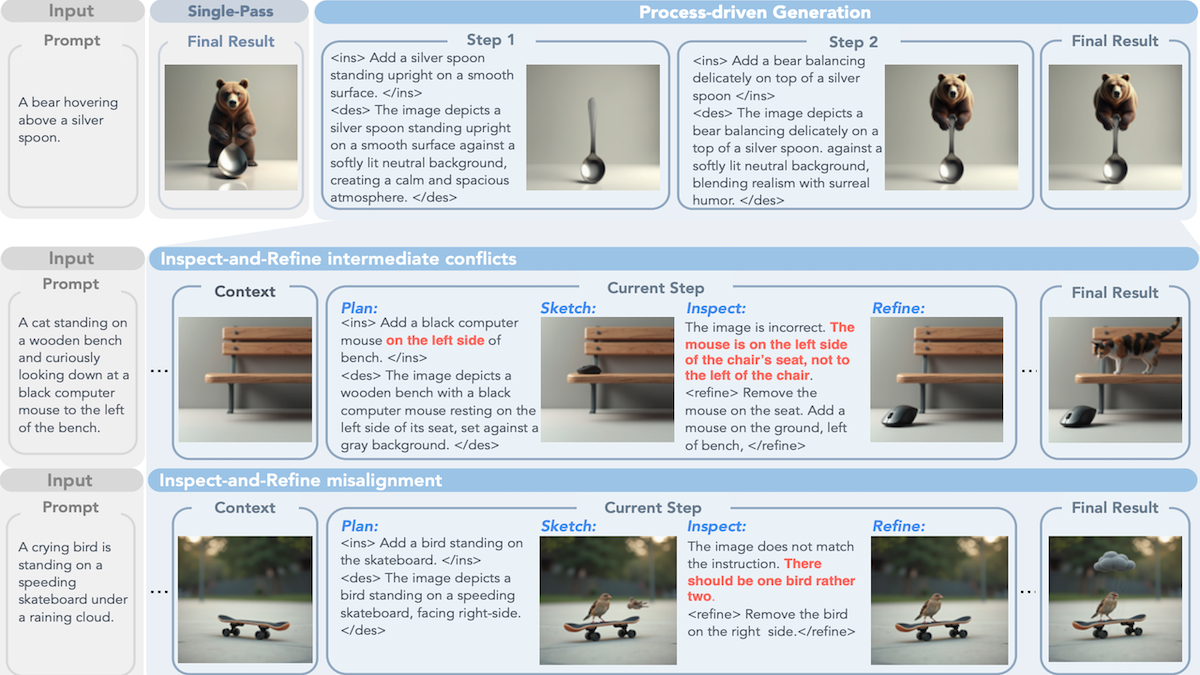
Text-to-image generators that use diffusion or flow-matching typically compose a whole image at once (although they refine the whole image in steps). Researchers got better results by breaking image composition into discrete stages, then checking and revising interim results.
What’s new: Lei Zhang and colleagues at Meta, University of California San Diego, Worcester Polytechnic Institute, and Northwestern University proposed a fine-tuning method for image generators that trains a model to compose images by planning, generating an element, checking whether it matches the prompt, correcting if necessary, generating another element, and so on.
Key insight: Text-to-image models often fail to represent spatial relationships (such as whether one element is above, below, in front of, or behind another) and object attributes (such as numbers of fingers, arms, or legs). The generation process becomes easier to control when the model learns to complete the image by looping through a staged process. Given a prompt like “a bear hovering above a silver spoon”, the stages can be:
Training on data that represents this process can teach the model not only to generate an image based on a prompt but also to build up the image composition and correct it.
How it works: The authors started with BAGEL-7B, a pretrained multimodal model that takes images and text (say, two images and an instruction to combine them) and produces images and text (say, the combined image and a description of how the input image was changed). They fine-tuned it to generate images by cycling through stages to plan, sketch, inspect, and refine the composition.
Results: The authors’ fine-tuning method improved BAGEL-7B on tasks that require generating images in which object relationships match a text prompt (for example, placing a bear on a spoon instead of behind a spoon). It also improved BAGEL-7B’s ability to generate images based on real-world knowledge, such as scenes of a particular time of day or historical era.
Why it matters: Image generators frequently produce good-looking images, but their output is often at odds with the prompt. For instance, objects may be out of place and have the wrong attributes. This work offers a way to make such systems more dependable beyond simply scaling training data.
We’re thinking: An image generator that composes images in stages is analogous to an LLM that reasons over its input step by step. Both approaches direct the model to break down requests into pieces, and both improve the output.
Work With Andrew Ng
Join the teams that are bringing AI to the world! Check out job openings at DeepLearning.AI, AI Fund, and Landing AI.
Subscribe and view previous issues here.
Thoughts, suggestions, feedback? Please send to thebatch@deeplearning.ai. Avoid our newsletter ending up in your spam folder by adding our email address to your contacts list.
|
-3.png?width=1200&upscale=true&name=The%20Batch%20top%20banners%20(1)-3.png)