| | Welcome, humans. | AI is getting better at math. | But Tudor Achim says the bigger shift is that AI may finally be able to prove what it says. | Tudor is the co-founder and CEO of Harmonic, the company behind Aristotle, a formal reasoning system built to generate mathematical proofs that computers can actually verify. | That sounds abstract. But it could matter a lot. | Because if AI can move from “trust me, this is right” to “check me, this is right,” it could reshape math, software, chip design, scientific computing, and maybe even how humans discover new knowledge. | 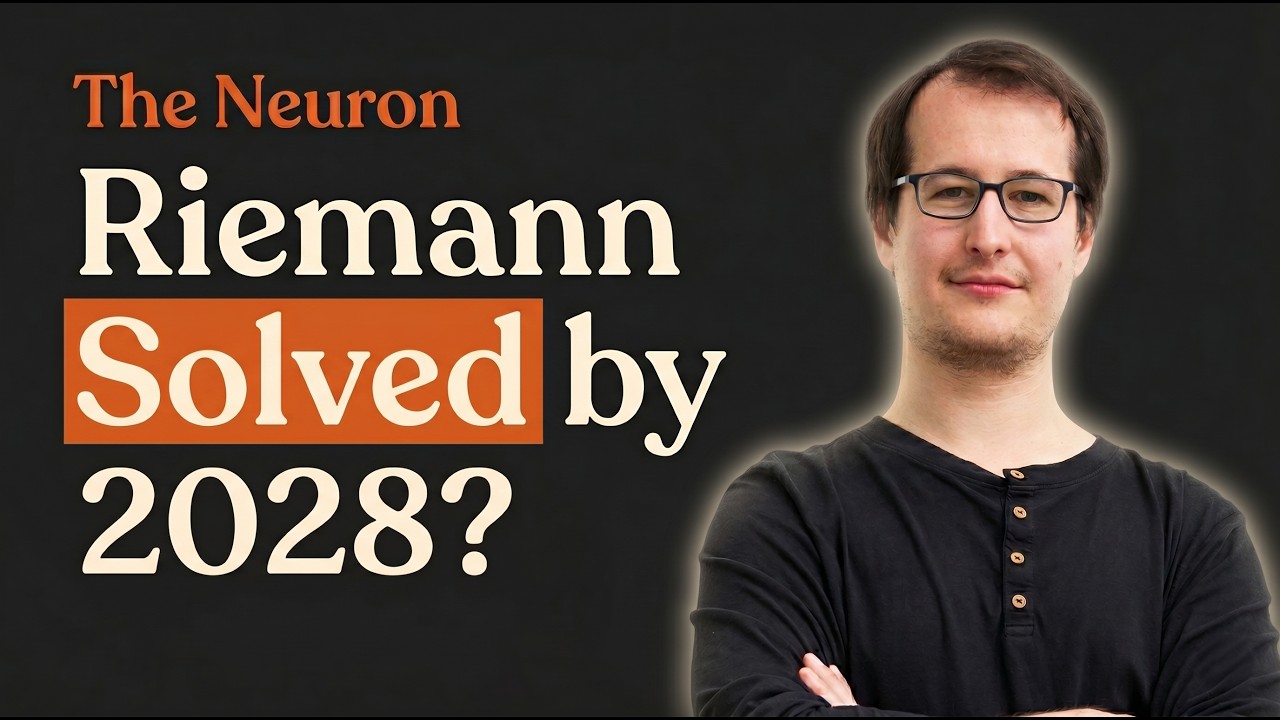 | The AI Trying to Solve Math’s Biggest Mystery w/ Tudor Achim of Aristotle |
|
| | |
| Plenty of companies can launch an AI pilot. Far fewer know how to make it stick. Explore this resource hub, sponsored by Dell AI Factory with NVIDIA, for strategies, decisions, and real-world lessons on turning AI into something scalable, useful, and worth the investment. | | | In our latest episode, Corey and Grant sit down with Tudor Achim to unpack what “mathematical superintelligence” actually means: | 00:00 AI That Proves Its Work 02:00 What Mathematical Superintelligence Means 03:22 A Clearer Bar Than AGI 04:01 Are Today’s AI Systems Actually Creative? 05:42 Math Is Not Just Arithmetic 08:58 How AI Amplifies Mathematicians 10:02 Why Verification Makes AI Useful 11:45 Lean, Explained Simply 12:15 What a Machine-Checked Proof Means 12:42 Could AI Prove Riemann by 2028? 15:24 Why Harmonic Opened Aristotle to Users 17:33 Formal Math Becomes Practical 21:01 Human Proofs vs. Machine-Verified Proofs 23:11 GitHub for Mathematicians 24:44 Compute, Limits, and Infinite Math 27:29 The Moment That Changed Tudor’s View 29:10 Trust Layers Beyond Math 31:20 Tudor’s Aristotle “Aha” Moment 33:49 Should AI Change Education? 37:07 The Spec Problem in Verified Software 39:10 How Aristotle Could Help Chip Design 42:25 Will We Ever Run Out of Math Problems? 46:03 The Problem Tudor Wants Solved
| Bottom line: The future may not be AI replacing mathematicians. It may be mathematicians directing much more powerful tools, and finally being able to verify the results. | Listen now on YouTube | Spotify | Apple Podcasts | Dive deeper with these resources: | | | We have a goal to hit 50K subscribers by the end of the year (if not 100K), and we’re only ~30K away! If you like learning about AI, and already watch some of our videos, do us a favor and click here to subscribe today. | Stay curious, | The Neuron Team
Corey & Grant | | FROM OUR PARTNER | Are you hitting the limits of siloed AI? Just as humans once transformed society by sharing intent, knowledge, and innovation, AI faces a similar inflection point. To achieve distributed superintelligence, we must move beyond scaling up. We need to scale out, too.
Outshift by Cisco is building the Internet of Cognition: an open infrastructure enabling agents and humans to collaborate in real time. | Visit Outshift.com | | 🎙️ In Case You Missed It… | Four recent interviews you’ll definitely want to check out (pick whatever looks interesting to you and dive in!): | | | TL;DW: Rebecca Paul, Head of Medicinal Drug Design at Isomorphic Labs, and Michael Schaarschmidt, Foundational AI Research Lead, explain why drug discovery is still brutally slow, expensive, and failure-prone and how foundation models could help scientists design better drug candidates faster. Their big point: “AI-designed drugs” are not one magic model. It takes many models working together across biology, chemistry, structure prediction, molecule generation, and human judgment. | Why you should watch: If you’ve ever wondered what comes after AlphaFold, this one gets into it. There’s a great section on how something that once could take an entire PhD to validate experimentally can now sometimes be predicted in seconds or minutes, and a wild bit about the dream of getting from a protein target to a drug candidate in one design cycle. Also: “undruggable” proteins may not stay undruggable forever. | | | | TL;DW: Peter Wilczynski, CPO at Vantor (formerly Maxar), built a 3D model of the entire Earth at 50cm resolution and made it machine-readable. He argues spatial intelligence is the gap nobody's talking about in AI, and probably the missing piece before agents can actually operate in the physical world. | Why you should watch: If you've ever wondered why AI can write code and solve math olympiad problems but still can't reliably tell a drone where to go, this one answers it. Also, there's a wild bit about how the physical world becomes the new navigation layer for AI agents. | | | | TL;DW: Corey sits down with Kendall Rankin, who left LinkedIn in 2024 to join Producer AI when it was a startup (advised by The Chainsmokers, no less). Google acquired the team in February 2026, and Kendall is now on the Flow Music team inside Google Labs. On the episode, they generate a garage rock song from a single sentence, build a custom synth in the "Spaces" feature, and walk through SynthID watermarking and one-shot music videos. | Why you should watch: Most AI music demos hand you a polished finished song and skip the part where things go sideways. This episode is the part where things go sideways. First pass fumbles, Corey asks for "more fuzz," second pass actually lands. That iteration loop is the whole story for anyone trying to figure out if these tools are actually usable. | | Last thing: And if you haven’t subscribed yet, please do! Click the image below to go to our channel and hit “subscribe” to get notified right when new videos go live. | | | | That’s all for today, for more AI treats, check out our website. | ICYMI: check out our most recent episodes below! | |
|
| |
|