|
 |
👋 Hi, this is Gergely with a subscriber-only issue of the Pragmatic Engineer Newsletter. In every issue, I cover challenges at Big Tech and startups through the lens of engineering managers and senior engineers.
The Pulse: Is Amazon’s writing culture collapsing because of AI?
Also: Anthropic goes public with the largest-ever IPO, Meta frantically reverses shutdown of popular AI coding harness Conductor, and more
|

| |||||||||||||||


The Pulse is a series covering events, insights, and trends within Big Tech and startups.
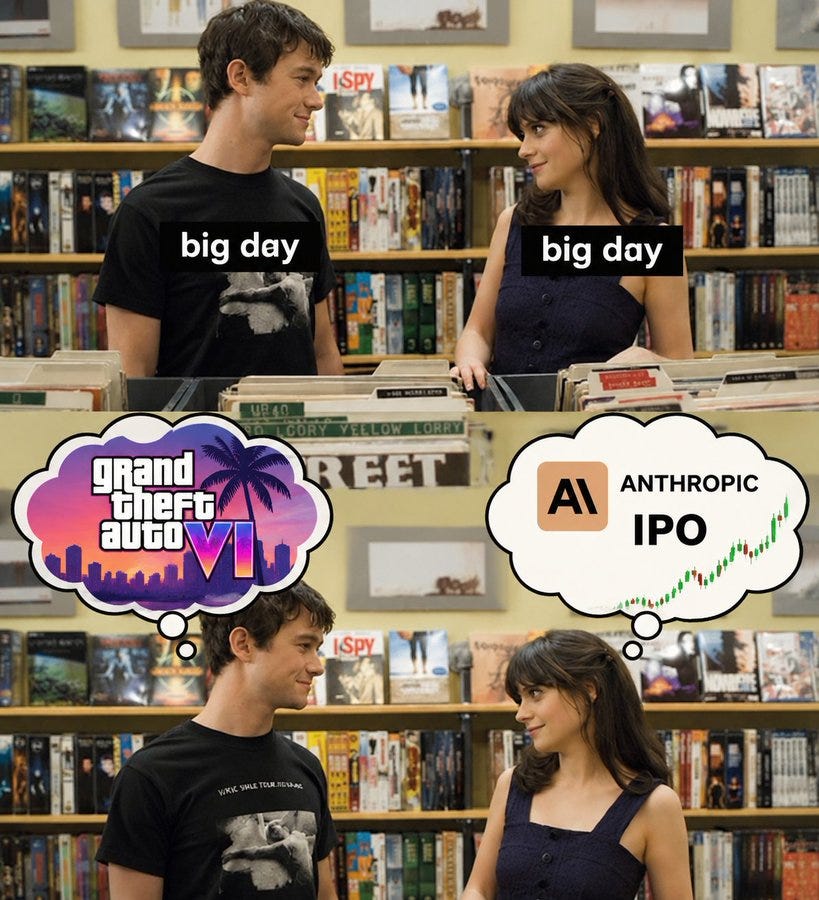
Today’s a busy day: Anthropic has gone public in the largest-ever IPO, and the GTA VI video game is out.
 |
I’ll make things a bit more concise than usual:
Anthropic: the largest-ever IPO. The leading AI frontier lab raised $107B with its IPO, and around 600 early employees could see gains of $100M or more. It’s absolutely incredible for a startup that is only five-and-a-half years old.
Is Amazon’s writing culture collapsing because of AI? A former Amazon software engineer sees signs that written artifacts – the ‘six-pager’ documents the company uses to promote good decision making – are increasingly AI-generated and AI-read, and warns it’s not a positive development.
Meta struggles to understand devs & reverses Conductor shutdown. Meta shuttered the AI coding harness Conductor after acquiring it, but is now reversing its decision – possibly after learning that a rival harness, T3 Code, is getting four times the usage of the latest Gemini model. Oops!
Is AI making us pay off decades of tech debt? The industry is currently on a speedrun of vulnerabilities being uncovered and patched or exploited. One way of looking at it could be that we’re on a speedrun to pay off decades of tech debt.
1. Anthropic: the largest-ever IPO
Only five and a half years after being founded, Anthropic has listed on the Nasdaq Stock Exchange:
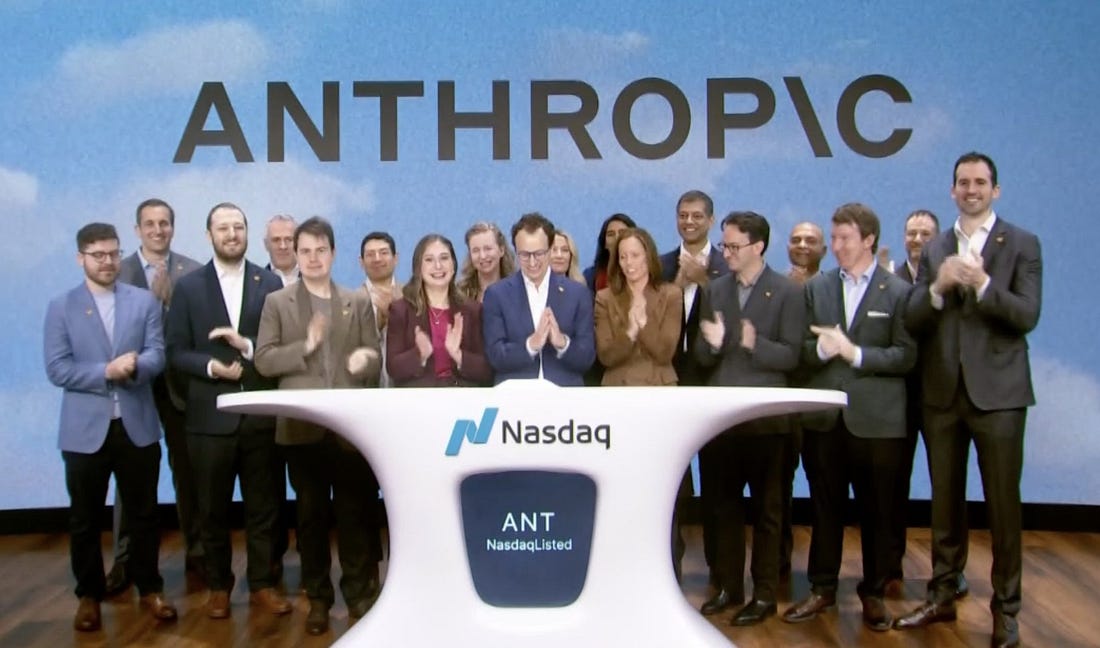 |
The company raised an incredible $107B through its public offering, meaning it is the largest-ever IPO. The previous record was set by SpaceX, which raised $86B on its public offering, back in June.
On today’s stock market open, the company was valued at an incredible $1.3 trillion, making it the 12th most valuable publicly traded company in the world. That’s a higher market cap than Samsung ($967B), AMD ($880B), and is close enough to Tesla ($1.5T), and Meta ($1.5T). It’s especially impressive as Anthropic employs “only” 5,300 people – the other companies mentioned employ 15-50x more!
Early Anthropic employees are expected to earn truly life-changing fortunes, as their shares in the AI giant vest. On average, each employee holds $44M in stock options. However, this is misleading because equity is heavily concentrated among early shareholders.
Estimates say around 600 early Anthropic employees will make more than $100M from the IPO(!!), with circa 2,500 current and former staff estimated to earn more than $10M(!). So, that’s nearly half of the staff who get an extremely high payout. Of course, the others are also expected to see large returns: Senior Software Engineer packages are around $600-700K in total compensation annually, while Staff Software Engineer ones are in the region of $1.4M per year in the US, as per Levels.fyi.
Beating OpenAI to a market listing, with more revenue than OpenAI generates, and setting the bar for the biggest-ever IPO must, on some level, be satisfying for the seven Anthropic cofounders. Remember, Anthropic started after they quit OpenAI, where they worked at the time, following a fallout with OpenAI’s leadership on how AI should be built, back in December 2020. They quickly went on to found Anthropic on 26 January 2021. And the rest is history, as they say!
Congratulations to everyone at Anthropic; this IPO is a reminder of why VC investors take big, risky bets which might seem pointless or even reckless to the general public at times.
2. Is Amazon’s writing culture collapsing because of AI?
A special thing about Amazon’s engineering culture has long been its writing culture, as covered in the deepdive, ‘Inside Amazon’s engineering culture:’
“There are three approaches I would call out as ones worth understanding and experimenting with at tech companies of any size:
A writing culture. This single approach has made a massive difference at Amazon, and with remote work spreading, taking this note from Amazon’s playbook is a smart thing to do.
Operational excellence. Amazon knows how not just to build, but to operate large systems, reliably. They have an open playbook that is there to copy for anyone else wanting to improve operations.
Platforms and autonomy. In 2002, Jeff Bezos mandated that all teams offer their services to other teams via APIs. This platform-like approach shaped how the company grew. The approach gives teams full autonomy on how they work internally, as long as they operate reliably.”
The writing culture helped create a “thinking culture” at the company, and I believe this has led to more thoughtful decisions at every level over the years. But this is now under threat from AI, which apparently is undermining faith in the “six-pager” documents which help formulate decision-making at the online retail giant. This trend has even spawned its own derisive abbreviation internally: “AI;DR” (AI; Didn’t Read).
According to a former insider, AI is being used to generate these documents and this is eroding the company’s “thinking culture.” Steve Huynh was a Principal Engineer at Amazon, spending 18 years there in total. Recently, he published the article, ‘On the death of Amazon’s writing culture’:
“Two years before I started, Jeff Bezos had banned the use of PowerPoint in meetings with his senior team. His reasoning was that the nature of PowerPoint presentations made it easy for their recipients to miss important ideas and information. It may have been easier for a presenter to create slides, but the greater value for an audience came from a well-written document.
So meetings at Amazon were unconventional to outsiders. In a one-hour meeting, the first thirty minutes were “study hall.” If you were presenting, you brought printouts of your six-pager, and everyone read it in silence. The only sounds came from people writing notes in the margins with their red pens. Thus, when the discussion started, everybody began from the same place.
Such a meeting simply could not take place until your ideas had been written down coherently enough to survive thirty minutes of scrutiny.”
But now, Steve claims that people are producing the six-pager documents with AI (emphasis mine:)
“Amazon’s writing culture survived the pandemic. The printouts may have moved online, and study hall may have transformed into a shared doc with comments down the margin, but that was fine. People still wrote the documents, and people still read them.
But it did not survive the advent of AI.
From what I hear, the moment a model could produce something that passed as a human-written six-pager, they stopped being written by humans. A senior engineer in my community told me that he has started tagging documents as “AI;DR.” (AI; didn’t read). In his view, “If a model wrote it, a model can summarize it.” He had better things to do with his time.”
He identifies three problems with this approach:
Sloppy decision-making. The writing culture weeded out weak ideas because the writing process itself exposed flaws to the author, which prevented bad ideas from being presented for serious consideration. In contrast, give a bad idea to AI, and it will produce a plausible-looking six-pager on why it’s an unexpectedly brilliant idea.
Loss of trust among colleagues. It used to be that a six-pager meant someone invested time and effort, and therefore it deserved a hearing. But no longer!
Outsourced thinking. Engineers use AI to generate a six-pager, or to scan it. This will surely lead to less critical thinking by folks, as more is outsourced to AI.
The question is how much this will matter to Amazon as a business today? It is now a mature company, with dominant positions in different sectors such as e-commerce and cloud computing.
When Jeff Bezos headed up Amazon, one of its main values was the “Day 1 culture”, as it summarized:
“In every Annual Report, Jeff Bezos attaches a copy of his original 1997 Letter to Shareholders. In that 1997 letter, Bezos outlines the fundamental measures of Amazon’s potential success—relentlessly focusing on customers, creating long-term value over short-term corporate profit, and making many bold bets. “This is Day 1 for the Internet,” Bezos wrote, “and, if we execute well, for Amazon.com.”
“Day 1 Culture” means thinking and operating like a nimble, hungry startup. But I believe Day 1 Culture ended when Bezos left the company to focus on what he saw as newer, more exciting projects like the space company, Blue Origin. Amazon has continued to succeed without him; if anything, there’s now a “Day 2 culture”, where slow, steady progress is more important than big bets or messing up existing things.
In this context, is the presence of less critical thought likely to make such a big difference? With the founder who championed critical thinking via the six-pagers long gone, the six-pagers remain mandatory, but I suspect it makes no major difference to people’s day-to-day work if AI is involved in producing them.
3. Meta struggles to understand devs & reverses Conductor shutdown
Until very recently, Conductor was a popular AI dev tool for running and managing agents when you have both Claude and Codex subscriptions. It raised $22 million of funding in March, and – as covered – was acquired by Meta two weeks ago, which announced it was shutting down Conductor, effective immediately. Given it’s in a fast-growing segment, the decision looked weird, but I assumed Meta had information that meant it was not worth keeping the growing dev tool going.
Most users of Conductor had no choice but to migrate to T3 Code, the other popular choice, and as a result, T3 Code is seeing record usage of circa 31 trillion tokens a day! Here’s T3 Code CEO Theo Browne sharing recent stats:
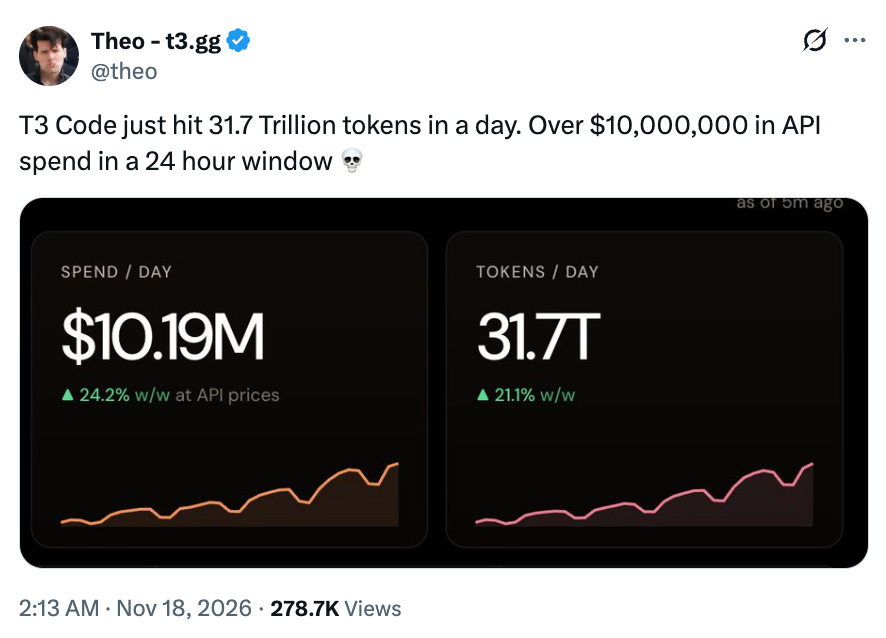 |
This means T3 Code is processing four times as many tokens as Gemini’s latest model! That’s based on a post by a Google employee four weeks ago, which stated Gemini 4 Argon processed 25 trillion tokens in 72 hours – around 8 trillion per day. That an independent dev tool would process so many more tokens than this is amusing, to say the least!
Perhaps Meta realized the strategic error in shuttering Conductor after seeing this post about T3 Code’s token run rate, as it has now reversed the decision:
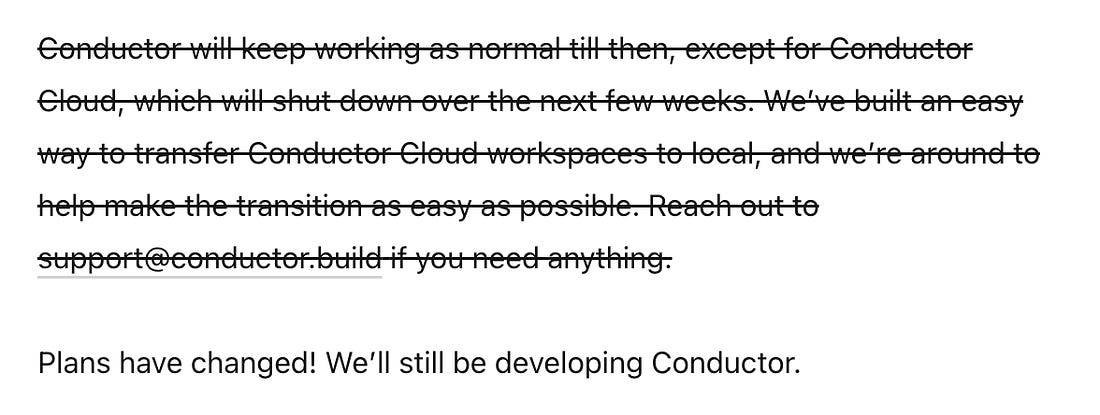 |
So, is Conductor going to shut down or not? Meta cannot seem to decide. It’s still operating for now – or at least until the next shutdown announcement! This episode reminds me of how bad Meta is at building and operating dev tools, in how it seemed completely unaware that it had acquired a platform beloved by devs.
The same happened in 2013, when Facebook acquired Parse, which at the time was the most popular backend platform for mobile apps. The social media giant ceased investment and closed it in 2017.
It’s interesting that a startup like T3 Code with tiny funding competes in the cutthroat dev tooling space. T3 Code is a pivot from Theo Browne’s Y Combinator startup, Ping Labs. To the best of my knowledge, Ping raised a total of $500K in funding from Y Combinator in 2021… and that’s it! Theo said that he is funding the $20K+ infra costs himself, and despite these modest financial resources, T3 Code is seeing far more success and stickiness than rival dev tools startups which raised several times more.
Of course, Theo himself is an active tech content creator on YouTube and social media, which is useful for T3 Code. His videos about AI models are trustworthy and widely shared because they’re based on his real-world development experience of building and improving T3 Code! So, an obvious next question is what comes next for the company, and how long it will go on without raising significant funding.
4. Is AI making us pay off decades of tech debt?
An interesting article from IEEE Spectrum, who writing about the PHP2Shell vulnerability:
“One of the things we’re witnessing now is that all the legacy software that was written by humans over the last 40 years is being exposed,” says Matt Suiche, AI security research lead at the cybersecurity startup Tolmo. “Now it is time for the technical debt to be paid off.”
The bug underlying the PHP2Shell vulnerability was reported to the PHP Foundation as far back as 2024. The bug caused a common type of issue called an out-of-memory error, in which the amount of memory allocated to a piece of data is too small to hold the data. Normally, this type of error causes the program to crash—an unpleasant but not inherently dangerous result. And so the bug remained unaddressed.”
Personally, the “40 years” figure seems like a bit of a stretch, as most software we use wasn’t written as early as 1986.
But it’s no overstatement to say the last ~10 years of tech debt is waiting to be fixed. A good example is another recent, serious vulnerability: the Brotli remote execution CVE. Brotli is a compression library used by Node.js, Bun, Envoy, and others. The flaw allowed an attacker to take over a service. Klaas van Schelven, developer at Bugsink, reconstructed the bug’s timeline:
“The bug itself sat in the repository for eight years and one day before the fix was committed.”
The fix had been ready months before the vulnerability was exposed, according to Klaas:
“The fix sat in the upstream Brotli repo for eight months, and both Chromium and Firefox had already rolled it in, with at least one of them (Firefox) having treated this as a high-severity security issue. First privately, but later publicly, including a detailed exploit chain, for months before Node published its fix. Whether Firefox actually notified Google is as yet unknown, though the public record does show that they considered it.”
We’re currently on a speedrun of vulnerabilities being discovered, patched, and – sometimes – exploited. Existing security issues in software running in production servers, OSes, browsers, etc, are being discovered much faster with AI agents. Anthropic’s CEO Dario Amodei warned of precisely this scenario in May, including that open models would soon achieve the same capability as Anthropic’s Mythos had back then at finding and exploiting security vulnerabilities.
It’s good news that most security issues seem to be found by “good guys” like security researchers and AI labs which disclose these to software vendors. The bad news is that the broader tech industry needs to up the cadence of applying security patches. It’s fast becoming unacceptable to wait weeks or months for version updates with critical security fixes.
This post is only for paying subscribers of The Pragmatic Engineer. This email is intended for a single recipient, but occasional forwarding is totally fine.
As a subscriber, you also have access to 🔒 subscriber-only resources for engineering managers and engineers.
Know someone who would benefit from the newsletter? Consider gifting a subscription.
| ||||||||||