
|
 |



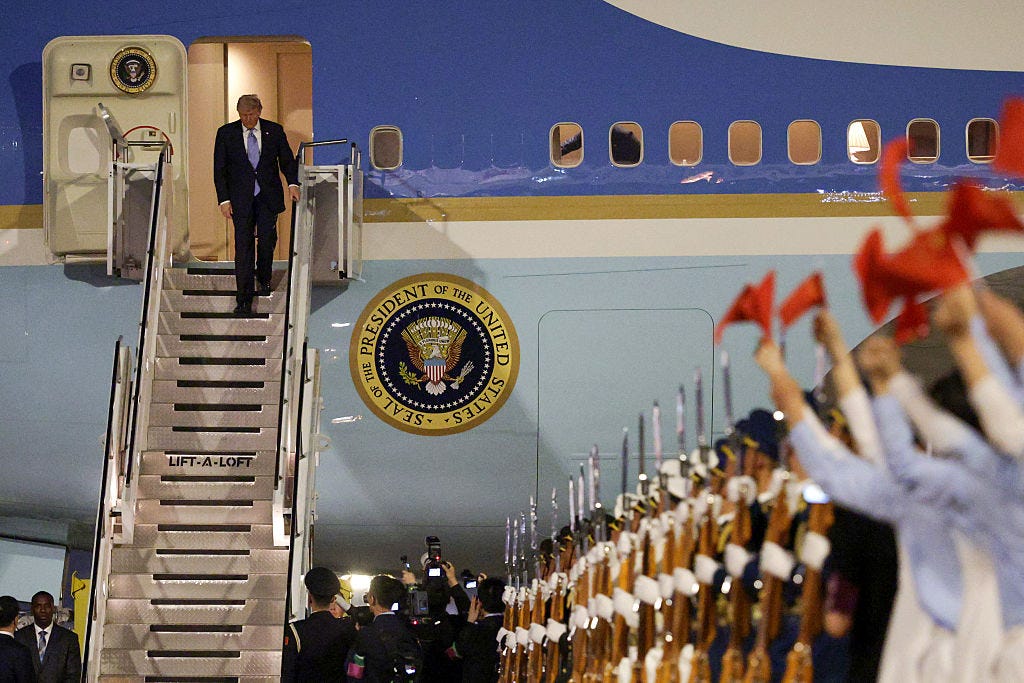 |
Donald Trump arriving today in Beijing. (Alex Wong/Getty Images)
Here are five quick points about Donald Trump’s quick visit to China, with meetings scheduled to start in a few hours as I type.
By the end of this week, we may have a clearer sense of how much—or how little—came out of this toe-tap foreign excursion. My bet is on “how little”: Recall how little came out of the humiliating “Putin Summit” in Alaska last summer. But we’ll see. Meanwhile here is a quick, non-comprehensive guide to some issues I’ll be keeping in mind.
1) China has worse problems in the long run. But right now, it’s watching the US burn itself down.
After the 2008 economic crisis, while Deb and I were living in Beijing, I interviewed a Communist Party official about the US-China economic tensions of the day. “You Americans feel so sorry for yourselves,” he said, as I remember it. “We’d trade your problems for ours, any day.”
And he went on to detail why. Hundreds of millions of Chinese people were poor (and still are). Around its borders, the US had partners or allies—and across the seas, it had a network of allies. Around its own borders, China had enemies or troublesome neighbors. US universities and companies attracted talent from around the world. Much of China’s young talent was drawn to those same American schools and companies. And so on.
Everything I wrote from China in that era¹ reflected what I still believe: That in the long run, the US has advantages over every other economy and world power. And in the long run, China has deep challenges on every front—demographic, environmental, military, political.
But the long run comes later. Right now the Chinese leadership is watching the MAGA team destroy almost everything that gave the US its long-term edge: Its universities. Its openness to international talent. Its network of foreign alliances. Its place as a self-interested but sane center of world commerce. Its limits on corruption. Its imperfect but aspirational commitment to rule of law.
My guess is that Chinese leaders would prefer a less randomly self-destructive US than the one they confront now. After all, stability of the US-centric world trading order has given China room to develop over the past 40 years. Its leaders understood how to deal with the “Madman Strategy” under Richard Nixon. It’s harder to deal with an actual mad man.
But right now, the sanest thing they can do is stand aside, as MAGA demonstrates what many Chinese officials told me when we lived there: That the only threat to American strength and dominance would come from America itself.
At the moment, Xi Jinping “has the cards,” to use Trump’s favorite phrasing. I’ll be watching to see how Xi plays them.
2) The Chinese know who they are dealing with.
Watching or listening to Donald Trump, especially in these past few months, you often wonder: Does he know that other people can see this?
-When he sends berserk-seeming posts and self-glorifying AI images all through the night? When he goes out of his way to insult female reporters in the press pool, especially reporters who are Black? When he repeatedly calls Black leaders, from Barack Obama on down, “low IQ” and “very stupid”? When he invents grotesque fantasies of fact—that gas prices are falling, that he has “aced” dementia-screening exams? When he lights up at hours-long public groveling by his minions, nationally televised as “cabinet meetings”? When he can’t stop talking about the stupid ballroom?
Leaders in China have seen all of this. They know the kind of person Trump is, and all the buttons he likes to have pushed.
He likes big public festivals featuring him, “on a scale which nobody has ever seen before”? No problem! Big spectacles are where Beijing excels.² We’ll never forget watching the mass precision of the 2008 Olympic opening ceremonies. Trump likes to think that his powerful deal-making presence can make others bend to his will? No problem! Smile, and flatter him—like all the CEOs aboard his plane—and then quietly walk away, having pocketed the winnings.
If you’ve lived in other countries and wrestled with other languages, you know that when a local says, “Oh, your [Japanese/ Chinese/ French] is so good!” it’s actually hollow praise. The Chinese will tell Trump what a great leader and shrewd negotiator he is. Of course he will believe them. And then he’ll be putty in their hands.
3) Donald Trump has no idea what he is walking into.
This is true by definition: He doesn’t know about anything except ballrooms and golf courses. Donald Trump didn’t know that the US already holds rights to all the military bases it could ever want in Greenland, without threatening to invade. He didn’t think or care how a Prime Minister of Japan would feel about a live-televised Oval Office “joke” about Pearl Harbor. He didn’t recognize that Britain’s current king was mocking him as acidly in his recent speech to Congress, as Barack Obama had done at the famed 2011 White House Correspondents dinner.
When it comes to China in specific, the MAGA team is notably short on prominent figures with on-scene experience. They’re squeezing in this rushed “summit” between trips to Mar-a-Lago and managing the disaster in Iran. Based on his own statements over the years, Trump himself knows two things about China:
-That it is bad.
-That Xi Jinping likes him personally, and therefore is good.
Too harsh? Remember what Trump credulously told the New York Times, after his friend Xi Jinping had given him a big ceremonial welcome in 2017:
I like very much President Xi. He treated me better than anybody’s ever been treated in the history of China.
Right.
4) Something we want to hear about: Jimmy Lai.
Jimmy Lai, now age 78, spent decades as a prominent Hong Kong publisher and journalist. Since 2020, he has been imprisoned, for what the Chinese government claims to be sedition and national-security threats, but what the rest of the world sees as repression of political dissent. This is all the more egregious—in the rest of the world’s view—because of the terms of the “One Country, Two Systems” agreement that returned Hong Kong to PRC control in 1997. According to that agreement, the PRC government was supposed to guarantee previous press-and-free-speech privileges in Hong Kong for 50 years, until 2047.
Jimmy Lai is only one of a large number of political prisoners in China. But his case is prominent and symbolic. On top of that, he’s a citizen of the UK. Any supposed Leader of the Free World should speak up on his behalf.
How Trump addresses Jimmy Lai’s case, or overlooks it, will be another sign of his interest in or commitment to a free press.
-Say nothing about Jimmy Lai? Not worth his time.
-Say something formulaic? Just going through the motions.
-Say something with force, and make it part of a deal? Watch this space, and whether he follows up. I hope to be surprised.
5) Something we don’t want to hear about: Taiwan.
The clearest sign of disaster from this meeting would be if Donald Trump announces any new “deal” on Taiwan. Much as with Iran, he has no idea of the damage he could carelessly do.
For more than 50 years, military stability in all of Asia has depended on the carefully crafted ambiguity of US and PRC policies toward Taiwan:
—On the PRC side, any political leader must commit to the goal of “unifying” China. That’s the basic price of admission as a Chinese public figure. And after all, Chinese leaders point out, the US agreed to a “One China” principle, during Richard Nixon’s famous accord with Zhou Enlai and Mao.
—On the US side, all presidents since Nixon have consistently said: “Yes, there’s only One China. But the two Chinas must never be put together by force.” And since Richard Nixon, every president has intentionally left ambiguous what, exactly, the US would do if the mainland tried to invade Taiwan.
There are a million more complexities. But in practical terms, the US goal—shared by Japan and Korea and most other countries in the region—has been for leaders like Xi Jinping to think: “Yes, some day we must take over Taiwan. But not today.”
“But not today”: It’s a logically clumsy, but in-practice effective, form of deterrence that has held for more than 50 years. Can you imagine that a jet-lagged and battered Donald Trump—so susceptible to flattery, dealing with crises on so many fronts, facing Xi Jinping on his home turf—might strike a “deal” on Taiwan that would make the region safer?
I cannot.
-Look what he did to the JCPOA, which had kept Iran in check.
-Look what he has done to the formerly open Strait of Hormuz.
-Look what he is doing to NATO.
So I’ll hope that the news we’re about to hear from Beijing does not include a “deal” on Taiwan. No news will be good news on this topic.
I’ll check back in when we’ve heard what happens.

This included my books Postcards from Tomorrow Square and China Airborne.
The NYT has a very nice illustrated feature just now, by Lily Kuo, Pei-Lin Wu, and Pablo Robles, showing the fine gradations in “respect” China shows to foreign dignitaries, based on who goes out to the Beijing airport to meet them.
| ||||||||||

