

Hello, and happy Sunday! Was this newsletter forwarded to you? Sign up to get it in your inbox.
When the Every staff convened after the holiday break, the biggest topic of conversation was personal projects. It wasn’t just our team that was tinkering around; on X, there was an explosion of people who used the downtime to take their first steps with Claude Code and other AI tools, build projects they’d always dreamed of realizing, and even convert a few parents and grandparents in the process. Given that AI tools are often still tightly limited in corporate settings, these personal wins are a key way that this tech spreads and people become advocates in the workplace. As Monologue general manager Naveen Naidu wrote in a personal essay reflecting on his 2025 odyssey: Your side project could become your whole new direction. Here are a couple of our favorite holiday builds:
A home base for record collectors
“I made DIG—short for ‘Discover In Grooves’—after taking Every’s Claude Code for Beginners course. I had zero coding experience, but I started building anyway. I’m a vinyl record collector, and I’ve always been frustrated by how fragmented the experience is—new releases scattered across subreddits, blogs, Instagram, disconnected tools. DIG is my attempt to fix that: one hub for discovery, tracking, collecting, and a social layer, with Claude-powered features that don’t exist yet.
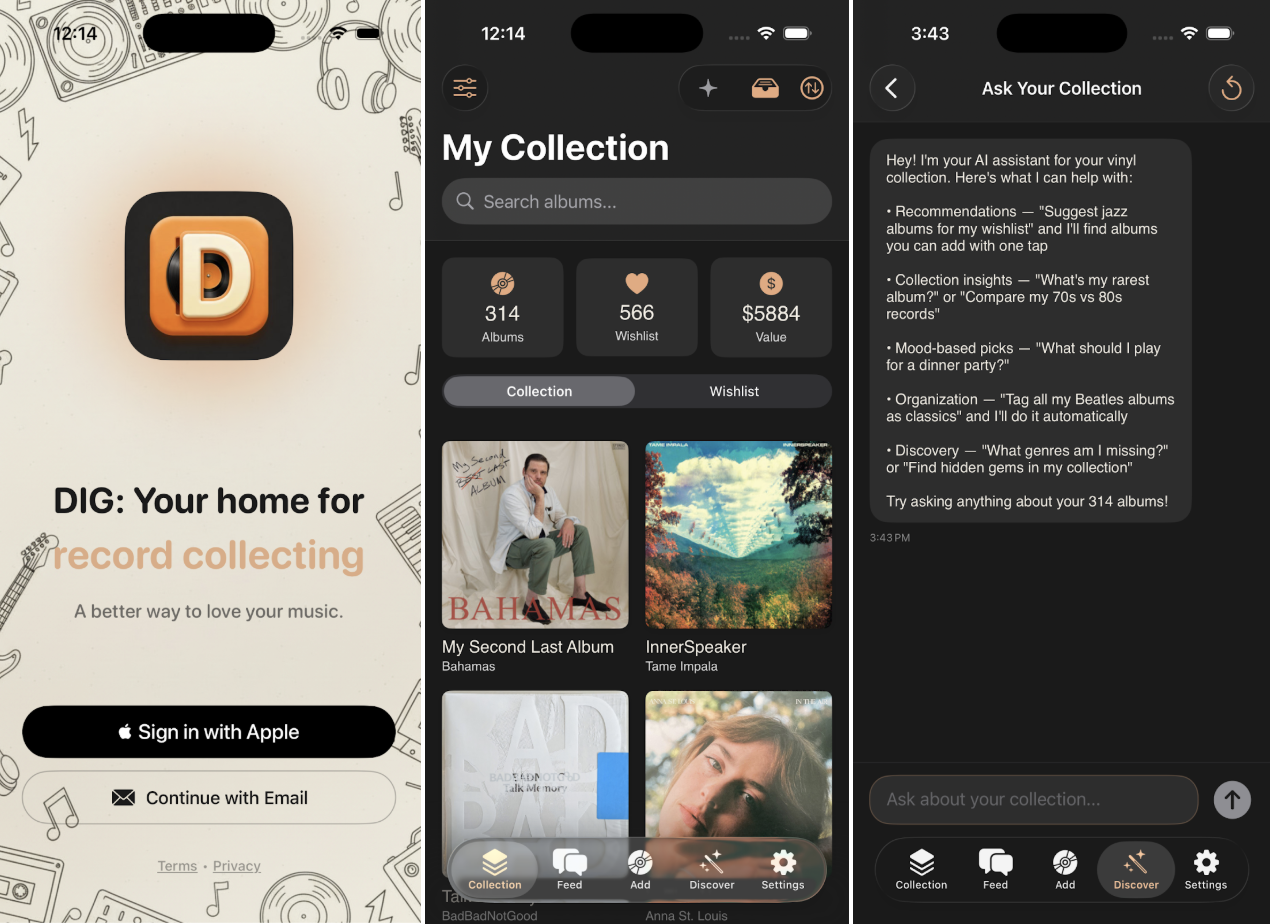
I learned by doing—getting my hands dirty in Claude Code, deploying to Vercel, wiring up Spotify and Discogs APIs. A year ago, I never would’ve thought I could do any of that. The hardest part has been knowing when to stop. With vibe coding, there’s always something new to add. At some point, you have to ship.
The real limitation is imagination. You can build almost anything if you’re willing to experiment. My advice: Just start. That, and set up GitHub properly from day one—I accidentally deleted my entire app early on because I didn’t realize Claude Code sessions are ephemeral. If you’re interested .n DIG, sign up for the waitlist or follow its progress on X.”—Anthony Scarpulla, social media manager
A health assistant that takes requests
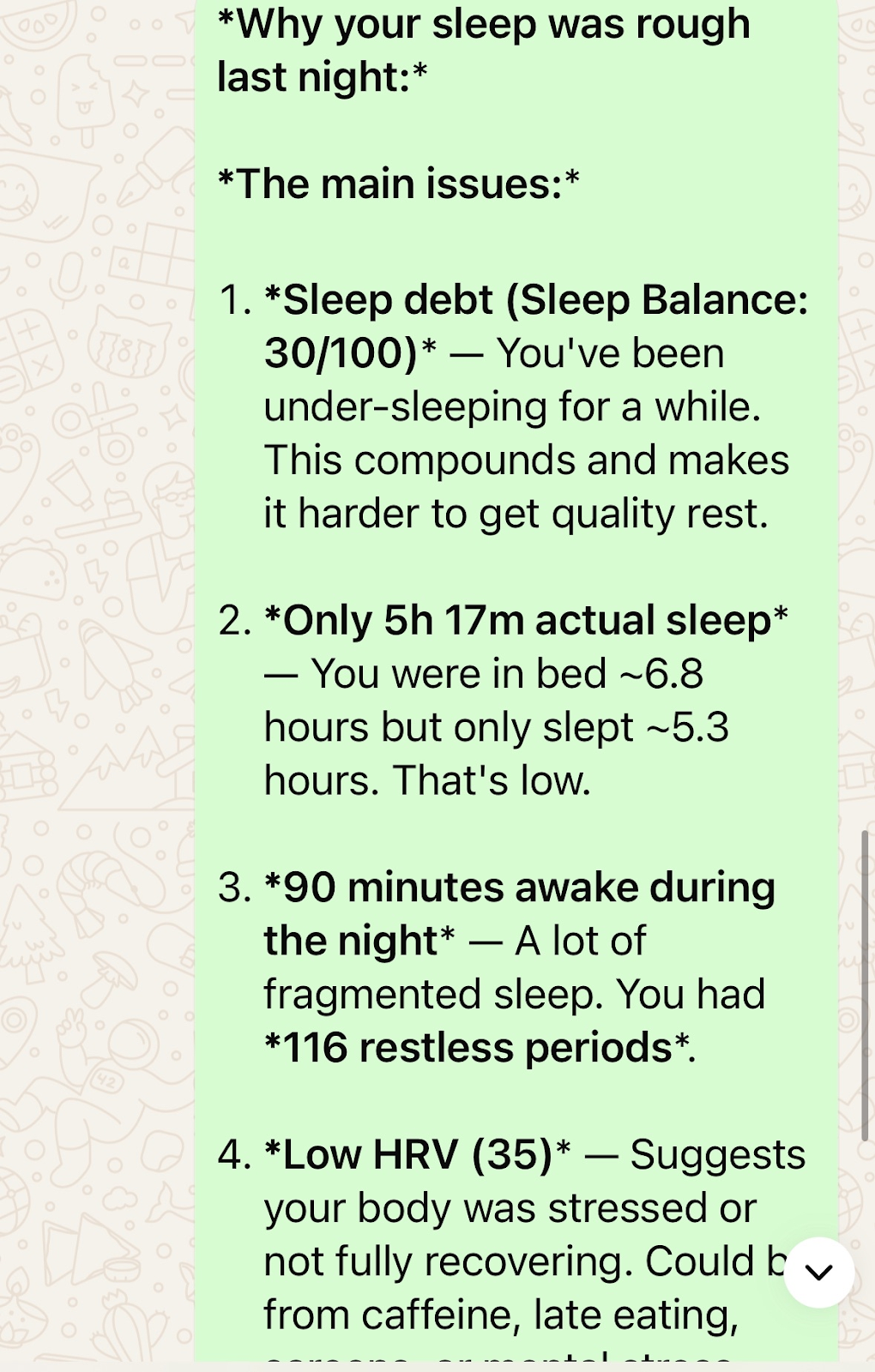
“I got lazy with my Oura app because it required me to log in and track my activity, and I stopped caring. The advice was generic—like ‘Sleep more.’ Yes, I know I need to sleep more. I wanted something more personalized: When should I start winding down? When should I do deep, focused work given how I’d slept? It was one-dimensional.
So I built my own AI health assistant hooked to my email, calendar, Oura Ring, and Apple Health. I get personalized updates at 7 a.m. and 9 p.m., and whenever my heart rate gets elevated and it looks like it’s veering into stress mode, I get a nice reminder to take a break. It’s wonderful.
What helped me get started? Honestly, a bucketload of curiosity, time, and compound engineering essays from Every CEO Dan Shipper and Cora general manager Kieran Klaassen. The hardest part was finding a good playlist to listen to while Claude did everything for me.
I had hiccups building things with previous AI models, but after experimenting with Claude Code in the terminal, I’ve become a believer. Find a problem that’s haunting you and spend some time with Claude Code figuring out how to solve it. You won’t regret it.”—Ashwin Sharma
Knowledge base
🎧 “Reid Hoffman Makes Five Predictions About AI in 2026” by Rhea Purohit/AI & I: LinkedIn’s cofounder has a habit of being right about the future, so Dan asked what he sees coming. Hoffman’s bets: Agents will break out of coding into everything else. One person directing agents will have the capacity of an entire team—his working definition of AGI for 2026. Enterprises that don’t deploy agents at every meeting will fall behind. Discourse will get uglier even as the tools improve. And biology—treated as a language to model molecules—will be the next frontier. 🎧 🖥 Listen on Spotify or Apple Podcasts, or watch on X or YouTube.
“I Asked Claude the Question I Could Never Ask My Boss” by Katie Parrott/Working Overtime: Katie Parrott operates on the assumption that she’s about to be fired at all times. So when year-end planning required her to analyze her own performance data, she braced for confirmation. Instead, the numbers showed she was driving a quarter of Every’s subscription trials with only 15 percent of the content. She asked Claude a bold question: Am I good at my job? It said yes—and pushed back every time she tried to explain the data away. Read this for a framework on using AI to build the case for your own value.
“The Heyday of the Writing-first Practitioner” by Eleanor Warnock: AI makes it easy to generate content. But does the advantage of being a prolific writer disappear when everyone can write? Every’s new managing editor argues it doesn’t. Fred Wilson, Julie Zhuo, and Warren Buffett didn’t build their reputations by outsourcing prose; they write to think, not just to market. Eleanor Warnock maps where this archetype thrives. Read this for her full framework and how she wields her own tech stack.
“How AI Made Pricing Hard Again” by Anh-Tho Chuong: Traditional SaaS had near-zero marginal costs—once you built it, growth was free. AI flipped that dynamic. Now every user action costs money, and the companies growing fastest are often bleeding the most. As the founder of a Y Combinator-backed open-source billing company, Anh-Tho Chuong has unique insight into the pricing models that work for AI startups. The upshot: Pricing is no longer a finance problem, it’s a product problem. Read this before your next feature launch.
“Agent-native Architectures: How to Build Apps After the End of Code” by Dan Shipper/Chain of Thought: Traditional software is a skyscraper—every beam load-tested, every force obeying the blueprint. Agent-native software is a garden. The core isn’t code but an agent, something squishy and alive—agent-native apps are like Claude Code in a trenchcoat. Dan lays out the full paradigm shift and announces a complete guide, plus a compound engineering plugin for Claude Code. Read this for the architecture that’s replacing traditional software development.
From Every Studio
Cora lets you customize how it drafts emails
Cora can adapt to how you actually write. GM Kieran Klaassen shipped new Draft settings that let you add your signature, choose how many draft options you want to see, and toggle auto-drafting on or off depending on how much help you need. You can update everything in Cora’s Settings → Drafts, or just tell the Assistant what you want: “Set my signature to...” or “Turn off auto-drafting.” The goal is to save you time without losing the personal details that make your emails feel like yours.
Sparkle’s getting smarter about clutter
Sparkle is learning to spot the files you’ve been meaning to delete for years—screenshots you took once and forgot, archives you downloaded but never opened, or duplicates hiding under different names. Keep an eye out for updates coming soon.
Go behind the scenes with the Cursor team
This Friday at 12 p.m. ET, we’re hosting Cursor Camp—a live, hands-on workshop with the team building one of the most powerful AI coding tools available. You’ll learn Cursor’s core features, get tactical tips from the engineers who build it, and see how the Every team uses it in real workflows. This is live-only (no recording), and Cursor is offering free credits to paid subscribers who attend. This camp is sponsored by Cursor. Learn more and register.
Alignment
Speech as creative force. I no longer use my keyboard. Typing feels prehistoric, like dragging a club across the savanna, grunting at prey. Everything I do is voice now. Emails, notes—even this essay.
I became a voice convert over Christmas after downloading Clawdbot on WhatsApp. It’s become my personal assistant and health coach all wrapped into one. I tell it what I need and it happens. Book a table, draft that email in my voice, remind me about the thing I can’t remember but you know is at 2 p.m.… you know, the thing on my calendar—the thing! And it does.
Last week I stopped myself mid-sentence and thought: Have we become like Greek gods? Those deities who simply spoke and the world rearranged itself? Perhaps.
Because turning voice into material, concrete action is so seductive and easy, I believe we’re returning to an oral culture where the primary interface between thought and reality is speech. But unlike oral cultures of the past, we have a precise record of the original thought, unaltered by the passage of time or minute changes in each retelling. What’s more, I can speak in half-baked thoughts, even vibes—and the machine converts it into cold, hard precision. It completely bypasses the work of translating the mess of consciousness into something others can actually understand.
We wanted flying cars. Instead we got the voice of a god, whispering to machines that actually listen.—AS
Do you want to get voice-pilled? Use Monologue.
That’s all for this week! Be sure to follow Every on X at @every and on LinkedIn.
We build AI tools for readers like you. Write brilliantly with Spiral. Organize files automatically with Sparkle. Deliver yourself from email with Cora. Dictate effortlessly with Monologue.
We also do AI training, adoption, and innovation for companies. Work with us to bring AI into your organization.
Get paid for sharing Every with your friends. Join our referral program.
For sponsorship opportunities, reach out to sponsorships@every.to.
Help us scale the only subscription you need to stay at the edge of AI. Explore open roles at Every.