


On Friday, April 17, Cora general manager Kieran Klaassen will lead a camp for Every paid subscribers on compound engineering, the AI-native engineering philosophy that he built and that has more than 14,000 stars on GitHub. Since the last camp, Kieran and product leader Trevin Chow have built out product-focused workflows to make the methodology as valuable for product managers and founders as it is for engineers. In this camp, they’ll walk you through what’s new, go deeper on the brainstorm and ideate steps, and share examples of using compound engineering beyond engineering work. Read the full compound engineering guide, install the plugin, and join us for the camp.—Kate Lee
I spent three months trying to make agent swarms work.
The idea of multiplying myself by coordinating multiple agents at the same time was a compelling pitch as the sole engineer building Every’s AI email assistant, Cora. If I could summon a fleet of AI agents, let them coordinate, and watch them produce work no single agent could match, it would relieve some of my overwhelm.
I tried everything to make it work—Claude Code teams, agents dispatching tasks to other agents, orchestration setups where a lead agent managed a pool of workers. Many iterations, many burned tokens.
But more agents didn’t make me faster. I’ve run parallel Claude Code sessions for months, which works when each agent has a clear task, and I’m directing the work. The swarm experiment was different: agents coordinating with each other, deciding what to work on, producing output I hadn’t shaped. When 10 of them finished simultaneously, I had 10 results to evaluate without enough context to know which ones I could trust. AI agents don’t have a speed limit, but the person managing them still does.
I kept looking for a smarter orchestration layer—a better protocol or a tighter framework that would filter the output and tell me which result to trust. Then I stopped and looked at what was really doing the work.
It was something I already had—a folder.
A project folder with a CLAUDE.md/AGENT.md (the file that tells an AI how to work in your project), some skill definitions, and context accumulated through months of compound engineering—that’s an agent. The context that this folder gives an AI model makes the generalized model a specialist in whatever task or field you want it to excel in.
I’m running 44 of these folders-as-agents across multiple projects now. Each one runs inside a specialized folder I’ve built and tested over months, and a dispatch layer I built on top does the routing between them. Here’s how it works.
Build AI apps that actually work
Softr’s AI Co-Builder lets you describe the internal tool or portal your business needs and get back a real, working app in minutes—database, logic, logins, permissions, security, and all. No coding. Not a prototype. Ready for real users immediately. Switch between AI and visual editing whenever you want.
The agents hiding on your hard drive
People hear “agent” and picture a Rube Goldberg machine—dozens of comically complex moving parts, each one triggering the next. But an agent is much simpler: a model with enough context so you don’t have to re-explain everything each time you open the chat.
Here’s an example: All of Cora’s code lives in a project folder in the Every organization on GitHub. When I open that folder with Claude, Claude can see the code and the structure. But it doesn’t know my way of working or what I care about, which is why the folder also includes a CLAUDE.md file. The file tells Claude how I name things and how I structure tests. That’s an agent—not a fancy one, but an agent nonetheless. Just by pointing the model at this folder, which contains some of my personality, knowledge, and taste, the model can be a specialist in my codebase.
Claude Skills—files that give the model specific capabilities—are an example of this “folder as agent” structure. Before anyone called them “skills,” people were already writing markdown files full of instructions and dropping them into project directories.
My ~/cora/ folder goes further:
Become a paid subscriber to Every to unlock this piece and learn about:
- How Kieran structures a CLAUDE.md file so any new agent inherits months of institutional knowledge
- How Kieran built a two-command dispatch layer that replaced 20 open tabs
- The four-step sequence Kieran follows before handing any agent off to automation

What is included in a subscription?
Daily insights from AI pioneers + early access to powerful AI tools
 Front-row access to the future of AI
 In-depth reviews of new models on release day
Playbooks and guides for putting AI to work
Prompts and use cases for builders
In-depth reviews of new models on release day
Playbooks and guides for putting AI to work
Prompts and use cases for builders
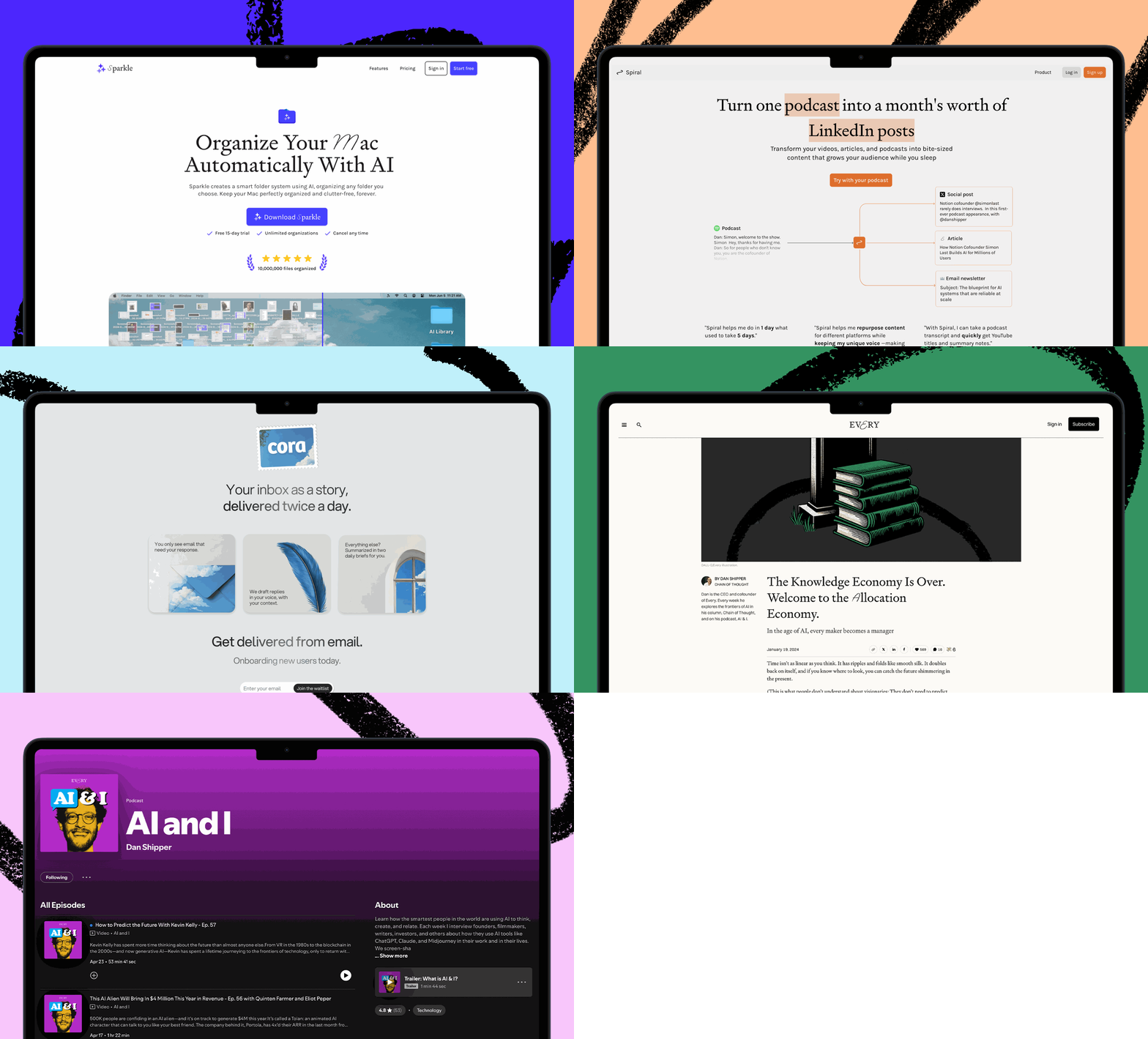
 Bundle of AI software
 Sparkle: Organize your Mac with AI
 Cora: The most human way to do email
 Spiral: Repurpose your content endlessly
 Monologue: Effortless voice dictation for your Mac