

Was this newsletter forwarded to you? Sign up to get it in your inbox.
I’ve been feeling personally attacked by my X feed lately. Well, even more than usual. Alongside the usual headline horror shows and barrage of bad takes, writers I respect and admire are on the warpath against writing with AI.
The discourse kicked off late last month when Washington Post columnist Megan McArdle posted about how she uses AI in her work. The reposts were merciless. “Genuinely an insane thing to admit.” “Journalistic dishonesty out in the open.” One person suggested that admitting to AI use should be made “deeply taboo,” even though he acknowledged in the same post that everyone’s going to do it anyway. But the one reaction that stuck with me was journalist Charlotte Alter: “Research is thinking. Outlining is thinking. Writing is thinking. Any portion of that done by AI is less thinking done by you.”
The problem is that so much of AI writing happens in a black box. The critics are imagining the laziest possible version of AI-assisted writing, and the writers who use AI seriously haven’t been showing their work, though that’s starting to change. That silence lets the worst assumptions fill the gap.
I’d rather just show you the whole mess—what is happening in my head when I write with AI, and it’s not what the discourse imagines. By the end, you can decide for yourself whether what I do counts as thinking.
What writing with AI is (and what it isn’t)
Many critics treat the use of AI in writing like a binary: Either the machine wrote it, or you suffered for it. But writing has never been binary. It’s always been a mess of drafting and revising, leaning on editors and borrowing structures, following formulas and breaking them. And no two kinds of writing are exactly alike: A journalist’s process relies on source calls and document requests. A novelist’s includes plotting arcs across 80,000 words. A personal essay, like the ones I write for Every, involves sitting alone with your feelings until they become a thesis statement.
Every writer’s process is different, and most of them would sound unhinged if described in detail. But throw AI into the mix, and suddenly everyone has opinions about the “right” way to get words on a page.

AI data looks nothing like a spreadsheet
Some of our legacy tools are holding us back. AI applications generate unstructured data, like text video, audio, sensor feeds, and user interactions. But traditional databases were designed for structured rows and columns. That’s where MongoDB Atlas comes in. It natively handles JSON-like unstructured data with the flexibility to store, query, and scale diverse datasets without rigid schemas. Plus native vector search, auto-scaling for demand spikes, and multi-cloud deployment across more than 125 regions make it the perfect fit for the AI era.
My process, start to finish
When people picture “writing with AI,” they picture a transaction. You type a prompt, the AI hands you text, you paste it somewhere, and move on. My process has about as much in common with that as cooking has with microwaving a frozen dinner.
And it’s evolved over time. In 2024, I was the human conveyor belt: Copy a prompt into ChatGPT, paste the output into a Google Doc, tweak it by hand, repeat. In 2025, I got smarter about context—I uploaded my past writing, built a style guide, and gave the AI something to work with beyond a cold prompt. The outputs got closer to my voice, but the process was still me wrestling with a chat window.
Now I have a dedicated writing agent—a set of detailed instructions that plug into Claude and guide me through every stage, from first idea to final polish. It has phases: brainstorm, interview, outline, draft, and review. It has a panel of critics who tear my work apart from different angles—skills I wrote to invoke certain kinds of feedback, whether it’s for length, pacing, or the soundness of the argument. It has style checks, AI-pattern detectors, and a line editor that tightens my prose sentence by sentence. Think of it as a very opinionated editorial workflow that happens to be powered by AI.
Brainstorming: ‘Interview me to find out what I think’
When I sit down to write a piece, and before I even write a word, I have the agent interview me. It asks questions to draw out what I’m thinking about the topic. For example: “Why is this on your mind? How has this shown up in your work? What do you want readers to walk away thinking about?” For this piece, since it was a reaction, it asked me: “What’s the friction for you personally here? When you read these tweets, what makes you want to write about it—is it that you think the critics are wrong? That they’re right but for the wrong reasons? That the whole frame is off?”
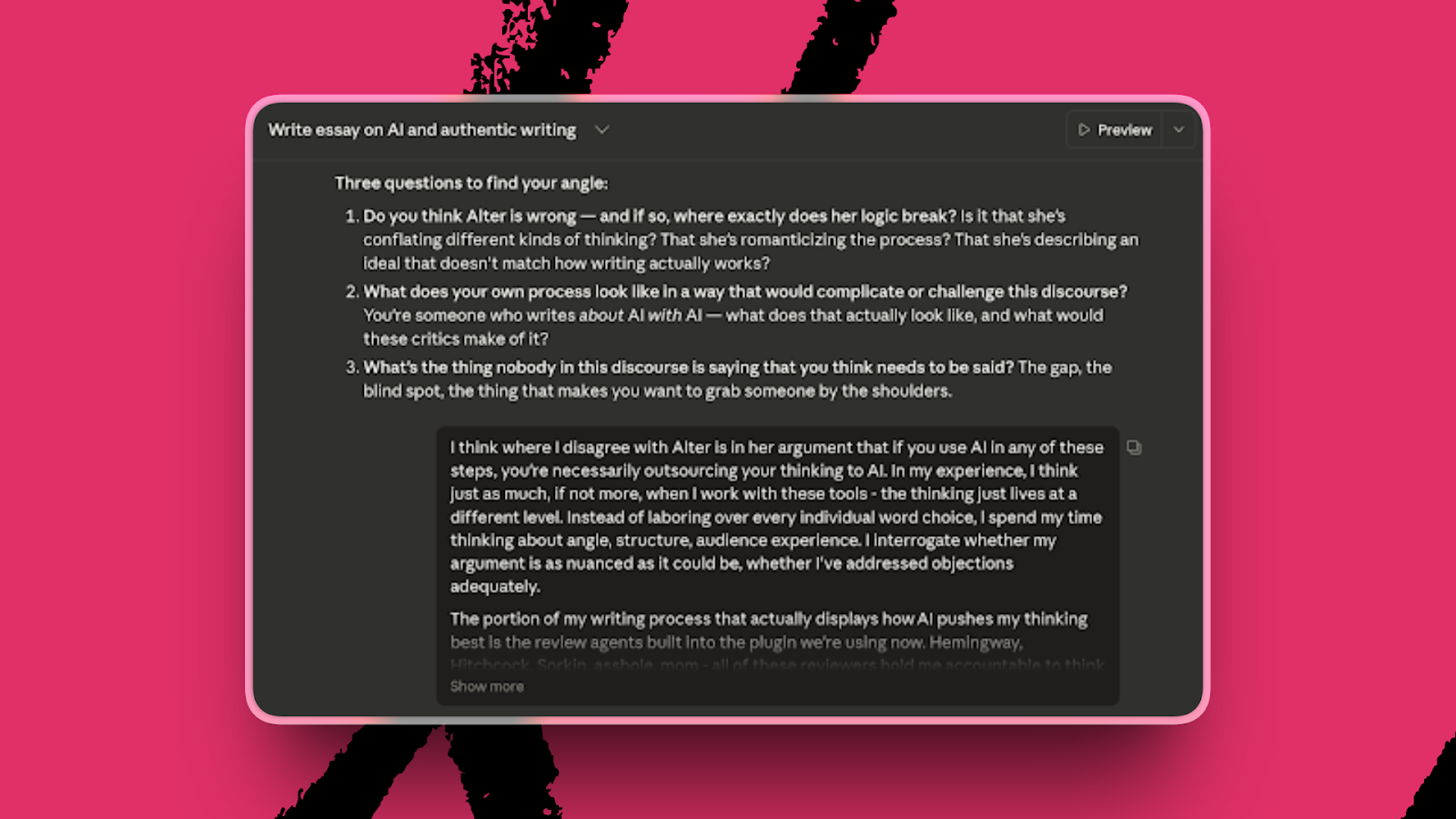
I spend a lot of time sitting with these questions. Sometimes I’ll struggle so much to find an answer that it forces me to realize I haven’t thought through the idea enough yet and need to spend more time reflecting on what I want to say. At least once per interview session, the AI will ask me something that feels irrelevant to the piece I want to write, and I say so. When I was writing this piece, for example, it asked me to critique another writer’s use of AI in their writing process. I said I didn’t want to go there; ranking other writers’ workflows wasn’t the piece I was writing.
Outlining: Structure is a negotiation
Then comes the outline stage. The agent proposes a structure based on everything I said in the interview. I never take the first outline on offer. I move sections around, cut beats that feel thin, and add things the AI didn’t think of.
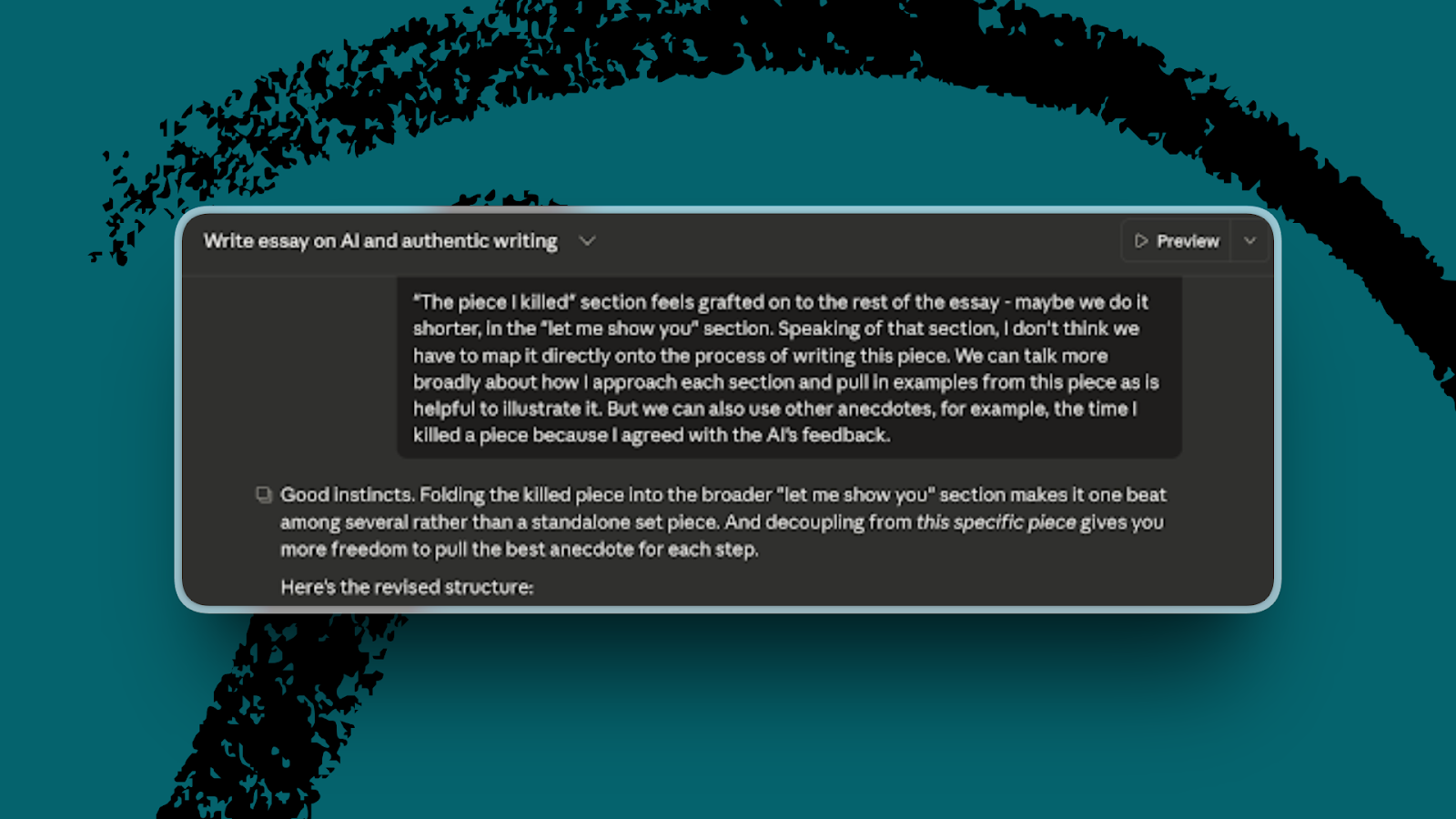
Early in the development of this piece, for example, I shared a story about tabling a draft I was working on based on feedback from my AI reviewers. Claude gave the anecdote its own standalone section. I told it that the anecdote felt grafted on and to fold it into the process walkthrough instead. It also wanted to map every part of the walkthrough onto this specific essay. I wanted the freedom to talk about my process more broadly and pull in examples from this piece only where they earned their spot, so I pushed back. We went back and forth until the structure matched what I could see in my head.
Drafting: Where the ratio gets interesting
Section by section, I have the AI lay out prose based on the outline. Some sections come back close—I rough them up, swap in my phrasing, break apart sentences that are too clean, and add the em-dashes and asides that make it mine. Other sections I throw out almost entirely and rewrite from the feeling of what I wanted rather than what the AI gave me. The mix shifts by section, by paragraph, and by sentence. There’s no fixed ratio, and the minute someone tries to assign one, they’ve misunderstood the process.
I’ve lost track of the number of changes I’ve made to the exact copy of this essay, for example. Some of the changes were big: redrafting whole sections that had drifted off the main thesis, or moving a paragraph from the opening to the conclusion because it worked better as a callback than a setup. Other changes are more targeted—exchanging an analogy that doesn’t feel like mine for one that does (the AI compared my writing process to “a home renovation versus buying furniture off a truck”; I went with “cooking versus microwaving a frozen dinner”). In each case, I’m the one deciding what stays and what goes—and why.
Revising: The toughest editors I’ve ever had
Then comes review—and this is where the “outsourcing your cognition” narrative falls apart completely.
As part of the writing agent, I built a panel of reviewers. Each one is a set of instructions that tells the AI to read my draft from a specific angle, and none of the ones below are nice about it.
- Hemingway, named for the king of economical prose, flags every adjective and unnecessary word, demanding I kill my darlings.
- Hitchcock, inspired by the director who claimed that drama was life with the “dull bits cut out,” checks if I’m giving the reader a reason to keep reading—a bomb under the table, to use the classic example.
- The mom reader lovingly flags where I’ve lost the general audience.
- The asshole reader, which does exactly what it sounds like, attacks every weak point and unearned claim with the energy of a reply guy who just discovered your newsletter.
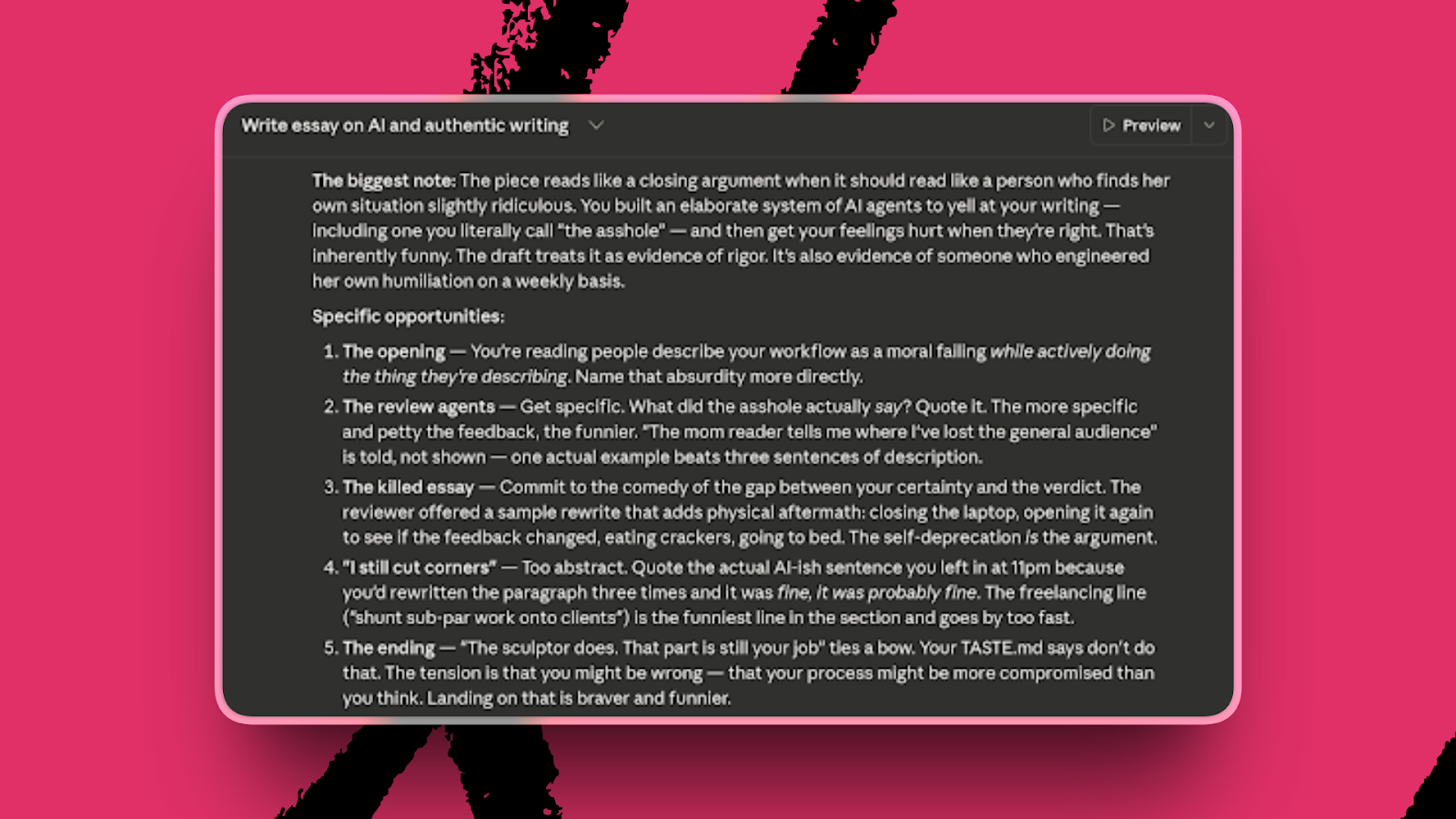
The AI generates the critique, and I have to decide what to do with it. Sometimes the reviewer sees a genuine weakness. Sometimes it’s pushing me toward a version of the piece I don’t want to write. The asshole might flag a claim as unearned, and sometimes it’s right—I need more evidence—and sometimes I decide the claim stands and the asshole can deal with it.
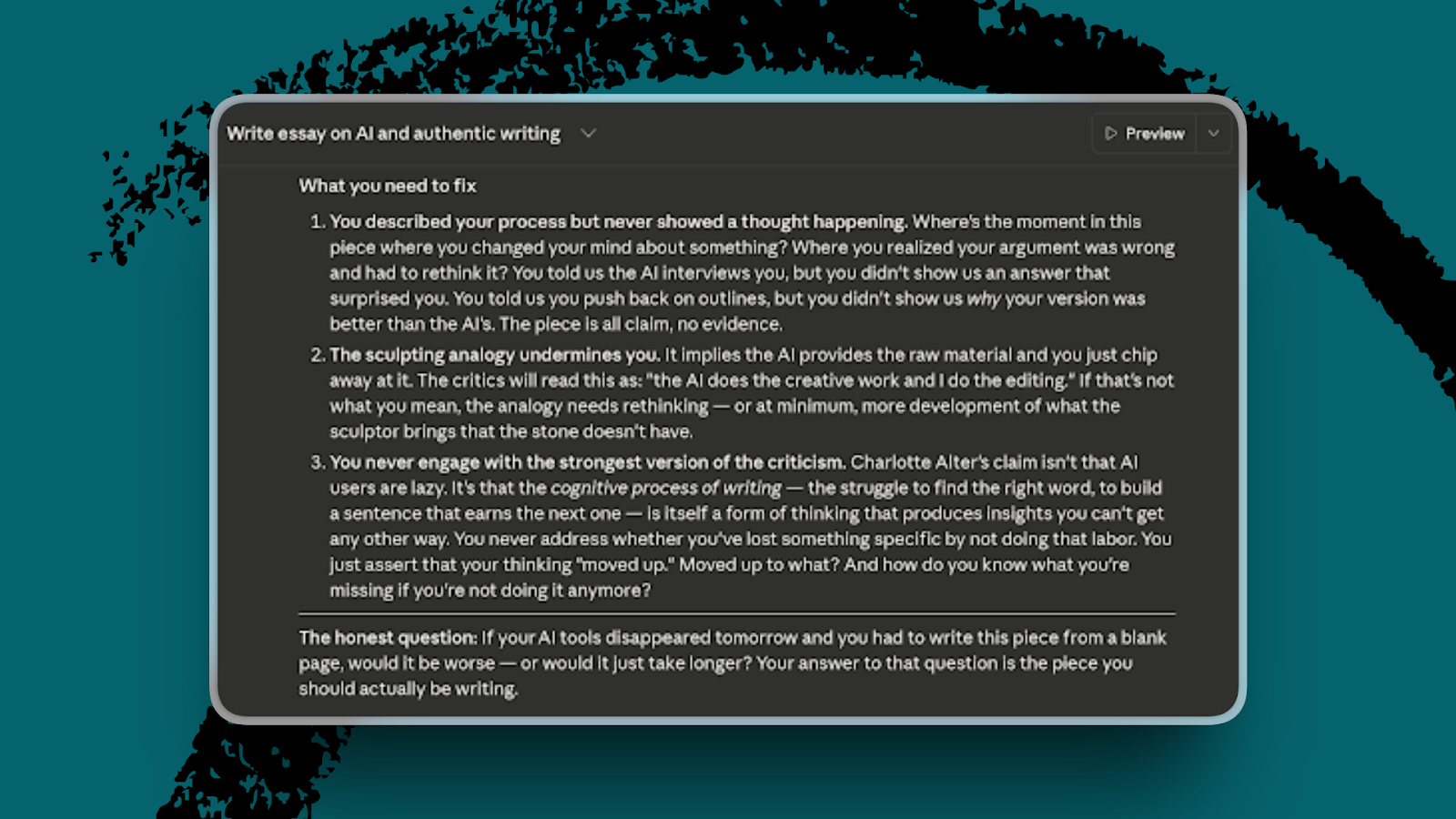
That is the opposite of cognitive offloading. I engineered a system that regularly humiliates me, and I keep coming back for more. If that’s not commitment to the craft, I don’t know what is.
Finalizing: The final pass and polish
Once I’m happy with the substance, I run a gauntlet of checks. An AI-check skill scans the prose for patterns that read as machine-generated—correlative constructions, stock transitions like “Here’s the thing,” and words like “delve” that no human uses voluntarily. A style checker enforces the house rules: em dashes without spaces, Oxford commas, and numerals for 10 and up. A line editor tightens sentence by sentence—cutting dead weight, flagging passive voice, and compressing anything flabby.
I built these checks because AI-assisted prose has specific failure modes. It tends toward a particular kind of smoothness—the verbal equivalent of a stock photo. Left unchecked, it reads like everyone and no one. The finishing pass is where I sand off the last of that generic sheen and make sure what’s left sounds like me.
The whole process—the interview, the outlining fights, the drafting and redrafting, the panel of critics, and the final scrub—feels like sculpting to me. I start with a rough block and chisel. Cut what doesn’t belong, reshape the argument, and rough up the surface until it sounds like me. It still requires judgement and expertise—the sculptor still needs to know where to cut and where to leave the stone alone.
I’m still fighting with the work
I spent much of last weekend taking umbrage with the critics. And if I’m honest, worrying that they were right. That I’d built an elaborate system to avoid doing the real work, and the fact that it felt rigorous was part of the trap.
Many critics see AI-assisted writing as lazy. And yes, I still cut corners. There are nights I accept the third draft because it’s 11 p.m. and the paragraph is fine, it’s fine, it’s probably fine. But I did that before AI, too. I’ve submitted paragraphs I knew were bad because I’d rewritten them four times and couldn’t look at them anymore. We’re all guilty of cutting corners, and that’s not AI’s fault.
But when I ask myself if what I’m doing still feels like writing, the answer is unequivocally yes.
I still lose 20 minutes chasing a word I can hear but can’t find. I still read sentences aloud to test whether the rhythm lands. I still agonize over whether a piece is saying something worth someone’s time or just filling space. I still worry about tone—too defensive? Too breezy? Am I earning this vulnerability or performing it? I still get that specific nausea when something I’ve published isn’t as good as I wanted it to be.
None of that went away when I started writing with AI. If anything, the tools stripped away the excuse that I was too exhausted from drafting to care about the finer points. When the initial output comes faster, you have nowhere to hide from the question of whether the thing you made is any good.
Am I a real writer? I’m a writer who takes feedback, iterates relentlessly, holds herself to a standard, and ships every week. One of my editors just happens to be an AI. The rest is still me.
Read Katie’s guide for how to use style guides to make AI sound more like you.
Katie Parrott is a staff writer and AI editorial lead at Every. You can read more of her work in her newsletter. To read more essays like this, subscribe to Every, and follow us on X at @every and on LinkedIn.
Discover Every’s upcoming workshops and camps, and access recordings from past events, including Katie’s Writing Camp, to learn more about her process for writing with AI.
For sponsorship opportunities, reach out to sponsorships@every.to.