


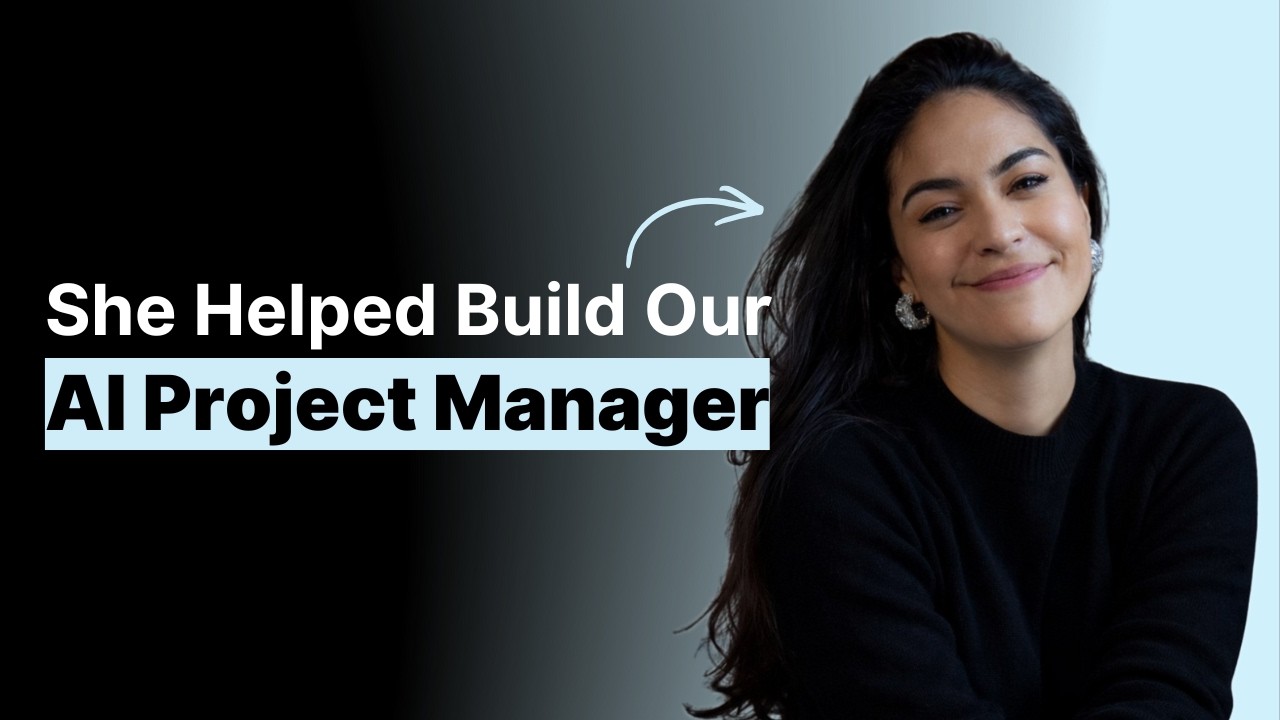
TL;DR: Today, we’re releasing a new episode of our podcast AI & I. Dan Shipper sits down with Natalia Quintero, Every’s head of consulting, about what she has learned from helping companies adopt AI and how the best stay ahead. Their conversation follows Every Consulting’s announcement of specialized playbooks for tech and finance companies to go from AI-curious to AI-native. Watch on X or YouTube, or listen on Spotify or Apple Podcasts.
Plus: Every is hosting a 90-minute session for paid subscribers about OpenClaw on Friday at 12 p.m. ET. The event will feature AI builder and author Nat Eliason, and we’ll cover getting it installed, our most valuable use cases at Every, and what’s next for always-on AI.
Most New Year’s resolutions don’t make it past February. The gym membership goes unused. The meal prep containers gather dust. The journals go unwritten.
Natalia Quintero‘s January commitment sounded equally doomed: waking at 6 a.m. every day to vibe code with AI. But four weeks later, she is still going and calls herself a “bonafide vibe code addict.”
As the head of AI consulting at Every, it also mirrors what Quintero has observed across the companies she works with: The people and organizations making the biggest leaps with AI aren’t the ones with the most resources or the fanciest tools. They are the ones who give themselves the time and space to experiment.
She’s had a front-row seat to how the world’s top companies approach AI adoption, having spoken to over 100 companies about their needs and worked closely with nearly two dozen organizations, including the New York Times and the hedge fund Walleye Capital. In this episode of AI & I, she tells Dan Shipper about the importance of play in AI adoption and the project management agent she built that has saved her 14 hours a week.
Here is a link to the episode transcript.
You can check out their full conversation:

Here are some of the characteristics they see in the most AI-forward companies:
1-There is a coordinated effort from the top
Natalia says that several key characteristics separate the companies thriving with AI from those floundering. The first is simple but non-negotiable: Leadership must be all in.
“For AI to be a high-leverage tool at any given company, it needs to come from the top down,” she says.
This is fundamentally different from how companies have historically adopted software, where company technology chiefs might just purchase a software program with the hope that employees use it, Natalia explains.
Dan agrees. He says the companies going the furthest have CEOs deep in ChatGPT and Claude Code. He cites Shopify CEO Tobias Lütke—who famously used AI to create an HTML-based viewer for his own MRI scans during his weekends—as an example.
He says that an organization’s ability to adapt AI is directly correlated with its chief executive’s AI skills: “You will probably go as far as your CEO has gone. It’s not something the CEO can delegate.”
2-They empower AI early adopters
The second critical pattern that Natalia and Dan see among successful adopters of AI is that those companies identify and empower internal AI champions.
“Inside of any organization, there are people who are just natural early adopters,” Shipper notes. “Your job as an executive who’s leading your org is to identify those people and spread what they know and elevate their status so that they can pave the way for everyone else.”
One of Natalia most striking examples of this in practice comes from an Every client in the private equity industry.
Natalia worked closely with Jonathan, a partner at the firm who not only has technical knowledge of AI but also understands the people dynamics around AI. By this, she means that he understands that AI adoption diverges across teams in an organization, depending on how much capacity and support they have to experiment with new technologies. This is a unique combination of skills, she says.
Natalia and Every’s consulting team worked with Jonathan as he sat down with every investor at his firm and mapped out all the tasks they performed—from research to diligence to market mapping to portfolio management—in granular detail. This kind of mapping is one of the key steps in determining what tasks can be automated with AI and how.
This helped Every and the client build “a very, very detailed view of what it looks like at this firm for an investor to do their job,” Quintero explains. They then identified high-leverage opportunities to apply AI to those specific workflows.
One of the most time-consuming tasks for the private equity client was sifting through investment thesis materials they’d collected for over a decade to apply their current investment strategy to potential new opportunities. By connecting the right sources of data to ChatGPT and then funneling it through a set of custom prompts, they were able to produce a solid draft of an investment memo in 30 minutes compared to a previous time frame of three weeks.
“That’s only possible when you have someone on the inside who understands all of the elements,” she says.
3-They give people creative space to experiment
The private equity example also underlines another common pattern in successful AI adoption: Employees and leadership need to have the space to “play” with the technology.
“Having that creative space is very, very counterintuitive to the way that we usually work,” Natalia says, referring to knowledge workers. “How much of our time is really spent in traditional jobs just figuring out if there’s a new way to do things?”
Natalia fell into the very trap she often sees with clients at the end of last year. Her days were packed with meetings and client work, leaving no time to explore new AI tools. “I didn’t really have time to play with a lot of these tools,” she admits.
To combat this, Natalia and Nityesh Agarwal, an Every engineer, have been starting their workday at 6 a.m. every day to vibe code and experiment.
The result of those early mornings is Claudie, an AI project manager running on Opus 4.5 that lives in the Every GitHub. Claudie has access to Google Workspace tools, which enables it to handle a variety of project management-based tasks, including onboarding new clients, conducting quality checks on collected data, and providing weekly updates on what’s going on with clients.
With Claudie, Natalia’s weekly project management workload has been cut down from 15 hours to one. But getting there took several iterations.
“We got 85 percent of the way there three times and then had to scrap it and start again to get to a new framework that actually got us to 100 percent,” she says.
The Claudie system includes a detailed “job description” that Claudie reads every time it’s asked to do something—defining where it works, what its job is, what good work looks like, who it reports to, and who its colleagues are.
But it can still make mistakes, says Natalia, so you have to teach the system to rectify its errors by making sure Claudie has access to sufficient information. “This is the same way you would build a relationship with any new staff member that you would bring on board,” she says. “You’re really building and cementing that relationship, and you’re also investing in that relationship.”
Companies that give people risk-free space to try new technology, learn its ins and outs, and fail without getting behind in their jobs are the ones where people can eventually achieve that breakthrough moment.
What AI projects are you working on? Have you found ways to carve out creative space in your organization? We want to hear from you—and we might even interview you.
Timestamps:
- Introduction: 00:00:00
- Why successful AI adoption requires coordinated, top-down effort: 00:01:30
- How a private equity firm reduced investment memo creation from weeks to 30 minutes: 00:07:05
- The benefits of connecting AI to proprietary context: 00:13:30
- The plan-delegate-assess-compound framework for engineering teams: 00:15:20
- How non-technical team members are becoming vibe coding addicts: 00:17:55
- Building Claudie: an AI project manager from scratch: 00:20:50
- Why creative exploration time outside the 9-to-5 is essential: 00:23:00
- Live demo: How Claudie automates client onboarding and tracking: 00:27:50
- The human side of AI: spending less time in spreadsheets, more time with people: 00:38:40
You can check out the episode on X, Spotify, Apple Podcasts, or YouTube. Links are below:
- Watch on X
- Watch on YouTube
- Listen on Spotify (make sure to follow to help us rank!)
- Listen on Apple Podcasts
Miss an episode? Catch up on Dan’s recent conversations with founding executive editor of Wired Kevin Kelly, star podcaster Dwarkesh Patel, LinkedIn cofounder Reid Hoffman, ChatPRD founder Claire Vo, economist Tyler Cowen, writer and entrepreneur David Perell, founder and newsletter operator Ben Tossell, and others, and learn how they use AI to think, create, and relate.
If you’re enjoying the podcast, here are a few things I recommend:
- Subscribe to Every
- Follow Dan on X
- Subscribe to Every’s YouTube channel
Tom Matsuda is a freelance writer focused on business, culture, and technology. You can follow him on X at @_tommatsuda and on LinkedIn.
To read more essays like this, subscribe to Every, and follow us on X at @every and on LinkedIn.
We build AI tools for readers like you. Write brilliantly with Spiral. Organize files automatically with Sparkle. Deliver yourself from email with Cora. Dictate effortlessly with Monologue.
We also do AI training, adoption, and innovation for companies. Work with us to bring AI into your organization.
Get paid for sharing Every with your friends. Join our referral program.
For sponsorship opportunities, reach out to sponsorships@every.to.
Help us scale the only subscription you need to stay at the edge of AI. Explore open roles at Every.