

There’s no resting on your laurels in the AI race: OpenAI’s Codex went from trailing Anthropic’s Claude Code to pulling ahead in functionality, at least for now, in a matter of months. Today, Every CEO Dan Shipper explains why OpenAI’s coding app has become his daily driver for work, head of growth Austin Tedesco shares his no-nonsense advice for switching over from Claude Code, and Spiral general manager Marcus Moretti argues it’s OK—good, even—to let some AI trends pass you by.
‘AI & I’: Why we switched from Claude Code to Codex
Codex takes the lead
If you’re looking for evidence of AI’s unrelenting pace, here it is: In January, Dan wrote that whoever wins vibe coding wins how you work on your computer—and that OpenAI had some serious catching up to do.
Three months and the release of OpenAI’s latest model later, Codex is there, and in a new episode of AI & I, Dan and Austin get into why they do much of their knowledge work in Codex now. They cite the power of GPT-5.5, paired with a desktop app that is faster and more powerful than Claude Desktop or Cowork.
Watch on X or YouTube, or listen on Spotify or Apple Podcasts. You can also read the transcript.

Here are a couple of Dan and Austin’s favorite current use cases for Codex:
- Austin uses Codex for strategy docs. Austin needed to write a go-to-market plan for a new Every product but kept getting pulled away by other work. So he pointed Codex at the team’s Notion meeting notes, Slack threads, and his preferred template and told it to pull together content where they’d discussed strategy and transform it into an action plan. What came back was 80 to 90 percent of the way there.
- Dan uses Codex for recruiting. When he is recruiting people to work at Every, Dan starts with a sense of where strong candidates might have learned the skills Every needs, instead of looking for a specific job title. He then asks Codex to find people who match that career arc—for example, to find someone to help scale Every’s courses, he looked for candidates who had worked at education startup General Assembly before transitioning into AI.
Miss an episode? Catch up on Dan’s recent conversations with LinkedIn cofounder Reid Hoffman; the team that built Claude Code, Cat Wu and Boris Cherny; Vercel cofounder Guillermo Rauch; podcaster Dwarkesh Patel; and others, and learn how they use AI to think, create, and relate.

Write at the speed of thought
That gap between your brain and your fingers kills momentum. Monologue lets you speak naturally and get perfect text three times faster, and your tone, vocabulary, and style are kept intact. It auto-learns proper nouns, handles multilingual code-switching mid-sentence, and edits for accuracy. Free 1,000 words to start.
Migration anxiety
Claude Code-to-Codex
If you want to switch to Codex or any other coding app, how should you think about migrating? When your setup includes app-specific project folders, skills, plugins, or integrations, it can be daunting.
Become a paid subscriber to Every to unlock this piece and learn about:
- How Austin managed the migration from Claude Code to Codex
- How the general manager of Spiral decides which new AI tools to adopt and when
- The one skill Every’s chief operating officer is teaching his son in an AI world

What is included in a subscription?
Daily insights from AI pioneers + early access to powerful AI tools
 Front-row access to the future of AI
 In-depth reviews of new models on release day
Playbooks and guides for putting AI to work
Prompts and use cases for builders
In-depth reviews of new models on release day
Playbooks and guides for putting AI to work
Prompts and use cases for builders
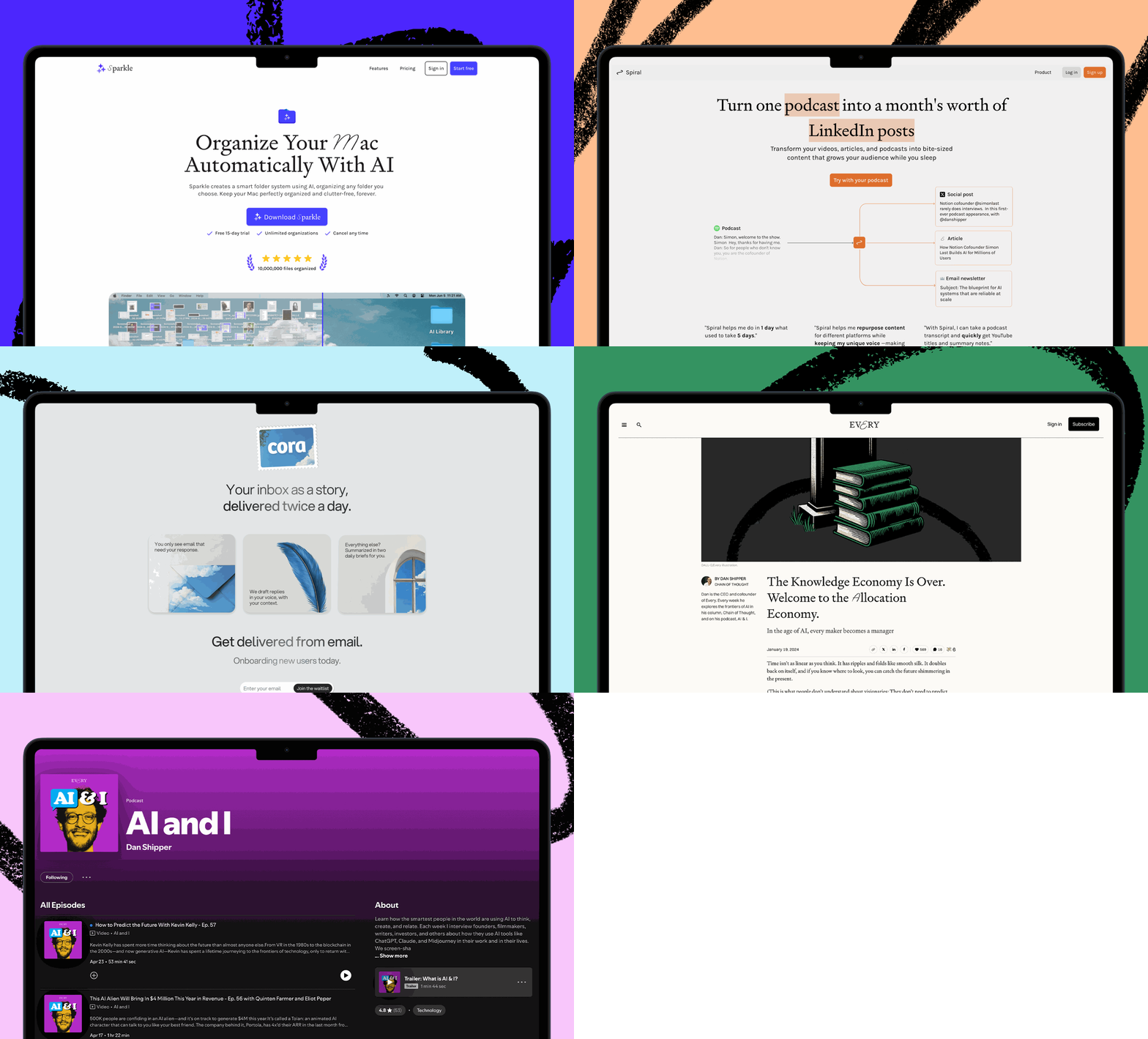
 Bundle of AI software
 Sparkle: Organize your Mac with AI
 Cora: The most human way to do email
 Spiral: Repurpose your content endlessly
 Monologue: Effortless voice dictation for your Mac