


AI can be exhilarating and destabilizing. Just when you think you have your setup figured out, a powerful new model drops—or, in the case of Anthropic’s Fable 5, gets abruptly disabled. Today, we explore this instability from multiple angles: Staff writer Katie Parrott maps the five stages of grief that accompanied the Fable ban and shares a practical playbook for the next time a model you depend on disappears, head of growth Austin Tedesco explains how loops are causing him to rethink his approach to working with AI, and GitHub chief operating officer Kyle Daigle tells AI & I guest host Mike Taylor how the company is responding to an agent-generated surge in commits.
‘AI & I’: Can GitHub be for everyone?
Today we’re releasing a new episode of our podcast AI & I. Head of tech consulting Mike Taylor guest hosted this week and spoke to GitHub COO Kyle Daigle about how the company is responding now that everyone—and their army of agents—can ship code.
The volume is extreme: Last year, there were 1 billion commits on GitHub. This year, that figure will safely exceed 14 billion, Daigle says, which puts GitHub in an important but delicate position: It must help developers handle agent-generated code without dictating which pull requests communities should trust or merge.
Watch on X or YouTube, listen on Spotify or Apple Podcasts, or read the transcript. And for a behind-the-scenes look at the making of the podcast, check out Mike’s piece on his decision to ditch standard-issue prep in favor of building and mock interviewing an AI version of Daigle.
Here are the highlights:
- The developer versus non-developer distinction is disappearing: GitHub has long taken an expansive view of who counts as a developer, but AI has blown up the definition entirely. Legal, finance, sales, and marketing professionals are using the GitHub Copilot app to build prototypes and apps. “A lot of the folks that the industry would call knowledge workers, or just non-developers by trade, are using these tools,” Daigle says.
- Agents can write and review code, but humans decide what ships: GitHub has built agentic code review and merge tools to help developers handle the surge of pull requests, but people who run open-source projects should ultimately decide which outside submissions they merge. “We want to provide tools,” Daigle says, “but really leave them in control.”
- Daigle runs a daily loop on himself: In AI, a loop is a cycle in which an agent does work, evaluates the result against a goal or standard, incorporates feedback, and repeats the process until the task is complete or the output improves. Daigle uses the same workflow to improve his communication style—each day, an agent reviews a rolling seven-day window of his emails and Slack messages, identifies patterns, provides constructive feedback, and checks whether he incorporated its advice.
Miss an episode? Catch up on Dan’s recent conversations with LinkedIn cofounder Reid Hoffman; the team that built Claude Code, Cat Wu and Boris Cherny; Vercel cofounder Guillermo Rauch; podcaster Dwarkesh Patel; and others, and learn how they use AI to think, create, and relate.
Under the hood: How Dropbox engineers are building AI that understands you
Work today is scattered across tools that don’t talk to each other—and none of them have the full picture of what you actually need. On the Working Smarter podcast, Dropbox engineers share how they are building context-aware intelligence that connects to all the tools your team uses for work—so you get AI that works wherever you do.
With episodes on context engineering, multimodal search, agentic AI, security, and more, Working Smarter shows you what it takes to build AI that helps you work smarter. The tools you trust, explained by the people who made them. Listen to the latest episodes of Working Smarter wherever you get your podcasts.
Inside Every
Loops, loops, loops
“I’m super loop-pilled,” says head of growth Austin Tedesco. He’s not alone. Loops—which have AI tackle a goal through iterative cycles of completing a section of the task, reviewing the results, incorporating the learnings, and generating the next step—have become a hot topic of discussion here at Every in recent days...
Become a paid subscriber to Every to unlock this piece and learn about:
- How to use loops for non-coding work
- How to determine which tasks you need frontier models for
- How to prepare for another model to disappear

What is included in a subscription?
Daily insights from AI pioneers + early access to powerful AI tools
 Front-row access to the future of AI
 In-depth reviews of new models on release day
Playbooks and guides for putting AI to work
Prompts and use cases for builders
In-depth reviews of new models on release day
Playbooks and guides for putting AI to work
Prompts and use cases for builders
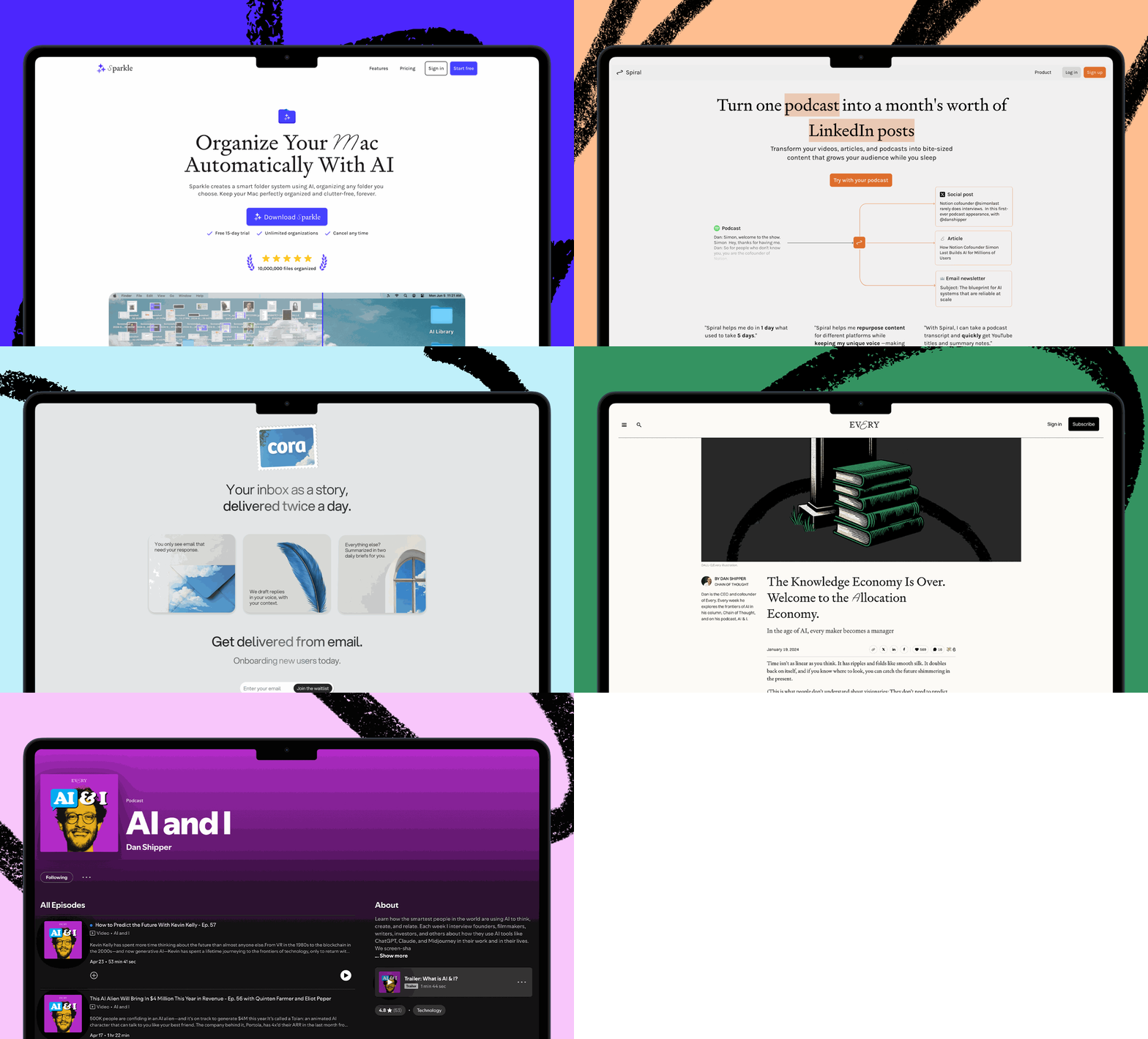
 Bundle of AI software
 Sparkle: Organize your Mac with AI
 Cora: The most human way to do email
 Spiral: Repurpose your content endlessly
 Monologue: Effortless voice dictation for your Mac