|
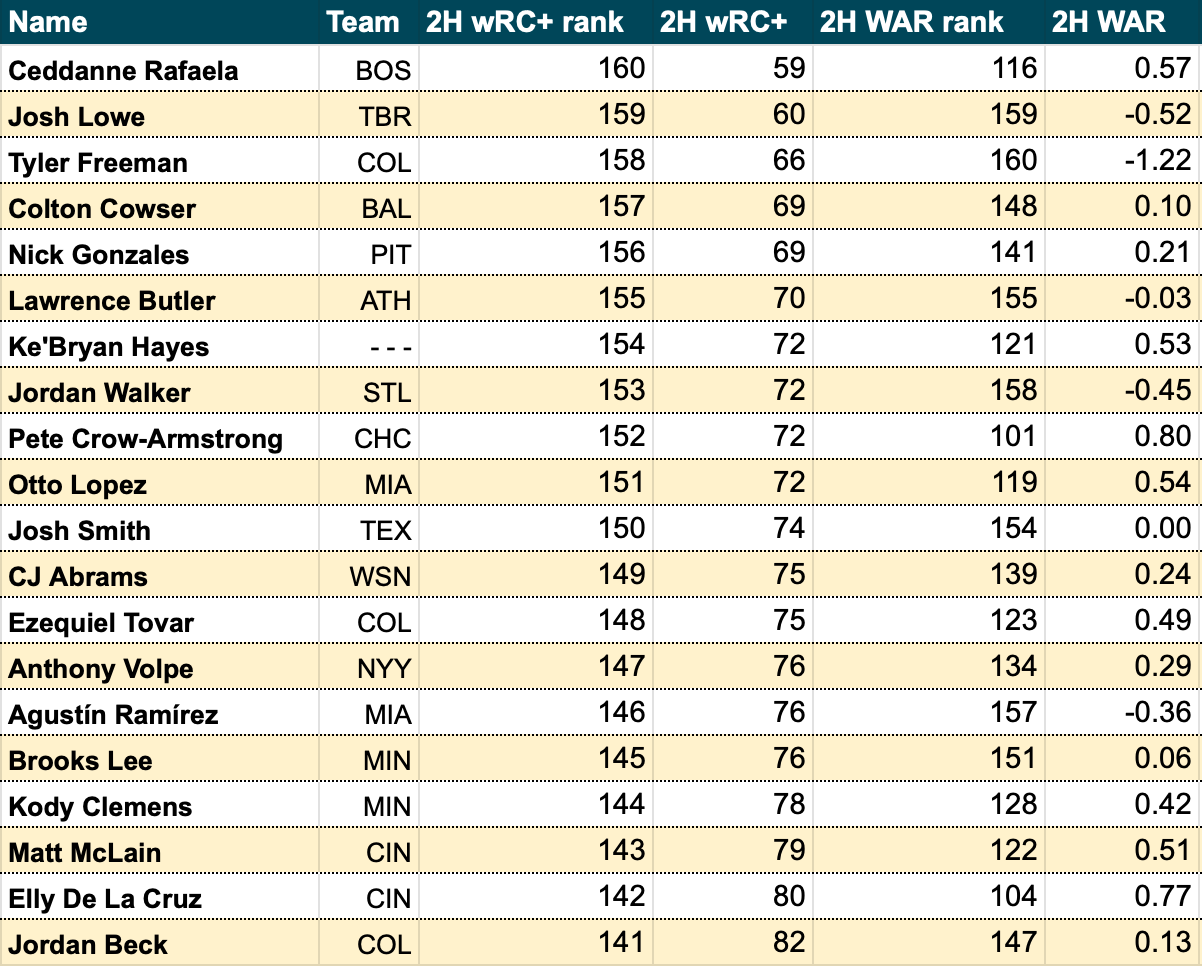
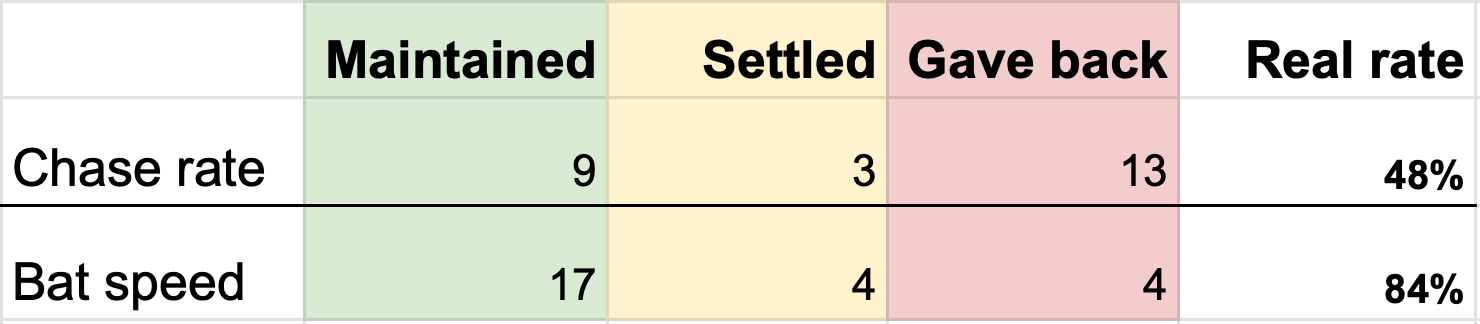
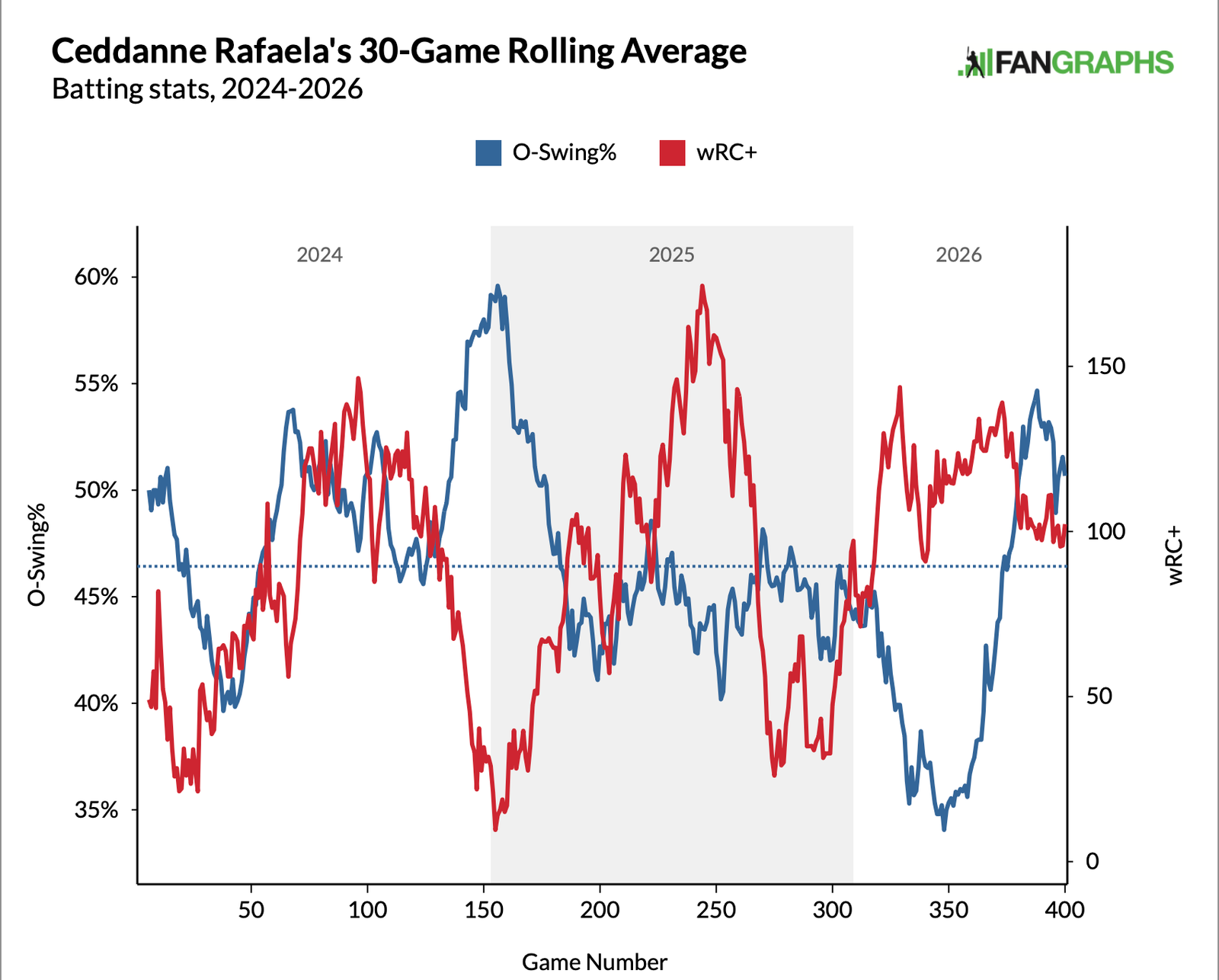
Hey, as baseball gets rolling again after the All-Star break, I wanted to use this checkpoint for the newsletter, too. What do you like? How does it fit into your life? What could make it a better or more essential part of your baseball diet? If you have a few seconds — seriously, it won’t take long — fill out a survey to help me steer the newsletter forward. I’m very grateful for all of you who already read and support The Bandwagon. Going forward, I want to make sure it’s primed to grow and be the best version of itself. I appreciate any feedback you can provide, and I’ll report on my takeaways soon! Now, back to the baseball. Take a look at this table. Any guesses? That’s the hitting leaderboard from the second half of 2025, flipped upside down. It shows the worst qualified hitters after last season’s All-Star break, ranked by wRC+, the park- and era-adjusted batting stat at FanGraphs. These are the 20 guys who struggled the most at the plate through sustained playing time last summer. We’re looking at grisly batting lines that would get unheralded players shipped back to Triple-A, or relegated to sparse bench duty. Performing like this for part of a second straight season will get just about anyone bumped out of the lineup, as Josh Smith, Jordan Beck and Agustin Ramirez can attest. But then there are the names you’ve probably noticed already. Six of these 20 hitters — the least successful regulars of the previous half of baseball played! — were top 25 hitters in either wRC+ or WAR in the first half of this season. 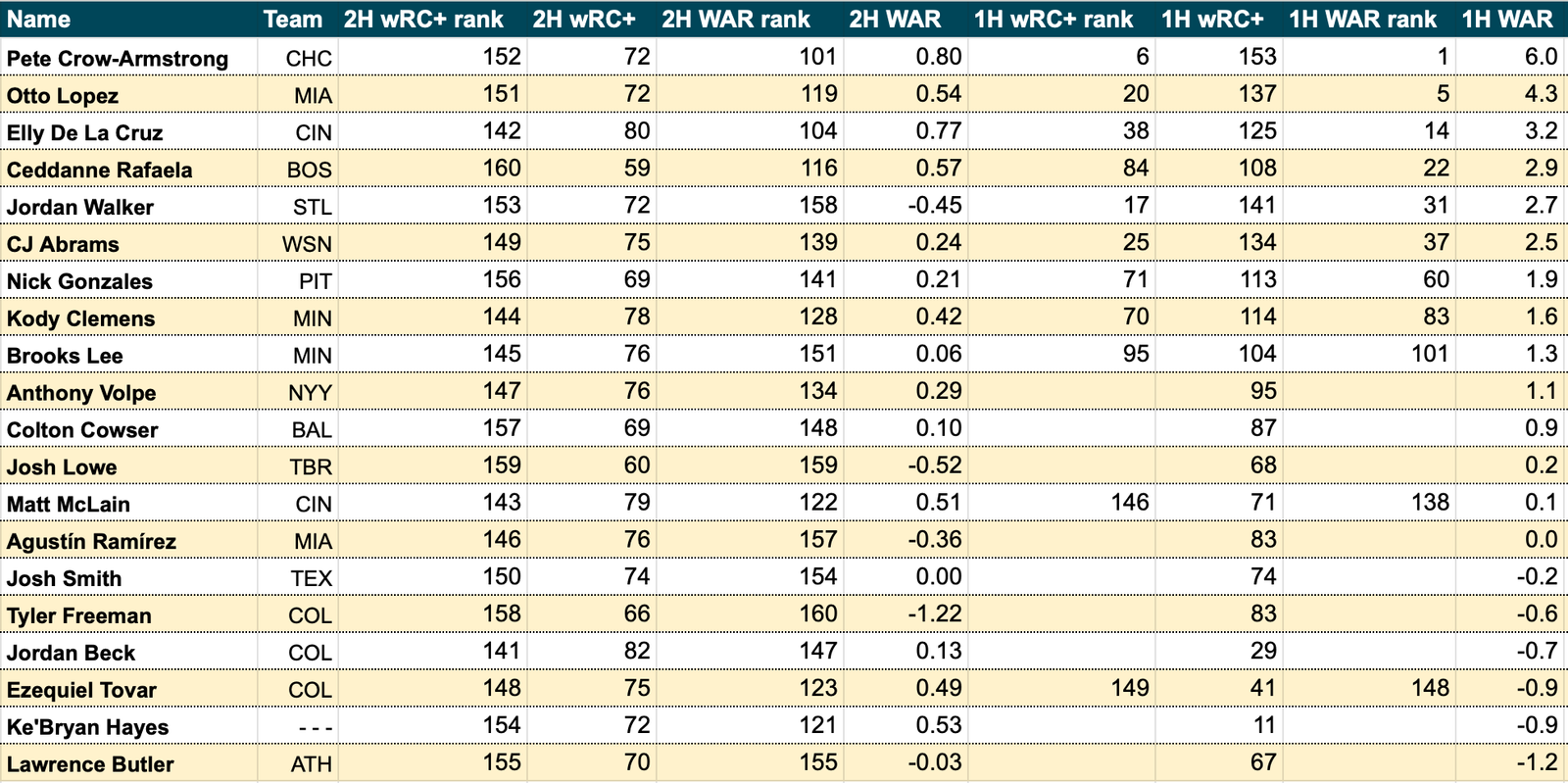 Data via FanGraphs. Blank cells means the player did not have enough plate appearances to qualify. Cubs center fielder Pete Crow-Armstrong has been the most valuable position player in baseball, non-Shohei Ohtani division. Otto Lopez is rampaging toward a batting title in Miami, while playing premium shortstop defense. Ceddanne Rafaela is PCA Lite. Home Run Derby champ Jordan Walker is mashing. CJ Abrams is a key part in an electrified Nationals offense. Elly De La Cruz, more established than his compadres here, bounced back from a prolonged slump in a big way. All of these players demonstrated ability in fits and starts before this season. All are 27 or under, could still be viewed as in their formative years. All except Lopez arrived in the major leagues with at least a degree of prospect acclaim. They stumbled hard into the winter, but came back with a vengeance this spring. For these players, the night really was darkest just before the dawn. Are they two-faced, or truly changed? ⚾⚾⚾ You’d be forgiven in you harbor doubts. Crow-Armstrong was the fourth-most valuable position player at the All-Star break in 2025, even though his offensive contributions weren't as special. Flying even closer to the sun in 2026, Crow-Armstrong presents both the highest stakes and trickiest arc in this group. Watching almost any 10-second glimpse of him in action, you’d conclude he’s an extraordinarily talented player. His 21 homers and 24 steals in this season’s first 96 games represent declines from last season’s first half, when he ripped off 25 homers and 27 steals in 95 games. Yet by the middle of August last year, things had changed so dramatically that Cubs manager Craig Counsell was pinch-hitting for Crow-Armstrong in some key late-game situations. By season’s end, he wound up on the list I led off with. His huge swings in production traced back to one glaring weakness: His swings. Or, more specifically, his penchant for taking so many swings. Last season, Crow-Armstrong swung at 52% of the pitches he saw outside the heart of the plate. Some of these pitches are strikes, but they’re pitcher’s strikes. They’re not the swings you want to take, they’re the swings you sometimes have to take. Crow-Armstrong was swinging with reckless abandon, emphasis on the reckless. Nobody else getting regular playing time swung more at these pitches. The MLB average was about 38%; Juan Soto swung at only a quarter of them. Altogether, these swings produced a .211 average and .316 slugging percentage. Maybe more incredibly, Crow-Armstrong swung at 57.5% of non-fastballs outside the heart of the plate, which was nearly four percentage points clear of the next most enthusiastic hacker (Rafaela, actually). The reason to buy 2026 Crow-Armstrong as the real McCoy lies in his real response to that weakness. This year, Crow-Armstrong still has an aggressive ethos, but he has mixed in a healthy dose of discipline. He’s got the overall swing rate down to 43% on pitches outside the heart of the zone, which is 41st-highest out of 189 hitters who have seen 750+ pitches. Through some mixture of Alex Bregman influence and organizational coaching, the Cubs have helped Crow-Armstrong find a happier medium. It’s allowing him to rack up a serious number of walks and moderate his cold snaps. “The way I framed it and the way it was presented to me really gave me some confidence,” Crow-Armstrong told The Athletic. “I’m not going up there and looking to not swing. That’s not how you walk, really. But it’s looking for one thing and sticking to that.” In prolific analyst Matthew Trueblood’s book, the elevated walk rate is a significant new development that should mean Crow-Armstrong is “not going to go back to the guy who batted .188/.237/.295 in August and September last year.” ⚾⚾⚾ At the risk of oversimplifying something impossibly complex, what we can see about a hitter’s process comes down to when he swings and how he swings. Behind both, between his ears, there’s the unseen why — intent, powerful and inextricable from what happens but never actually observed, like atomic particles you win a Nobel Prize for discovering. When hitters make big changes, we go looking for changes in The When and/or The How. (For about a week of torpedo bat crazy last April, I guess we also considered the what.) The When is about plate discipline, about what to swing at and what to spit on. The handy binary measure is just in-zone or out-of-zone; obviously, no one wants to swing at would-be balls. But there’s plenty more at play. Some hitters should be swinging at almost every pitch they see down the middle. Others should be waiting for fastballs early in counts. Some tap into their power on the inside of the plate, others have a hole up and in. Plate discipline, in sum, is a hitter’s ability to discern what’s coming fast enough to maximize strengths and minimize weaknesses. The How includes a lot of things. Where do his hands start? Does he have a leg kick? How big? Does he have a flat swing or a cut geared for fly balls? For a long time, this discussion revolved around side-by-side video detective work, the nerdy expert level of those Scholastic spot-the-difference pages. Lately, Statcast’s bat-tracking metrics have inserted some concrete numbers into the fray. We can monitor a hitter’s bat speed, among other metrics: How fast is his average swing? How often does he unleash a fast swing over 75 mph? How tilted or flat is his bat path? In the flashpoint interplay between the two, we can sometimes glimpse a hitter’s relative prioritization of pulling the ball in the air, or his ability to adapt his swing to the count and the pitch. When I saw the striking number of young players who jumped from dismal to excellent, my rough hypothesis went like this: Gifted hitters who experience failure, now provided access to more actionable information about their craft, are finding and fixing their weaknesses more quickly than in eras past. The data-leveraging revolution that has dominated the pitching world for a decade is happening for hitters, basically. I’m not going to prove or disprove that idea today. But I can already tell you the picture is more complicated than that. The biggest thing players and teams have quickly learned how to change in the How department is bat speed, the process precursor to exit velocity results. Crow-Armstrong, for instance, has just been working on making better swing decisions. He has ramped up his bat speed by 2.1 mph in each of the past two offseasons, which is a lot, taking him from the 26th percentile of hitters to the 79th percentile. Making these sorts of gains is impressive, but only if they stick. That’s where changes aren’t created equal. I took a look at the most extreme cases of improvement between 2024 and 2025, the top 25 qualified hitters who made the biggest gains in chase rate (the When) and bat speed (the How). Then I tagged them into one of three categories based on how those gains have carried over into 2026: Have they maintained or improved on them, settled at a moderated level between the old the improvement, or totally given back the gains? The mechanical, at least in this sample, sure looks easier to maintain than the mental. If I had done the first half/second half exercise a year ago, I wouldn’t have found any examples quite as stark as this season’s crop, but I would have noticed Jake Meyers and Brice Turang. Meyers, the Astros center fielder known for his defense, had been the worst regular hitter in baseball in the second half of 2024. Turang, the then-similarly defensive-minded Brewers second baseman, was sixth-worst. In 2025, Meyers sprinted out to a 120 wRC+ in the first half, cutting his chase rate from an average-ish 29% to a borderline-elite 23%, making more contact in the process. Turang, meanwhile, jumped up only to a modest 102 wRC+, but he did so by adding bat speed. He popped six homers in that first half, fresh off a full season where he managed only seven. Turang kept the bat speed, and learned how to deploy his fast swings, how to modulate his latent contact ability and his newfound charge. Since the start of 2025, Turang is sporting a 124 wRC+ that, paired with his defense and baserunning, makes him a top 15 position player in the sport. Meyers reverted to his old discipline numbers and drifted back to the bottom of the leaderboards. Our first-half heroes won’t all experience outcomes that extreme, but some might. Otto Lopez and Jordan Walker, encouragingly, are clear bat speed gainers who have taken existing skills and amplified them. More than anything, bat speed and the resulting power provides greater margin for error. 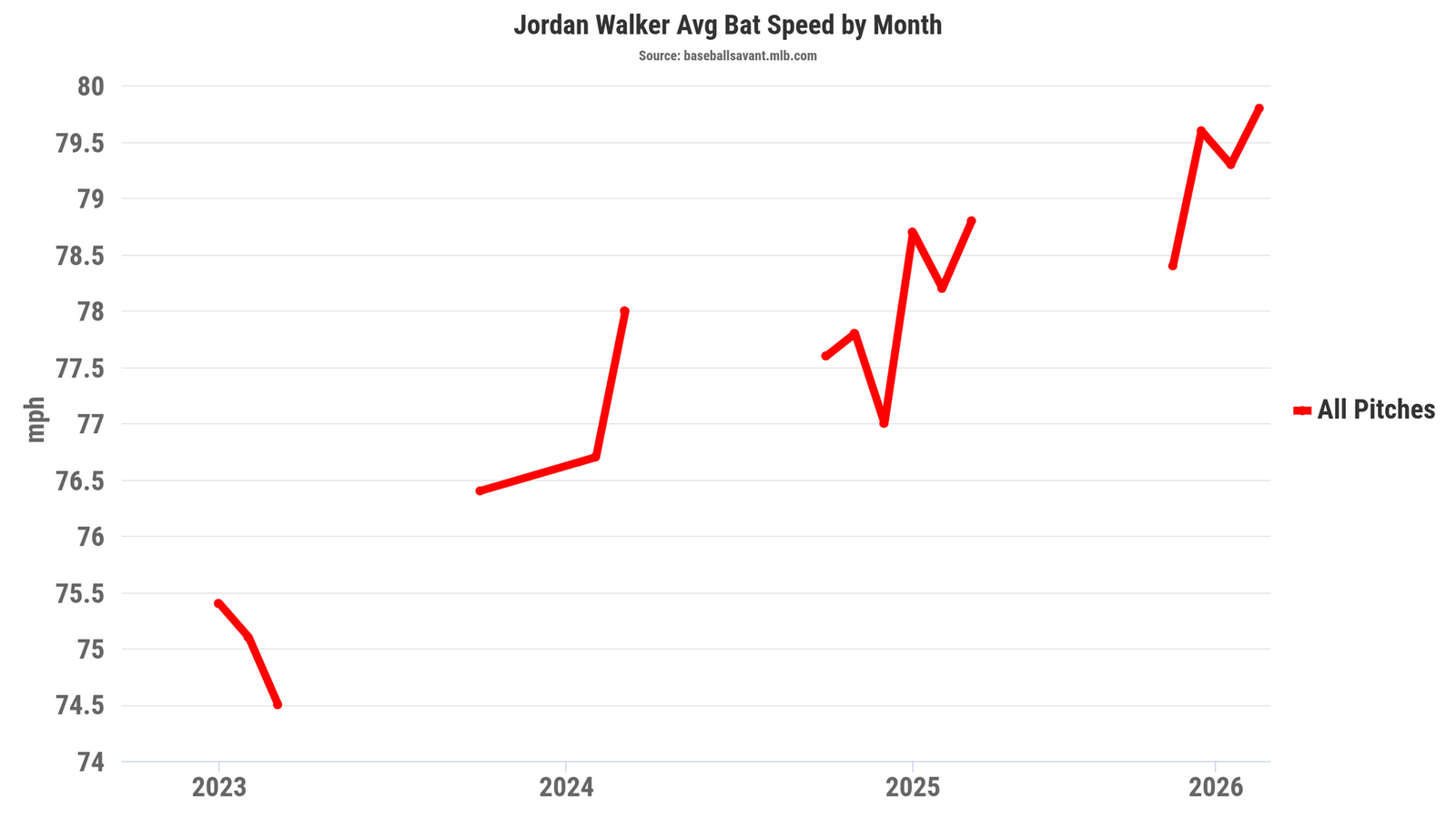 via Baseball Savant Abrams has been on the upside and downside lists a few times now, but his current run of success seems tied to that intertwined space between When and How. He’s pulling the ball in the air at a career-best rate. Rafaela’s hot start could be traced to better discipline, but that has already begun to ebb in what’s becoming a recurring theme for him. As for Crow-Armstrong, his sparkling start is attributable to huge improvements on both fronts. He’s swinging harder, and swinging at a better selection of pitches. Now it’s a matter of carrying both things forward, separately and in tandem, of cracking the Why that allows him to master his When and How. When the Cubs returned to play for the second half on Friday, Crow-Armstrong led off the bottom of the first. He laid off the first five pitches, sprung into action to foul off two fringe offerings with two strikes, and worked a walk. Then he stole second. ⚾️ The Bullpen⚾⚾⚾⚾⚾⚾⚾⚾⚾⚾⚾ It’s good to remember that all this crafting and maintaining of processes is being done by young men, young human beings, still figuring out a lot of things, not just baseball. Longtime Washington Post sports writer and friend of the newsletter Jesse Dougherty is back writing about sports at NOTUS. Last week he published a terrific profile-turned-meditation on James Wood and all the things away from the ballpark that undergird a star turn on the field. Click for the email from his mom, stay for the unexpected way actual meditation comes up at the end. ⚾⚾⚾⚾⚾⚾⚾⚾⚾⚾⚾ The Netflix production of the Home Run Derby, like the streaming giant’s coverage of Opening Day, leaned hard into an approach I’d characterize as “weird showbiz jazz hands.” It felt like the fictionalized quirky sports broadcasts from Dodgeball or Happy Gilmore, just without the benefit of being scripted or funny. Those movie moments work because they are winking acknowledgements of the absurdity at hand. The audience (both inside the film’s universe and outside it) doesn’t and shouldn’t have any long-running attachment to the proceedings. So it’s weird and bad that Netflix employs that tone for events that fans have emotionally invested in for years. Fans take their sport seriously. They care. That baked-in, follow-it-anywhere interest is why Netflix wanted the event in the first place! But once the ink is dry, the hand-off from (forgive the business terms ahead) asset to new product inevitably pivots from respecting the tried and true presentation of the event to a branding exercise that can only charitably described as “creative.” ⚾⚾⚾⚾⚾⚾⚾⚾⚾⚾⚾ The only player to hit a home run in the All-Star Game was Miguel Vargas, the White Sox third baseman quietly anchoring that surprisingly good. lineup. He has improved too steadily over the past few years to make the table at the start of this newsletter, but he fits into the story I told earlier. As Michael Baumann wrote at FanGraphs, Vargas already had good plate discipline and swing path traits. He just didn’t pack the punch to make much of it. Until this year: Adding 3.1 mph of bat speed in one offseason is a huge deal. It’s the biggest year-over-year change this season, and the second-biggest year-over-year change since we got this data in 2023.
The only player who added more bat speed in one offseason? Brice Turang, between 2024 and 2025. You’ll remember how that story panned out.
Bonus Vargas story: Back in the spring of 2023, an injury was preventing Vargas from swinging, but the Dodgers nonetheless had him take at-bats. He seemed to take something real from the experience, and I wrote about it at the time. ⚾⚾⚾⚾⚾⚾⚾⚾⚾⚾⚾ Justin Verlander is retiring. As more teams pull back the reigns on starting pitchers attempting complete games, even when they have no-hitters in progress, I keep thinking about Verlander’s prime years. Teenage me has a distinct memory of announcers ooh-ing and ahh-ing at Verlander riding along in the mid-90s for most of a game before dialing up the real heat in the ninth. Maybe Verlander’s overlap with Jacob Misiorowski or others will represent a passing of the torch, but it’s hard to see that particular art lasting much longer. and Verlander’s career itself is the proof. He has been an outlier all along. In the pitch tracking era, which dates to 2008, no one has thrown more heat in the eighth and ninth innings than Verlander. His 219 fastballs at 98+ mph are tops in that span, followed by Sandy Alcantara’s 181. The third-most? Noah Syndergaard, with 53. Verlander also has the most total late-inning pitches since 2008. If he can get back from injury in time to make one last strong finish, he has another milestone within reach. Since the strike, only CC Sabathia has thrown more innings than Verlander. He could take that title with just six-and-a-third more frames on a big-league mound.
|
Pledge your support to keep The Bandwagon going in 2026
|
|
|
|
|
|