|
OK! We’re back. A lot of things happened while I was traipsing around the picturesque villages and dining destinations of Europe, but we’ve gotta talk about one thing that definitely did not happen: Scoring against Cristopher Sánchez. The Phillies ace hasn’t let a run cross the plate since April. Up to 44 2/3 innings, Sánchez’s scoreless streak is already among MLB’s all-time top 10. If Sánchez manages a clean first inning against the Padres on Wednesday, he’ll match Zack Greinke’s 2015 run for the longest streak since Orel Hershiser’s 59-frame record. And if he makes it through tonight’s start scoreless … the chase will really be on. This would be an enormous baseball record to break or even threaten, by modern standards. The major leagues’ most recent headline statistical achievements have fallen into one of two categories: - Novel combinations, like Shohei Ohtani’s 50-50 season and Ronald Acuña Jr.’s 41-73 season — no one has ever rubbed their belly and tapped their head like that before!
- Records by narrow definition, like Aaron Judge’s American League homer mark or Cal Raleigh’s catcher long ball record — no one has ever climbed that high while wearing a weighted vest!
Those were all exhilarating, don’t get me wrong, but the best baseball record chases come with a well-known destination. Most casual fans have heard of Hershiser’s 59 innings, even if it’s not quite the 56-game Joe DiMaggio hitting streak. It’s a number that means something without explanation or context. It’s a beacon with obvious appeal. The last time we’ve seen one of those records touched is either Max Scherzer’s 20-strikeout game (just tying the record, obviously) or Ichiro breaking the single-season hits record in 2004, probably under-appreciated because of the home run chases that preceded it. (The great missed opportunity of recent years was Jacob deGrom’s 2021 season, in which he might have given Bob Gibson’s 1.12 ERA a run for its money if he hadn’t gotten injured.) So, anyway, Sánchez is on the verge of something special. If he keeps this up, he could eclipse 59 innings in two or three more starts. And that, two or three more, is at the heart of why this record seemingly could be on our minds both now and in the near future. Already this season, we’ve tracked dominant Padres reliever Mason Miller carrying a scoreless streak of 34 2/3 across from 2025. Brewers dynamo Jacob Misiorowski gave up one run (which is not none, but is close) in 38 1/3 May innings. His teammate Kyle Harrison just ripped off a casual 23-inning streak of zeros. Those guys are doing great pitching the modern way: Shorter bursts. In 2026, the average start lasts just a hair over five innings. When Hershiser set this record, the average starter got at least one out in the seventh. You already know the gist of the multi-pronged rationale underpinning this change: More emphasis on all-out effort and missing bats, more awareness of the third-time-through-the-order penalty, less appetite for letting starters work through trouble better handled by bullpen reinforcements. Aesthetically, it could be better. Mathematically, it creates more instances of starting pitchers with a zero in the runs column of their box score. Even as run-scoring has stabilized from its early 2010s nadir, the scoreless start has continued to become more and more common. 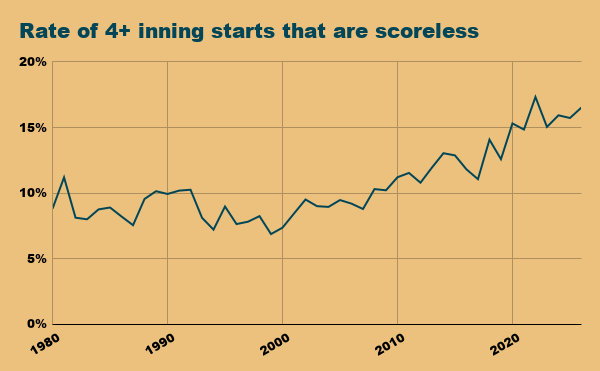 Data via Baseball-Reference Any starting pitcher racking up more than a handful of scoreless outings per season inherently has a chance at stringing together a significant streak. Paul Skenes and Tarik Skubal each logged 12 scoreless starts of at least four innings last season. Blake Snell did the same in 2023. Jack Flaherty did it in 2019. Lots of pitchers every year put together more than a half dozen. Six have already cobbled together streaks of at least three scoreless starts (4+ innings) in 2026. There were only eight such streaks in the entire 2015 season, when Greinke made his bid for this record. In theory, more ping pong balls in the scoreless start lottery should produce more sequences that warrant record-chasing attention. It seems incontrovertible that it’s easier to throw five scoreless innings than seven, but there’s also a reason bullpen games haven’t totally taken over — you’re simultaneously testing the probability of having five good days against one. I wonder what the plan of attack would be if a pitcher and his manager optimized for setting the record. Would he set a course for three five-inning blasts of greatness? Or would he steel himself to go seven or eight just two more times? Probably, the real answer is that this isn’t a thing you can or should optimize for, but it’s on my mind nonetheless. While I was honeymooning, my wife and I indulged in a meal at an acclaimed restaurant in Spain that offers only a very elaborate tasting menu. Over the course of a couple hours, a veritable parade of carefully crafted plates arrive at the table, each one with a detailed explanation of the art behind the food. Starting with one-bite bits and escalating from there, the barrage breaks down the concept of what you think about as a meal. You never think, “Wow, that’s a huge entree” or “We should have split that appetizer,” because each individual portion is an event easily consumed. But after more than a dozen of them, I realized I was probably in uncharted territory, stress-testing long-dormant threads of my belly button. Could I have stomached the same amount of food if it arrived on four big plates instead of 15 small ones? I don’t think so. But I’m not Cristopher Sánchez. His streak spans five-and-a-half starts heading into Wednesday night, and he can’t be accused of exiting early. Each of the five full outings has lasted at least seven innings, with a complete game masterpieceagainst the Pirates included in there. Though his sinker-changeup-slider arsenal has escalated to miss bats entirely, Sánchez’s profile is still that of an efficient groundball pitcher. The lanky lefty definitely doesn’t talk like the type of guy who is going to be overthinking this. He’s not worried about his individual pursuit over grinding out a solid seven innings, and he’s probably just the sort of pitcher who can stare down a few huge meat-and-potatoes starts. Still, Hershiser accumulated his 59 innings in only six-and-a-half outings, with his last start of the streak (and the regular season) spanning 10 innings. If Sánchez is the man to break it, he would take at least seven-and-a-half. If someone else lurking in the wings, or hot on the Cy Young trail like Misiorowski, is the one who steps up, they might take even more starts — or relief appearances — to reach the mark. Is that less impressive? Or more? I hope we get more chase time to think about it. ⚾️ The Bullpen⚾⚾⚾⚾⚾⚾⚾⚾⚾⚾⚾ The big fan phenomenon of the month was shirtlessness. Tarps Off made a splash in baseball most prominently thanks to a college club baseball team that had a very fun time at a few St. Louis Cardinals games. It’s happening all over the place now, having made the jump from college football. The gist is: A section of fans, usually young men, join forces to take their shirts off and whirl them around like rally towels. This first crossed my radar when it was Oklahoma State football fans went shirtless, seemingly as a way to feel anything amid a terrible season for their team. It spread to other schools in moments where fans felt their listless teams needed all the energy it could get, including my school, Virginia Tech. I like that particular framing of it. And I think it fit well with the Cardinals’ arc this year. Are they supposed to be good? No! Are they punchy and fighting and defying some odds anyway? Yes! Manager Oli Marmol’s embrace of baseball’s pioneering group of shirtless enthusiasts, which included inviting them into the clubhouse to celebrate with the team, was delightful, and that’s what I’ll remember. Is it fun for everyone else to do it? Of course, but the full spirit of the thing — in the baseball world — depends on St. Louis. ⚾⚾⚾⚾⚾⚾⚾⚾⚾⚾⚾ The dueling narratives in Detroit are probably both sad for Tigers fans. Tarik Skubal, ace of aces, required surgery to remove loose bodies in his elbow. The famed Dr. Neal ElAttrache used a new-to-the-majors procedure involving a NanoNeedle Scope 2.0, a tool that essentially allows for the surgery to occur with less impact on the joint, and thus a faster recovery time (in theory). The good news is it seems like Skubal is going to prove that prediction correct, as he’s already throwing simulated gamesand rapidly approaching a return. The bad news is the Tigers have been so bad during his absence — 9-22 bad — that his return is now important mainly for demonstrating his renewed health to potential trade suitors. There’s a lot to unpack about Detroit as a whole, a team that has put together two of the best stretches of baseball the league has seen in the past two-plus years, and now also a few of the worst stretches. That is probably for a different day, though. ⚾⚾⚾⚾⚾⚾⚾⚾⚾⚾⚾ If I did the “if May were April” exercise that I performed last year, I might lead with this: Nick Kurtz is now just the best hitter in baseball not named Ohtani or Judge. From his debut on April 23 last year to the end of the season, he was third in wRC+ behind those two, with a 170 mark (meaning 70% better than the average MLB hitter). And this May, he led all of baseball with a 183 wRC+. He is reaching base at an absurd clip, with his overall season OBP up to a league-leading .440, even with relatively less power than he demonstrated last year. The A’s have fallen behind the surging Mariners, but Kurtz is a super-duper-star. ⚾⚾⚾⚾⚾⚾⚾⚾⚾⚾⚾ If May 1 had been Opening Day, here’s how the (hilariously early by any standard) postseason picture would look as of this morning: NL leaders: Brewers (.750), Braves/Phillies (.655), Dodgers (.633) NL wild cards: Braves/Phillies (.655), Pirates (.586), and a three-way tie of D-backs/Nationals/Mets (.533) for the last spot Huh! AL leaders: Rays (.643), Guardians (.633), Mariners (.567) AL wild cards: White Sox (.600) … and then a four-way tie for the last two spots between the Twins, Rangers, Blue Jays and Astros (.500) Huh! (But said with sadness and a little disgust.) ⚾⚾⚾⚾⚾⚾⚾⚾⚾⚾⚾ The ever-expanding Savannah Bananas universe now includes the Indianapolis Clowns, a reincarnation of a Negro Leagues team that played up some ugly stereotypes while performing a precursor to the Bananas’ mashup of competition and entertainment. The Atlantic has a strong exploration of the team’s return, written by Josh Levin, that tries to understand the tightrope being walked by Black players and fans. These new Clowns include young Black players turning to the Bananaball world for a second chance to make a living playing baseball and also literally Jackie Bradley Jr. I want this group to succeed in illuminating a complex, true history about the joy of Negro Leagues baseball and the negative motivations that drove some of the shenanigans, but I can’t say the story left me trusting the Bananas’ leadership to do that. At one point, the organization’s entertainment director explains the planning behind the team’s concept: Early on, when Meyer and his colleagues were kicking around concepts for the team, he worried that they might be veering into whoa territory. He told me that he wrote up a five-page memo, essentially laying out the difference between a “minstrel show and the brand of today.” His takeaway: “If we’re super heavy in making these guys look like clowns, then we’re really playing into this just negative part of the history.”
But by the end, Levin tells us that the Bananas stopped responding to his questions, and Meyer never passed along that memo as promised. ⚾⚾⚾⚾⚾⚾⚾⚾⚾⚾⚾ The Bandwagon is a labor of love, but it still needs your support. If you enjoy the work here, please consider pledging a contribution to keep the newsletter going strong. I’ll be back soon to catch up on more of what we missed while I was away.
|