| Bloomberg Evening Briefing Americas |
| |
| Over the past 12 months, the US has seen every norm of economic policy—trade, fiscal, monetary—tossed aside, Clive Crook writes in Bloomberg Opinion. At the same time, the American economy stands at the precipice of a revolution just as tectonic as the transition from farming to manufacturing, or manufacturing to services. The difference is that the artificial intelligence revolution could happen a lot faster. Where will this unprecedented surge of disruption lead? Everybody who claims to know is either lying or deluded, Crook writes, leaving us with what’s called “radical uncertainty.” The models that guide expert predictions rest on data that have never encountered shifts like these—certainly not all at once. Measures of risk that are based on established patterns are therefore essentially useless. If the US economy crashes next year, there will be far too many causes to choose from. Yet far from crashing, maybe the economy is on the cusp of a productivity revolution, powerful enough to overwhelm every choice that Donald Trump and his successors might make. Nobody knows, Crook says. This is as radical as uncertainty gets. —David E. Rovella | |
What You Need to Know Today | |
| China has officially launched a national venture capital fund and three large regional funds, together worth billions of dollars, as part of a push to foster home-grown tech champions. The National Startup Investment Guidance Fund is backed by 100 billion yuan ($14.3 billion) from the Ministry of Finance through the issuance of ultra-long special sovereign bonds. China is ramping up its push for technological breakthroughs as competition with the US intensifies in areas such as semiconductors. Tighter fiscal conditions—including rising debt risks and weaker revenue—have forced Beijing to be more disciplined about how it invests. At the same time, the rise of AI startup DeepSeek demonstrated the effectiveness of private capital. The national fund will run for 20 years—with 10 years devoted to investment and another 10 to exits. This will help support long-term growth of companies and cultivate what officials have called “little giants,” smaller firms aligned with the government’s tech priorities, as well as unicorns across industries. | |
| |
|
| Forget the dollar, Uruguay says. The South American nation’s central bank chief wants to convince savers in one of Latin America’s most dollarized nations that their love affair with the US currency is bad—bad for the economy and bad for their wallets. Guillermo Tolosa plans to implement measures to boost the use of the Uruguayan peso as part of a strategy to develop a domestic capital market that could benefit local borrowers—from corporates and individuals to the government itself. Uruguay’s move to reduce its reliance on the greenback also reflects a broader international debate about the future of the dollar and its eroding appeal, especially amid Trump’s trade war and his radical policy turns. The dollar’s share of central bank reserves slipped from about 71% at the turn of the century to almost 59% last year, according to data from the International Monetary Fund. | |
| |
|
| |
|
| Brazil’s central bank is facing extraordinary scrutiny over its decision to liquidate Banco Master, a rare instance of judicial intervention that may risk undermining the legal certainty of its regulatory decisions. Both the country’s Supreme Court and Audit Court are seeking details about the move, with the regulator facing a looming deadline to provide information. The liquidation followed months of investigations into Banco Master’s operations and its politically connected chief executive, Daniel Vorcaro. Once touted as a rising star in Brazilian finance, Master attracted billions of reais from retail investors through investment platforms, promoting its bonds as safe because they were backed by Brazil’s deposit insurance system. A central bank rule change in December 2023 however punched a hole in Master’s business model. | |
|
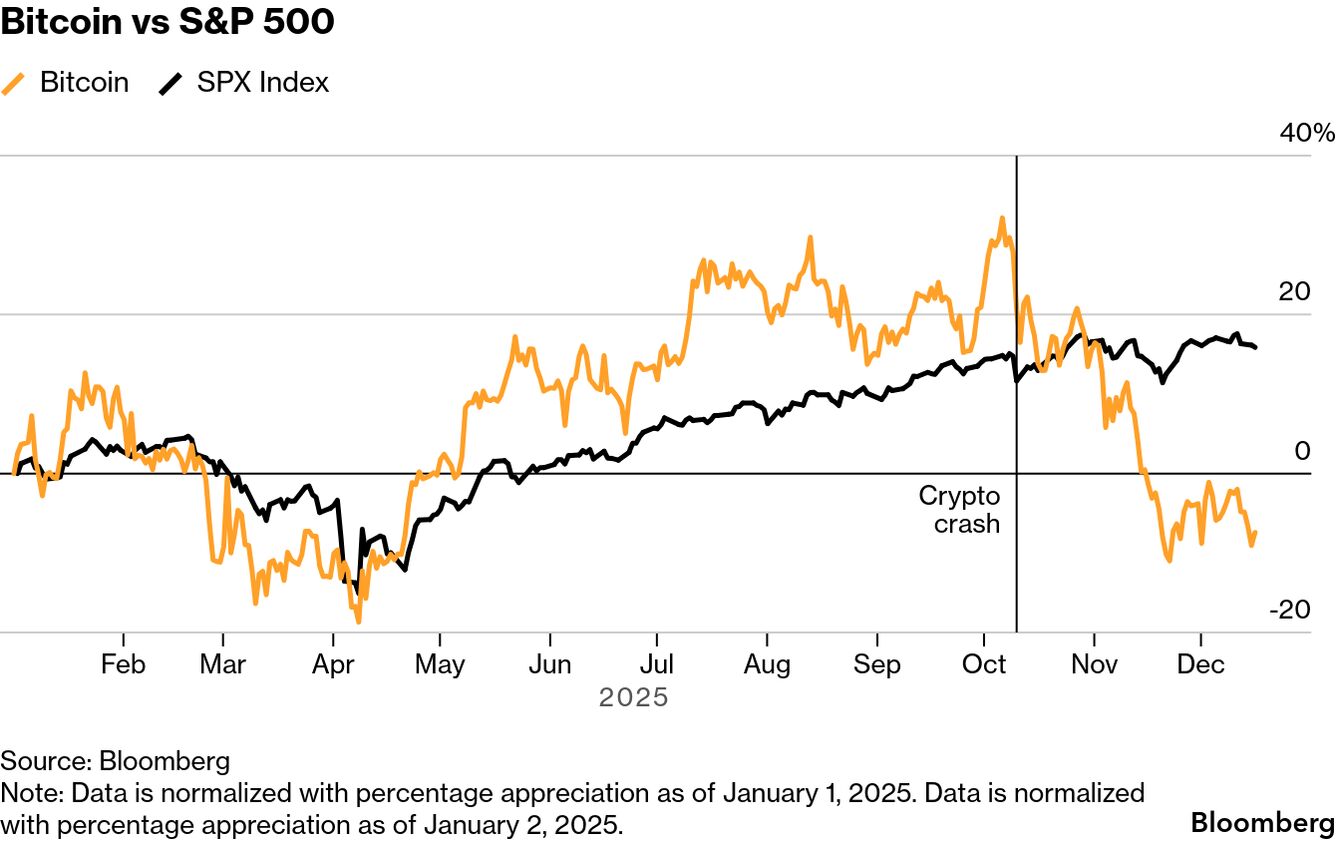
| It looks like Bitcoin may be good for something after all. The funny money’s 30% slide from its all-time high is creating conditions financial advisers say are likely driving more tax-loss harvesting in digital assets than in previous years. While the world’s largest cryptocurrency by market value is down 5% year-to-date, the equity benchmark S&P 500 has gained roughly 18% in the same time period. This divergence gives investors holding both assets a clear incentive: sell underwater crypto positions to offset their stock gains before Dec. 31, especially those who bought the digital asset near its October peak. In the practice of tax-loss harvesting, an investor sells an asset at a loss, and then uses it to reduce their taxable income. Initially, losses offset any capital gains dollar-for-dollar. If they exceed gains, up to $3,000 can be deducted from ordinary income each year, with any additional losses carried forward to future tax years. The result of this? A lower tax bill. | |
| |
|
| Trump’s social media post announcing yesterday’s attack on Nigeria called it a strike at Islamic State terrorists who target Christians. The issue of Christian persecution in Nigeria has long animated right-wing circles, with Trump amplifying such claims in his first term and escalating that rhetoric in his second. The Christmas Day attack earned him praise from far-right supporters such as Laura Loomer, an informal adviser whom the Associated Press reported was previously “banned from social media sites because of her racist and anti-Muslim speech.”  Nigerian police on Friday at the scene of a US airstrike on Jabo, Nigeria. Photographer: Tunde Omolehin/AP Photo Officials in Nigeria, however, have called such claims “simplistic,” noting that there is an ongoing regional conflict, rather than a religious one, in which groups of so-called bandits or militias often target Muslim communities as well. As for the American attack, which was later confirmed by Nigeria, it was reportedly aimed the Sokoto region of northwestern Nigeria, an area where a local Catholic bishop recently said Christians aren’t facing persecution. The AP reported the group the US may have been targeting is unrelated to the Islamic State. | |
|
| |
What You’ll Need to Know Tomorrow | |
| |
| |
| |
| Enjoying Evening Briefing Americas? Get more news and analysis with our regional editions for Asia and Europe. Check out these newsletters, too: Explore all newsletters at Bloomberg.com. | |
| |
Before it’s here, it’s on the Bloomberg Terminal. Find out more about how the Terminal delivers information and analysis that financial professionals can’t find anywhere else. Learn more. Want to sponsor this newsletter? Get in touch here. | | | You received this message because you are subscribed to Bloomberg's Evening Briefing Americas newsletter. If a friend forwarded you this message, sign up here to get it in your inbox. | | |