

On Friday night, the U.S. government banned Anthropic’s distribution of Fable 5 and Mythos 5 to non-U.S. nationals. In response, Anthropic disabled Fable for all customers. As of this writing, the situation is ongoing.
It remains to be seen how it will play out, but I can already see the difference in my AI usage. Here’s a graph comparing my Claude and Codex usage before and after the ban (the “event” below):
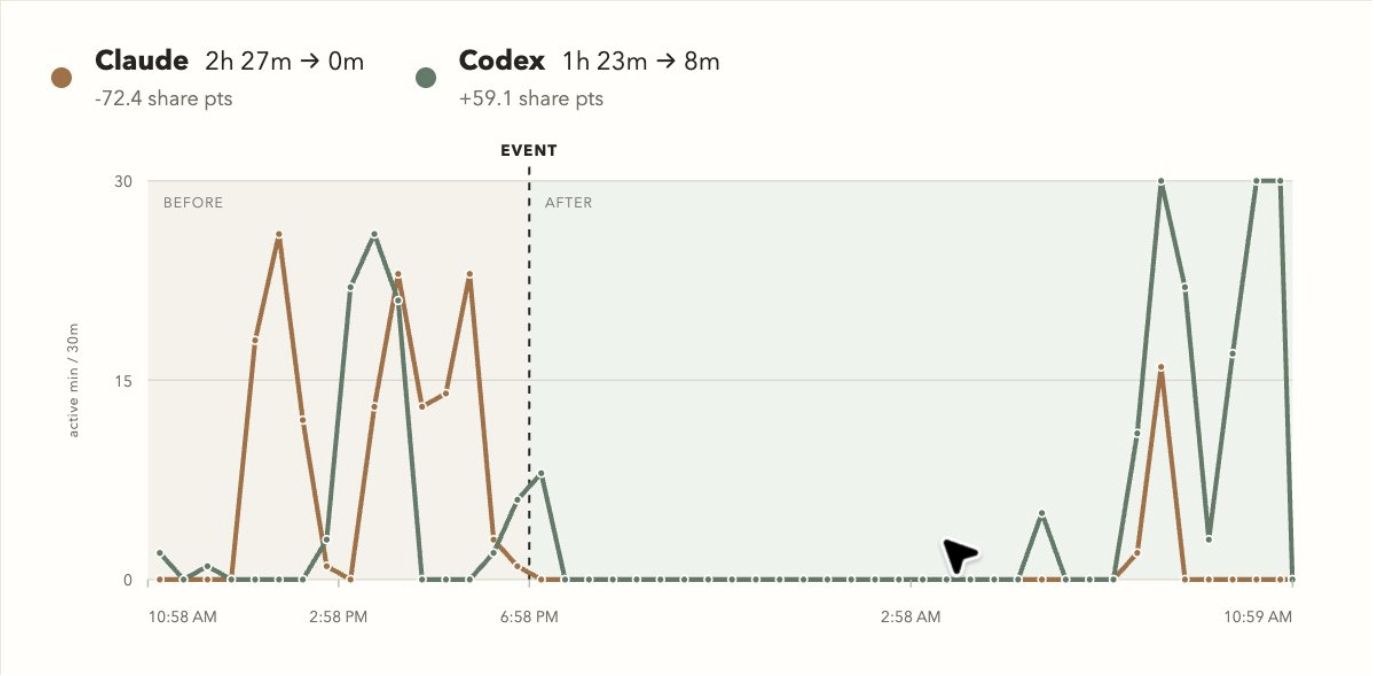
Before the ban, I was split about evenly between Claude and Codex. After (and after a period where I was using neither because I was sleeping), I switched almost entirely to Codex.
My guess is that this ban is not going to last very long. It seems to rest on a misunderstanding between the government and Anthropic about which kinds of guardrail bypasses are fixable and what counts as an adequate solution. Anthropic believes the jailbreak identified by the government is narrow rather than universal—it surfaces only minor vulnerabilities that other public models are already susceptible to. The government apparently believes otherwise. Because both sides are highly incentivized to work this out, I’d bet that the ban is revoked after a few days—and demand for the newly returned Fable skyrockets.
However, this kind of move is extremely disruptive and distracting for people working at Anthropic. The only comparable scenario I can remember is Sam Altman’s firing, which was resolved relatively quickly. Even though Altman was reinstated, I do think the chaos disrupted the company’s momentum for months afterward.
We’ll keep a close eye on whether the same is true here.—Dan Shipper
Was this newsletter forwarded to you? Sign up to get it in your inbox.
Knowledge base
“Vibe Check: Fable 5 Is the Best Coding Model in the World” by Dan Shipper and Katie Parrott/Vibe Check: Anthropic’s Fable 5, the first model in its Mythos class, tops every model Every has tested on coding. It’s also overpowered, and overpriced, for most everyday work. Dan and Katie Parrott ran it through Every’s standard evaluations and landed on one rule: Reach for it on long, complex, minimally supervised tasks, and stay with GPT-5.5 or Opus 4.8 for the rest. Read this for the head-to-head verdict and when Fable 5 is worth the cost.
“How to Get the Most Out of Fable 5” by Laura Entis/Context Window: The fastest way to be let down by Fable 5 is to prompt it like GPT-5.5. It rewards organized context, a clear definition of done, and room to run, shown through four worked examples: senior engineer Nityesh Agarwal repairing a broken PowerPoint-generation workflow, head of growth Austin Tedesco building a go-to-market strategy from scratch, Cora general manager Kieran Klaassen batching scattered product feedback into one set of changes, and head of platform Willie Williams building from a detailed original plan. It comes with a copy-ready Claude Fable 5 prompt library to start from. Read this for the before-and-after prompts.
“AI Everywhere, All at Once” by Laura Entis/Context Window: Four Every team members rewire their setups for Fable 5: Austin saves it for hours-long “rocket launcher” projects, Kieran makes it the middle of his “AI sandwich,” Willie argues the one thing even the best models can’t do is vibe, and head of tech consulting Mike Taylor keeps it away from confidential client work, since its environment can retain context past a task and break an NDA. Plus a dispatch from Apple’s developer conference, where Monologue general manager Naveen Naidu finds a Google-powered Siri that’s finally good and Apple opens free on-device AI to smaller apps, and senior designer Daniel Rodrigues also breaks down how he builds Every’s animated hero images. Read this for the four setups and the Apple developer shift.
🎧 🖥 “How Anthropic Uses Claude Fable 5 With Mike Krieger” by Dan Shipper/AI & I: Mike Krieger—Instagram’s cofounder and now head of Anthropic Labs—shows Dan how Anthropic itself works with Fable 5, handing the model long, ambitious jobs at night and trusting they’ll be done by morning. Watch or listen to this for how the people who built the model use it. 🎧 🖥 Listen on Spotify or Apple Podcasts, watch on YouTube, or follow the discussion on X.
“My Editor Caught Me Sounding Like AI. Now AI Catches Me First.” by Katie Parrott/Working Overtime: Katie found a list of her own writing tics—symmetrical sentences, throat-clearing introductions, and phrases that sound like something but say nothing—in a shared document with her editor. So she built a Spiral skill that encodes those tells and flags them before her editor has to. Read this for the build-your-own-AI-editor workflow.
“The Moral of Fable” by Dan Shipper/Chain of Thought: Fable 5 is the best coding model in the world, but to most knowledge workers it feels incremental. The people within Every feeling its full force have changed how they work: Kieran now hands whole projects to agents and folds what he learns into the next run. The catch is cost: Fable burns tokens fast enough that running it takes serious capital, which could put the frontier out of reach for most. Read this for what AI-native work looks like at its best, and who can afford it.
Log on
Get hands-on with how Every uses AI. These are the live camps, workshops, and meetups where team members teach the workflows behind our work.
Upcoming camp
- Codex Power User Camp: On June 26, Dan and the Every team host a two-hour live walkthrough of the Codex power-user guide, including setup, workflows, and Codex-native app development. Learn more and register.
Recordings you may have missed
- Fable 5 Camp: On June 12, Dan and the Every team hosted a live walkthrough of how to get the most out of Fable 5—setup, prompting, and the workflows built around long, hands-off tasks. Watch the recording.
Alignment
Uncharted waters. Last week, Anthropic, now worth close to $1 trillion, asked the world to pause AI development because of how close we may be to AI recursively improving itself. In the same week, a team at Columbia University edited the genes of human embryos, correcting mutations tied to high cholesterol and a blood disorder by swapping a single letter of DNA.
Depending on your disposition, this is either exhilarating or terrifying—probably both. I don’t know what the right guardrails are, or whether I believe they’re actually enforceable. But each week as I read the headlines, some part of me desperately wants to go back to 2008, when I was in high school and the most destabilizing thing in my world was beefing with my arch-nemesis on Facebook. That world is long gone, and isn’t coming back. We’re in uncharted waters now, and the only thing left to decide is whether we sail with our eyes open or closed.—Ashwin Sharma
That’s all for this week! Be sure to follow Every on X at @every and on LinkedIn.
We build AI tools for readers like you. Write brilliantly with Spiral. Organize files automatically with Sparkle. Deliver yourself from email with Cora. Dictate effortlessly with Monologue. Work on documents with AI agents using Proof.
For sponsorship opportunities, reach out to sponsorships@every.to.