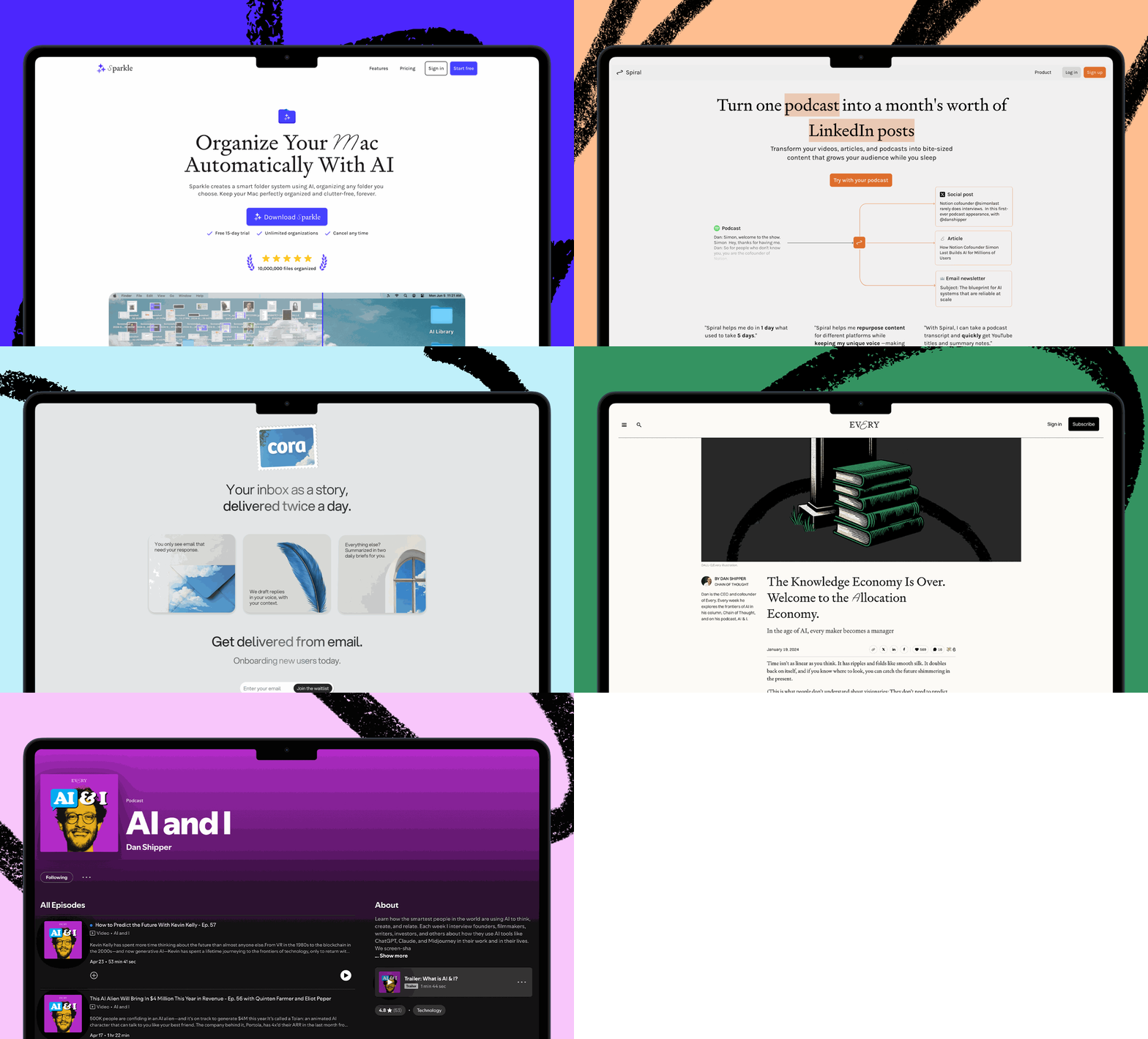

Hello, and happy Sunday. This week paid subscribers got Katie Parrott’s prompt for making Codex interview her before it builds anything, so her setup fits how she works, and two workflows from Lee Knowlton: orchestrating a team of agents by voice while he does the dishes, and turning three years of his daily runs into an interactive chart in one shot. And Mike Taylor went hunting for the best AI agent builder in enterprise software and found it buried inside Microsoft’s Copilot. Upgrade to get all of it.—Kate Lee
Was this newsletter forwarded to you? Sign up to get it in your inbox.
Knowledge base
🔏 “The Best AI Agent Builder Is Trapped Inside Microsoft” by Mike Taylor/Also True for Humans: Mike makes the case that Microsoft’s Copilot Studio is the best agent builder available, because it lets agents call other agents—so you can get several agents working together on a task without building the setup yourself. The catch is finding it, under the onboarding, the 404s, and the 80-odd things Microsoft calls Copilot. Read this to find Copilot Studio and put it to work if your company already runs on Microsoft tools.
🔏 “A Codex of One’s Own” by Katie Parrott/Context Window: Every’s head of operations Arielle Shipper and head of consulting Natalia Quintero compared their Codex setups and found them almost nothing alike—one was built on minimal process, the other on detailed planning and supervision. Katie had Codex interview her before building anything, asking about her recurring work, active projects, and which decisions she wanted to keep making herself. Also inside: a Signal on Demis Hassabis stepping back as CEO of Google DeepMind and Meta’s Muse Code launch, plus the models the team is driving this week.
🔏 “Mini-Vibe Check: ChatGPT Voice Mode” by Laura Entis/Context Window: The team spent a week with GPT-Live—fixing bugs, drafting outlines, booking flights, and running agents while cooking. Engineer Lee Knowlton read a technical text aloud while voice mode answered questions against his live codebase. COO Brandon Gell found that mobile voice mode couldn’t reach past the current chat to the work on his computer. The verdict: “both not quite there yet and obviously the future.” Also inside: an AI & I with Benchmark partner Sarah Tavel, who thinks the next big AI product will be social. 🎧 🖥 Listen on Spotify or Apple Podcasts, watch on X or YouTube, or read the transcript.
“Designing With AI? Make a Jig.” by Jack Cheng: Borrowing a term from woodworking—a jig is a tool that makes it easier to build something else—Jack had his coding agent build on-page control panels to tune the AI-generated code behind our interactive OpenAI piece, “Before the Deluge.” Prompting was too coarse for fine adjustments; one jig gave him 27 sliders to shape a single step of the story. Read this for how the jig is changing AI-assisted design, plus a prompt to build your own.
The unlearning series
Three instructors from Maven share the hard-won habits AI is forcing them to unlearn.
“Drowning in Demos? Here’s a Better Way to Prototype” by Hilary Gridley: When AI tools like Bolt and Replit made prototyping cheap, Hilary’s product team at Whoop went from five prototypes to 30—and found the team was building faster without deciding better. Her takeaway: Once you can build almost anything in an afternoon, first ask whether the idea is worth chasing. Read this for how to keep cheap prototypes from turning into noise.
“Three New Habits for the Age of AI” by Xinran Ma: Xinran left a corporate design job to write the Design with AI newsletter, which now has more than 44,000 subscribers. Going solo forced him to drop three habits: waiting for certainty, forming opinions on tools he hadn’t tested, and looking up for permission. Read this for what that kind of unlearning looks like in practice.
“To Stay Ahead in AI, Think Like a Designer” by Aishwarya Reganti: Aishwarya is a data scientist who calls herself a designer—not of interfaces but of decisions. The former Amazon AI scientist and LevelUp Labs founder argues that once AI takes over execution, your expertise must shape your work before it starts—or your expertise doesn’t shape anything. Read this for how she applies that in her own work.
Log on
Get hands-on with Every’s AI workflows. These are the live camps, workshops, and meetups where team members teach the workflows behind our work.
This week’s camp
- Voice Mode Camp: our one-hour virtual session for paid subscribers, where the Every team demonstrated practical voice workflows for writing and agent orchestration and answered live questions. Watch the recording.
From Every Studio
Every Agent turns off the Plus Ones
Plus Ones were Every’s hosted OpenClaw agents: one AI coworker per person, each living in your Slack on its own cloud server. We learned that a dedicated server per person is expensive and requires constant maintenance. This week we shut off the last Plus One. The idea lives on as Every Agent: an AI coworker in your Slack that serves your entire company. Invites to the Plus One waitlist are going out now.
Alignment
The patent maze. Imagine you develop a new way to measure what genes are doing inside individual cells. You might think you have finally secured generational wealth for your family. But then the patent lawyers arrive, and you discover that parts of your method—from preparing the cells to labeling and sequencing them—may infringe overlapping patents held by life science companies and universities. Congratulations: You have invented a lawsuit.
The risk of patent infringement is one reason a startup may remain in stealth for years while it assesses whether launching will trigger an infringement claim. Companies sometimes agree to exchange licenses but often only after both sides have spent considerable time and money fighting.
Jake Taylor-King, the cofounder of drug discovery startup Relation, and Michael Young, the founder of clinical-trials startup Lindus, describe a possible way through the patent maze in their roadmap for AI drug discovery. They argue that AI could move patent analysis from the end of product development to the beginning.
AI agents could split a laboratory technology into its individual steps—the sample preparation, barcodes, enzymes, surface chemistry, and sequencing method—then search patents, abandoned applications, research papers, conference posters, and old equipment manuals. They could flag which claims could block development and where another technical route to the same result might remain open.
AI would not replace the patent lawyer or invalidate a strong patent. It would let a startup find the dead end in a database before spending years in the lab.—Ashwin Sharma
That’s all for this week. Follow Every on X at @every and on LinkedIn.
Everyone’s a builder now. Every All Access gets you the full membership plus the Builder Pack—$9,000+ in credits for the tools we build with.