


Tomorrow, more than 400 founders, executives, and builders will gather in Brooklyn for Thesis: 2027 to explore what great human work looks like after automation. Speakers include OpenAI’s Andrew Ambrosino, Notion CEO Ivan Zhao, and Browser Company cofounder and CEO Josh Miller. Every editor in chief Kate Lee will also moderate “Media After AGI,” a conversation with the Atlantic CEO Nicholas Thompson and tech journalist Kevin Roose. If you can’t join us in person, register for free to watch the livestream.
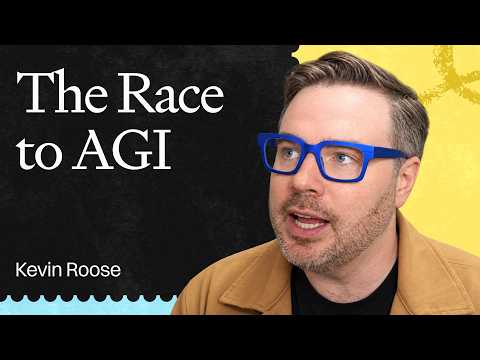
Ahead of the conference, we sat down with Roose on The Every Podcast to discuss his new book and the people shaping AI’s future.
Was this newsletter forwarded to you? Sign up to get it in your inbox.
Kevin Roose is obsessed with the moments in history when “the fabric of the world changes or goes in a new direction.” The race to build artificial general intelligence (AGI)—a world-saving or world-ending technology, depending on who you ask—is one of those moments. Roose has spent the past decade reporting on that race, with access to the people and decisions shaping it at OpenAI, Anthropic, and Google DeepMind.
For his new book, The AGI Chronicles, Roose interviewed 150 people to uncover a history largely hidden within AI labs and guarded by nondisclosure agreements. The book goes inside the labs where researchers train and test AI models, including what went on behind the scenes of Sam Altman’s dramatic firing and reinstatement at OpenAI.
In his second appearance on The Every Podcast, Roose joins Natalia Quintero to discuss his role in making sense of Silicon Valley for the wider world and the questions that guided his book: “Are we careening toward an existential cliff? Is it all hype?” His reporting left him convinced that while the risks are real, the outcome isn’t predetermined. “I don’t think anything is set in stone or predestined,” he says. “The choices we make right now matter a lot in terms of how the next few years or few decades go.”
Watch on X or YouTube or listen on Spotify or Apple Podcasts. You can also read the transcript.
Here are the highlights:
- The moment Roose “felt” the AGI. At OpenAI, Ilya Sutskever was known for walking desk to desk telling colleagues, “You must feel the AGI,” a phrase Roose borrows in The AGI Chronicles. Roose first felt it during his encounter with Sydney, “the deranged alter ego of Microsoft’s Bing chat function.” It wasn’t sentient or conscious, but the technology underneath it was powerful enough to make him want to understand how AI systems are built and what drives the companies racing to release them—sometimes cutting corners to beat their rivals.
- He had a “council of Claudes” review his work. Roose wrote all 450 pages of the book in a year with “this brain and these fingers,” supported by human editors and a researcher. He used AI to organize his research in NotebookLM and review his chapters using a “council” of Claude agents, which included an AI skeptic, an AI historian, and a “Walter Isaacson–style craftsperson” who judged whether the story was a joy to read. A master editor agent combined their feedback into a single document. The council caught a couple of factual errors his human editors had missed—a sign, Roose says, of how much the tools have improved.
- He sees his role as “demystifying” AI for the public. Roose has always loved exploring technology, from building web pages as a kid to tinkering with new AI tools today. His role as a tech journalist is also to explain these technologies. He recently left the New York Times to start a media company with Casey Newton, his longtime Hard Fork co-host. Their new show, Machine Gods, produced in partnership with NPR, aims to make AI “fun and accessible”. “The most important thing I could be doing at this moment,” he says, “is helping people understand what’s going on in San Francisco at these AI companies, with AI in general, and what it means for their lives and how they should prepare and adapt.”
Listen for an inside account of the people and decisions that shaped modern AI—and the choices still to come.
Miss an episode? Catch up on recent conversations with Sam Altman; Emmy-winning TV writer Fred Graver; Hugging Face’s first investor, Matt Hartman; Granola founder Chris Pedregal; writer Craig Mod; GitHub COO Kyle Daigle; Anthropic head of product Mike Krieger; and others to learn how they use AI to think, create, and relate.
Natalia Quintero is the head of enterprise AI adoption at Every. To read more essays like this, subscribe to Every, and follow us on X at @every and on LinkedIn.
Thanks to Miriam Partington for editorial support.
Everyone’s a builder now. Every All Access gets you the full membership plus the Builder Pack—$9,000+ in credits for the tools we build with.