

Hello, and happy Sunday. Head of evals Mike Taylor found that a writing skill tuned to one model can beat a stronger model running a generic skill, and we Vibe Checked OpenAI’s GPT-6.2 Astra and Sol and Google’s Gemini 4 Neon. Also new this week: Every filmed talk from Thesis: 2027 now comes with a skill file you can give your agent. And Ashwin Sharma reflects on his return to Jhourney, a meditation retreat that seems to suit ambitious, type-A overachievers.—Grant Harvey
Was this newsletter forwarded to you? Sign up to get it in your inbox.
Protocols
From this week’s stories, three skills to try.
Make AI write like you
From Mike Taylor’s “How I Finally Got AI to Write Like Me”
Mike has been trying to get AI to write like him since 2020. What finally worked was testing drafts against his published posts, not describing his style. He now goes from an opinion to a finished piece in about an hour instead of a day. Here’s how to build your own version:
- Strip your best work down to the substance. Gather 12–25 recent pieces in one format and set a few aside for a final test. Have AI turn each piece into a plain brief with the thesis, facts, and quotes. The steps
- Let a judge pick between two drafts. Give an AI judge the original and two drafts from the same brief. Ask which sounds more like the original, then swap the drafts and ask again to account for order bias. The judge
- Optimize the skill as you go. Test each change with the model you’ll use to draft. Keep the changes that improve the skill’s score, then test the finished skill on the pieces you set aside. The skill
Vibe Checks
“Vibe Check: GPT-6.2 Astra and Sol Leave Us Wanting More” by Katie Parrott/Vibe Check: OpenAI’s newest models are careful and candid: They follow the assignment, say when they fall short, and don’t game the test. But Astra drifts from the main point in longer drafts and reuses the same look in its designs (Kieran Klaassen of the frontier team kept getting mountains he never asked for). All six testers who rated Astra gave it yellow, and four of the five who rated Sol gave it red, so hand them clearly scoped work.
“Mini-Vibe Check: Four New Geminis. When Should You Pick Neon?” by Katie Parrott/Vibe Check: Google DeepMind added four models to its Gemini 4 lineup in little more than five weeks, and Neon, its newest, midweight model, is the one we’d pick for work we can steer. Katie rewrote her word processor so she could keep writing with Neon, and Kieran now pairs it with Opus 5.5 for coding at the keyboard. Mike says it made the best slide deck he’s seen from a Gemini model, but it burns through tokens.
Knowledge base
“Microsoft’s CEO Wants Every Company to Own Its Own Model” by Grant Harvey/Context Window: At a Microsoft Ignite roundtable, Satya Nadella said he’s “AGI-pilled,” but his bet is that the world won’t run on one firm providing models for everyone else, so he plans to turn the model business into a database business to make “as many models as firms.” Plus: new datapoints on the SaaSpocalypse, and the models 11 Every teammates are using this week.
🎧 🖥 “Notion’s Founder on the One Thing Your AI Is Missing” by Dan Shipper/The Every Podcast: In a conversation from Thesis: 2027, Notion CEO Ivan Zhao tells Every CEO Dan Shipper when it makes sense to build your own tools, why what your agents can read and use matters more than the app you use to talk to them, and how Notion tracks what its agents build. Watch on X or YouTube, listen on Spotify or Apple Podcasts, or read the transcript.
“What We Let Our Agents Buy” by Grant Harvey/Context Window: ChatGPT Wallet makes it easier for agents to buy things, but the struggle to decide what to buy remains. We asked the Every team what they will and won’t let their agents buy for them. Plus: why AI rollouts fail on people, not models; and how Katie built Wordbetter, a word processor with her Compound Writing skills built in.
Thesis: 2027, as skills
Take a talk home to your agent
Every filmed talk from Thesis: 2027, our first conference, now has its own skill file that you can install in Claude, Codex, or any other agent and use to work through the speaker’s method on your own projects. Paid subscribers can download it below each recording or have their agent pull it through the Every MCP.
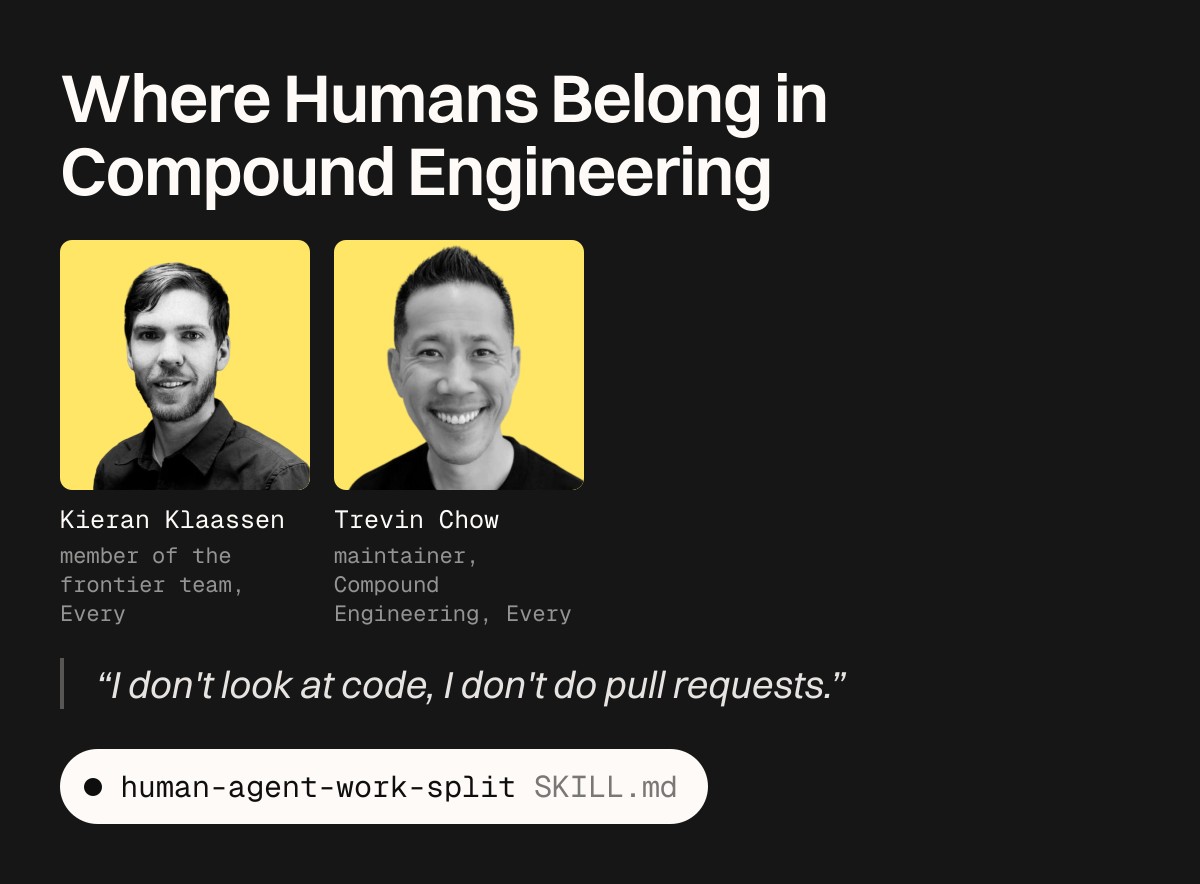
human-agent-work-split: From a Classroom session with Kieran and Compound Engineering maintainer Trevin Chow. It uses their “compound sandwich”—you decide what to build at the start and judge the result at the end, while agents do the work in between—to sort each kind of task into one of four buckets depending on the stakes. Get the skill
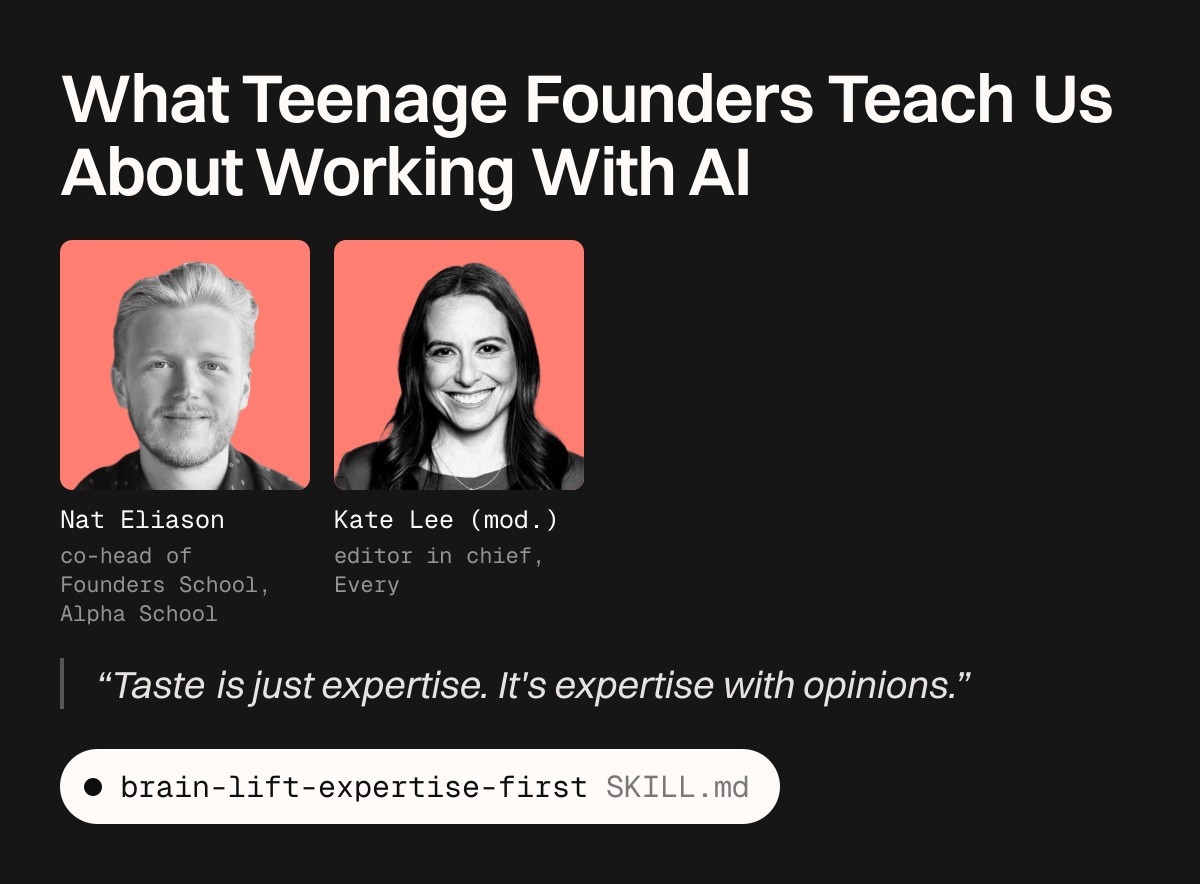
brain-lift-expertise-first: From a fireside chat with Nat Eliason, co-head of Founders School at Alpha School, and Every editor in chief Kate Lee. It coaches you to build expertise in your field before leaning on AI, so the model works from your opinions instead of falling back on generic output. Get the skill
Use it now: Pick the talk closest to a problem you’re working on this week, install its skill, and ask your agent to walk you through it. All 23 skills are on Every TV.
Log on
Get hands-on with how Every uses AI at live camps, workshops, and meetups.
Previous events
- GPT-6.2 live re-Vibe Check: The public version of the new Astra improved on Mike’s junior engineer benchmark but still trails Fable 5.2, and designer Tyler Nishida found the same grain-texture code in 94 percent of Astra’s designs, even after he told it not to use grain.
- All Access Office Hours: On Friday, All Access members spent an hour with the Every team discussing what we’ve been building and what’s coming up. Office hours run monthly and are open only to All Access members, who also get the Builder Pack: more than $9,000 in credits for the tools we build with. Get All Access.
- Thesis: 2027: All 25 sessions are available now for paid members and are rolling out free on our YouTube channel. Check out “How Established Companies Become AI Companies” with Ode staff software engineer Hugh Wimberly, Anthropic research product manager Jeremy Hadfield, and Every head of platform Willie Williams. Ivan Zhao’s conversation with Dan is now on The Every Podcast.
Alignment
Ahhh. I’m lying on a carpeted floor around 4:30 p.m., my arms and legs spread out like a starfish. I’m breathing in, out, in, out, in a smooth rhythm. A tingling sensation spreads across my cheeks and darts through my hands and toes. Emotions start to bubble up in the center of my chest until anxiety arrives, tight and prickly. I welcome it like I’m saying hello to a dear old friend.
These are some of my notes from a breath work session on my second jhana retreat, run by Jhourney, which teaches techniques (or jhanas) for accessing the states of deep absorption and bliss described in Buddhist meditation. I returned to the retreat because I feel disconnected from myself. I’m preparing for a wedding, I’ve started a new job, and, for some masochistic reason, I’m building a biotech-focused media company. There’s been a lot of overwhelm and dissociation, making the past six months a blur.
I first heard of Jhourney through Dan’s podcast conversation with author and researcher Nadia Asparouhova. This time, the most valuable part was the relief of sitting with something difficult without giving myself a hard time for experiencing it. When anxiety came up, I imagined a guesthouse and invited it in. When I noticed myself resisting the anxiety, I welcomed that feeling, too. Giving both a place to be helped me feel more at home in myself.
I came back to London feeling grounded, and some of that is still with me. There’s still a wedding to plan and a company to build, but I want to practice being there for myself whenever life gets overwhelming. I’m working hard to build a life I want to live. I’d just like to be present for it.—Ashwin Sharma
Grant Harvey is a staff writer at Every. To read more essays like this, subscribe to Every and follow us on X at @every and on LinkedIn.
Thanks to Eleanor Wikstrom for editorial support.
Everyone’s a builder now. Every All Access gets you the full membership plus the Builder Pack—$9,000+ in credits for the tools we build with.