



The usual question about AI writing is “Did a human write this, or did AI?” We think that’s the wrong frame. Writing is a process of thinking, developing ideas, drafting, editing, and publishing. AI can help throughout, but AI doesn’t write. People write with AI, well or poorly.
At Every, we’ve explored this for years. Dan Shipper wrote an early guide to writing essays with AI, Katie Parrott has documented her process in Working Overtime, and Laura Entis recently argued in defense of the practice. We’ve also shared how our editorial team uses AI and published guidelines requiring human authors to stand behind every piece.
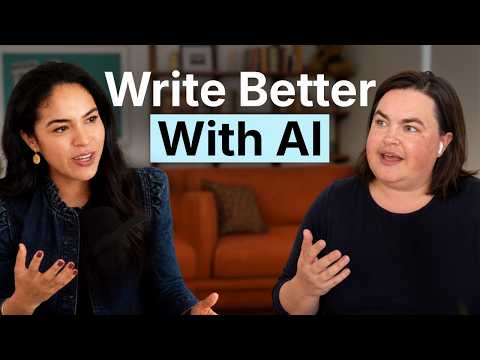
How We Write Now is a series about those processes. We’re starting with Compound Writing, a plugin and guide Katie has spent six months building and using. Inspired by Kieran Klaassen’s Compound Engineering and Dan’s agent-native architectures, it provides reusable skills for developing ideas, shaping drafts, reviewing work, and carrying what you learn into the next piece—all around your voice and standards. Katie also joined Natalia Quintero, Every’s head of consulting, on AI & I to talk about how we use AI in editorial work. In the weeks that follow, Laura will report on how professional writers are using AI, Mike Taylor will share his own process, and we’ll close it out with a live write-along.—Kate Lee
A few years ago, when I was living in South Florida, I took a trip down the Overseas Highway to Key West. As an English major and unabashed lover of problematic literary men, that meant a mandatory pilgrimage to the Ernest Hemingway house.
I wandered through the high-ceilinged rooms and grounds full of six-toed cats, half-listening to the tour guide’s story about Pauline replacing Hemingway’s boxing ring with a pool out of spite while internally wondering when we’d get to the main event: Hemingway’s writing studio.
It sat above the old carriage house, connected to the main house by a catwalk that Hemingway used to go back and forth. Inside was a round wooden table, a solitary chair, a taxidermied antelope, and, on the table, the iconic Royal typewriter.
I don’t remember what the tour guide said about his writing process, but I don’t have to, because Hemingway described it himself. He began “as soon after first light as possible,” reread what he’d written, and stopped while he still knew what would happen next.
Hemingway’s isn’t the only writing practice that fascinates us. We know these factoids—that Toni Morrison wrote her novels before first light, that Vladimir Nabokov wrote his on notecards so he could rearrange sequences at will—because we want to know how they did it. We’re hoping that if we can understand the ritual—where they sat, what tools they used, what time they woke up in the morning—a little creativity and discipline will rub off on us.
But a routine has to fit the person using it. Some writers are morning people; some are night owls. Some write at a computer, others longhand, and an elite few—the weirdos—still reach for a typewriter.
AI gives us another tool to decide whether, and how, to use.
I’m not sure I would have had the confidence to write from my own perspective, about my own experience, without AI. When I started at Every, it helped me get past the blank page, draw insights out of my experience, and shape them into arguments. Over time, the writing got stronger. So did I.
The tools for doing that work have changed considerably over the past few years. An early AI writing workflow often meant a long chat: Paste in some material, ask for a draft, explain what was wrong, try again. A useful editorial discovery could end up buried halfway through a conversation you’d have to excavate later. You might finish the piece without saving much of the process that got you there.
When Projects came along in the summer of 2024, my AI writing process got an upgrade I hadn’t known it needed. Suddenly you could keep style guides—documentation that defines your writing style—as well as sample essays and instructions, available across chats, giving the AI background on your work without pasting your autobiography into every new conversation. The next draft could begin with some of the same context as the last one.
Then that fall came Skills, which let you preserve a method for a particular job. An interview skill can tell the agent how to draw out your thinking without supplying an argument for you. An editing skill can tell it to examine the structure before polishing the sentences. Instead of having to be in the right project to get the right instructions, you can ask the agent to use the relevant skill with the piece in front of you.
And, bringing it all together, we have plugins, which let you bundle those skills so someone else can install them. That’s how I can share the methods behind my writing with you. Compound Writing supplies the instructions for interviewing, outlining, drafting, and reviewing; you bring your own voice, sources, and standards to the work.
As I’ve developed this practice, AI has also helped me see my habits more clearly: how often a frustration at work becomes a framework in my Working Overtime column, or how a long accumulation of details gives way to a short sentence that releases the pressure. Once those patterns had names, I could use them deliberately, notice when they were becoming formulas, and decide when to break them.
Then I save what the work teaches me. A recurring aversion can become a guardrail; a sentence-level preference can become an instruction the agent reads on the next piece. I still have to recognize what works, explain what doesn’t, and decide which lessons are worth keeping. The process gets more specific to me as I use it.
I think of Compound Writing as a writing gym. The skills provide equipment and structure, and I decide where to push harder. You might want help getting an idea onto the page, a skeptical read of an argument, or a closer look at a paragraph that doesn’t sound like you. You can choose the help without adopting my entire routine.
The guide walks through the method and plugin, shows the back-and-forth behind one of my essays, and explains how to set up your writing context and choose the skills you need. Start with one piece you care about finishing, and let the process grow from there.
If you want more Compound Writing (or more me), I talked with Natalia Quintero, Every’s head of consulting, for AI & I. Watch the episode on YouTube or X, or listen on Spotify or Apple.
Katie Parrott is a staff writer at Every. You can read more of her work in her newsletter. To read more essays like this, subscribe to Every, and follow us on X at @every and on LinkedIn.
Everyone’s a builder now. Every All Access gets you the full membership plus the Builder Pack—$9,000+ in credits for the tools we build with.