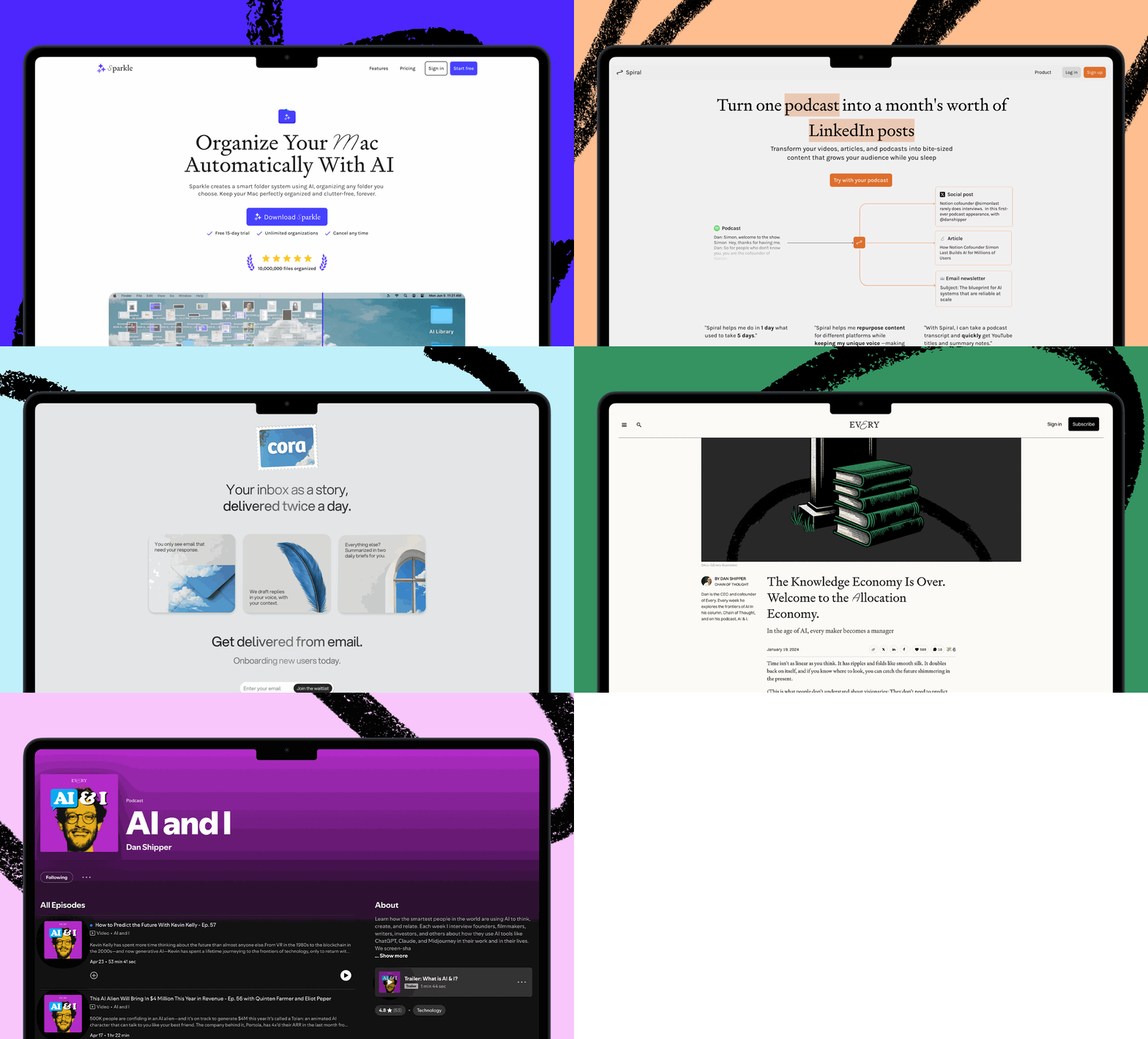

Hello, and happy Sunday. When OpenAI folded Codex into ChatGPT in mid-July—in a move known as the merge—the coding tool became a general-purpose workspace, and the setup most knowledge workers had learned changed. So Katie Parrott rebuilt our guide from scratch: ChatGPT for Knowledge Work is a complete walkthrough of the merged app—16 workflows from the Every team, recast for what now lives in Chat, Work, and Codex, plus the new goals, projects, and scheduled tasks. And companies have the same problem, only bigger. In early June, Natalia Quintero and Mike Taylor answered questions from 400 executives on rolling out AI, then wrote up the 33 they couldn’t get to live for attendees. We’re sharing that Q&A publicly for the first time here.—Kate Lee
Was this newsletter forwarded to you? Sign up to get it in your inbox.
Knowledge base
“Our ChatGPT and OpenClaw Guides Just Got an Overhaul” by Katie Parrott/Guides: Our Codex for Knowledge Work guide from May and OpenClaw guide from March got a full rewrite. Codex for Knowledge Work is now ChatGPT for Knowledge Work, updated for the merged app; the OpenClaw guide rethinks when a personal agent is worth running, and why a shared Every Agent may be the better call. Read these to update your ChatGPT and OpenClaw setups.
“33 Questions Executives Ask About AI—Answered” by Natalia Quintero and Mike Taylor: Natalia, Every’s consulting head, and Mike, our new head of evals, answer 33 questions from 400 executives on how to adopt AI, covering strategy, winning over skeptics, tool selection, governance, and restructuring teams. Read this to see our advice to executives rolling out AI.
“Benchmarks Don’t Know Your Job” by Katie Parrott/Context Window: Companies spend millions on AI but rarely test whether a model does their own work better than a cheaper one would. Our answer is KateBench, a copyeditor trained on 30,000 of Kate Lee’s edits, which shows how a high acceptance rate can still hide the edits a human has to redo. Also inside: a counterpoint to Andreessen Horowitz’s Olivia Moore on whether diminishing returns make cheaper models like Fable good enough; Cursor’s rebuilt Git hosting, and two new reliability benchmarks; the six-agent crew that tells Every designer Tyler Nishida’s family when there’s enough solar power to run the dryer; and links worth a click.
“The Case for Cloning Your Coworkers” by Laura Entis/Context Window: Companies are starting to clone their coworkers—capturing the judgment of the people they depend on as reusable AI skills, a project Every is running on its own team. Also inside: a discussion of investor Stanley Druckenmiller admitting he used AI on a Wall Street Journal op-ed; Arielle Shipper’s self-improving Codex skill; a fresh batch of Thesis Statements from frontier builders; a signal on the enterprise opening for open-weight models; and the daily driver on which models the team is reaching for this week. Plus this week’s AI & I: Walleye Capital CEO Will England on why AI use is mandatory for his 400 employees. 🎧 🖥 Listen on Spotify or Apple Podcasts, watch on X or YouTube, or read the transcript.
“I Tried the AI Model Built to Fix AI Writing” by Katie Parrott/Working Overtime: Katie tested Deft, a new model froma lab that pins the sameness of AI’s prose on how models are trained, not what they know. The output was genuinely less predictable, but also dense and prone to inventing facts. Read this to understand why AI writing all sounds the same and whether a new model can fix it.
Thesis Statements
Read seven more predictions from people at the frontier in Thesis Statements, a collection of specific, contestable claims by builders and thinkers about the future of great human work with AI.
- To work with AI, we’ll grow new senses by Alice Albrecht, AI researcher and founder
- The AI revolution will take so much longer than anyone is predicting by Gagan Biyani, cofounder and CEO of Maven
- The best businesses will use AI to revolutionize their companies, not automate them by Sam Gerstenzang, partner at Boulton and Watt
- The best leaders will focus on the messy work of unpredictable humans by Kit Krugman, chief people officer at Altana
- Offline devices will be like going to the gym for your brain by Craig Mod, writer and photographer
- Your AI tools will feel like part of your body by Yohei Nakajima, cofounder and general partner of Untapped Capital
- The minimum viable product will be for one person—or even one agent by Matt Van Horn, CEO and cofounder of June
To turn these ideas into action, join us at our inaugural Thesis: 2027 conference on November 5, 2026.
From Every Studio
Monologue shows you it’s listening, right where you type
Monologue, Every’s dictation app, released version 1.5.0 for Mac this week, with a new feature: the Dot, a small indicator that sits next to your text cursor, moves while you speak, and shows when Monologue is transcribing your words. If you move to another app mid-recording, the Dot follows your pointer so you can still see it. When you come back, it returns to where you started. When you’re not recording, it gets out of the way. After updating, choose “Try the Dot” to turn it on. You can hide it for a while, switch it off in particular apps, or go back to Classic.
The release also fixes a problem for anyone using a non-QWERTY layout. Monologue used to paste your words by pressing Command-V, which isn’t the shortcut on those layouts, so dictation would enter the wrong thing or nothing at all. Monologue now asks your app to paste instead of faking the keystroke. Plus, notes recordings can now cap themselves at anywhere from 30 minutes to three hours. You can export a voice note’s original audio. Home is now called Dictations. Download or update at monologue.to.
Alignment
Proof indigestion. Terence Tao, one of the greatest living mathematicians and someone I have written about at length in Every, has concluded that his field faces a strange new problem: too many mathematical proofs.
Normally, this would be exciting news and leave the optimists hoorah-ing for abundance. Mathematics has generally faced proof scarcity and depended on a few geniuses who painstakingly, or through divine inspiration, figure out what is true and what is not in our universe. More proofs should mean more progress.
But AI is now generating more apparently correct proofs than mathematicians can verify, either because they cannot follow them or lack the bandwidth. Tao calls this “proof indigestion”—a backlog of proofs whose central ideas have yet to be extracted and made useful to humans. If this continues, a growing share of mathematical work will involve verifying and explaining proofs to others after AI finds the results.
Recently, Tao spent several days digesting an AI-generated proof of Sendov’s conjecture, a longstanding problem about the roots of polynomials. Lech Mazur had produced a proof formalized in Lean, software that verifies proofs. The proof passed—all 90,000 lines of it—but was barely understandable to a human. Tao worked through it with AI, pen, and paper, and found the core idea. His version ran to about 15,000 lines and was, in his words, “remarkably elementary,” because it used surprisingly basic tools for a problem that had resisted experts for many decades.
To make the AI proof useful, Tao had to turn it into something another human could understand, explain, and build on. That shows how the division of labor between humans and machines may change and how our job will be to translate the products of an alien intelligence into knowledge the rest of us can comprehend.
The German mathematician Carl Friedrich Gauss called mathematics “the queen of the sciences” because every other STEM field is built on the language of mathematics. AI may soon generate materials and drugs that work before anyone understands why. I used to wonder what would happen if an alien superintelligence plopped down on Earth and handed us its scientific secrets, and vanished. I assumed we would catch up in no time, without having to discover everything ourselves. Proof indigestion suggests the opposite. We may be able to verify that the alien’s answers are correct and even use them, while spending years trying to understand why they work.—Ashwin Sharma
That’s all for this week. Follow Every on X at @every and on LinkedIn.
Everyone’s a builder now. Every All Access gets you the full membership plus the Builder Pack—$9,000+ in credits for the tools we build with.