Last week we launched How We Write Now, a series about how writers are using AI, starting with Katie Parrott’s guide to Compound Writing—her framework for developing ideas, shaping drafts, and carrying what you learn into the next piece. This week, Laura Entis, who has been reckoning honestly with her own AI workflow, goes further: She interviewed five professional writers—including Every CEO Dan Shipper, designer Maggie Appleton, and New York Times alum Kevin Roose—about where they let AI in and where they draw the line. She found that there is no universal recipe: The same tool that helps one writer think more clearly makes another’s prose worse. Read on for five distinct, idiosyncratic workflows (including custom prompts) that make a case that writing with AI is a skill in its own right.—Kate Lee
Was this newsletter forwarded to you? Sign up to get it in your inbox.
On deadline for a book about neurodiversity and work, journalist Alexandra Samuel fell victim to a condition all writers know and fear: writer’s block.
She had the research and a detailed outline. But there was always one more study to review, and so she put off writing anything. She booked a DIY writing retreat at a friend’s empty apartment, told herself she’d tackle a chapter a day—and turned to AI.
Each morning, she converted her research for that day’s chapter into a podcast, which she listened to as she scrambled eggs and made the first of many cups of coffee. The practice made sitting down to her computer feel more like continuing a conversation than staring at a blank page. When she hit a wall with drafting, she gave ChatGPT the day’s pages, closed her laptop, and had it interview her as she strolled through her friend’s neighborhood. The AI’s questions cut through her confusion. “After 40 minutes, my head was clear, and I knew where I was going,” she says.
She wrote 52,000 words in 10 days. These were her rough thoughts rather than polished prose—barely any of the words made it into the final version—“but it got me moving,” Samuel says. However rough, the material gave her the momentum to work towards a final manuscript. Her book, Working Neurosmart, will be published in April.
In online discourse, “AI and writing” are draw-your-swords fighting words. On one side of the imaginary line, they mean you’ve outsourced all your thinking to a machine. On the other, you’re engaging in the only logical form of modern communication, the equivalent of using your phone’s GPS instead of a paper map.
My own experience with AI and writing is less black and white. AI allows me to move faster—in pre-GPT days, I transcribed interviews by hand, a process that now takes minutes instead of hours—and it makes it easier to draw on my reporting, surfacing relevant quotes, confirming details, or drawing connections between information spread across several interviews. But it can also be a crutch: When I’m tired or pressed for time, I lean on it for too much and end up with words that sound good at first but lack a clear explanation, argument, or point of view.
I try to white-knuckle my way through an outline and rough draft myself. Only then do I bring AI in to help make structural changes, refine ideas and language, add supporting information—it’s great at filling in or clarifying details from a project’s source material—and improve transitions. I’ve found that once I’ve struggled to determine what I want to say, AI helps bring the piece closer to what exists in my head.
This is my current recipe for AI and writing. (As with all things AI-related, it will undoubtedly change.) Curious where other professional writers have landed, I interviewed five of them on how they do—and don’t—integrate AI at every stage of the writing process: research, ideation, structuring, writing, editing, and verification.
None of them has the same workflow or draws the same lines around how they use the technology. Like me, most still struggle to reliably identify which parts of the process AI makes easier without making their writing worse—even if they feel AI has made them better at their craft overall. A strategy that makes one person a sharper writer might degrade the work of another. Writing is the personal, sometimes joyful, often painful work of giving your ideas clarity and structure. AI can help with the process, but AI doesn’t write; it’s a tool, and knowing when and how to use it is as much a skill as writing well.
Agents make for excellent research assistants
Former New York Times technology reporter Kevin Roose used AI to research, transcribe, and fact-check The AGI Chronicles, his forthcoming 448-page account of the race to create artificial general intelligence. The book, based on more than 150 interviews, took him roughly a year to deliver; without AI, he estimates it would have taken three to five years.
He called on AI to identify relevant research papers and translate dense technical topics, but a major unlock was using AI to automate his entire transcription pipeline. After each interview, an agent transcribed the recording, extracted key details, sent him a list of five subjects who could speak about similar topics, and flagged any Slack logs, emails, text messages, or other artifacts he should ask the source to share.
The agent was great at turning up contact details for potential sources, including some with very little publicly available information. In one particularly tricky case, it exploited a security flaw that enabled it to extract the email address associated with that person’s GitHub account.
As Roose interviewed people and disappeared down research rabbit holes, he threw transcripts, peer-reviewed papers, articles, sections of books, and more into a set of queryable notebooks that served as his “outboard brain.”
Later, he used those notebooks and his working draft to prepare for interviews. His agents could survey the combined context, identify gaps in his reporting, and draw his attention to what the person he was about to interview could help him better understand.
Many of the people Roose interviewed for the book worked at the same companies developing the AI models he used to assist with his research. To protect his sources, if they told him something confidential about a specific company—OpenAI, for example—he wouldn’t upload that information with their name or identifying details into any of its models. He occasionally used local models for sensitive information such as internal company documents, “but in general I just tried to be smart about which models I used for which tasks and kept some information offline or away from AI entirely,” he says.
Maggie Appleton, a designer and anthropologist at GitHub Next who publishes illustrated essays about programming, design, and culture, regularly uses AI in the research process to surface connections she has overlooked.
When starting a new piece, Appleton uses dictation mode to “brain dump my notes,” then asks Claude Code or Codex to fill gaps in her research: “What don’t I know about in the literature? Look at what I’m saying and who I’m already referencing. Who should I be referencing that I don’t know about?”
Recently, this process re-introduced her to the work of anthropologist Lucy Suchman. Appleton had studied her work in university but somehow failed to see how Suchman’s research neatly mapped to the main argument of a speech she was workshopping.
“You get stuck on what you’re already looking at,” Appleton says. AI can shake you out of your frame of reference. “That was one of those moments where I thought, ‘Good job. I would not have gotten there.’”
AI can expand and sharpen your thinking
When Samuel starts a piece, she wants to get as many ideas as possible out of her head before her editor brain kicks in.
Earlier in her career, she typed in white font, so she couldn’t see what she wrote and get hung up on the details. Nowadays, she sometimes uses a voice memo or dictates her thoughts to ChatGPT during long, meandering walks through her beachside neighborhood, past a pond, through the woods, and back home along the water. She purposely doesn’t self-edit; she’s after sprawling messiness at this stage.
After the initial brain dump, Samuel uploads the transcript into a session in Claude Code and has the agent ask questions that surface gaps in her argument. “I flesh it out and get the rest of my mental garbage out of my brain,” she says. Then the writing can begin.
AI can also stress-test an idea to see if it’s worth pursuing. Emilia David, an associate editor covering enterprise AI and technology at Information Security Media Group, must quickly determine which AI developments matter to her audience. At VentureBeat, where she worked as a senior reporter until June, her coverage area was tightly defined: AI orchestration, or how AI applications and agents work together. To help identify story ideas, David fine-tuned a custom GPT to respond to pitches from the perspective of her target reader—a senior engineer at a large enterprise who cares about orchestration and observability—based on profile information from VentureBeat’s editorial and marketing leadership.
The reader is a Senior AI Engineer with expertise in designing and implementing efficient AI orchestration systems to streamline and scale machine learning models across the organization. They work at companies ranging from 200–10,000 employees and focus on building robust, scalable AI pipelines that can manage model deployment effectively across different environments. They communicate in a technical and practical manner and prefer deep technical details paired with practical advice.
To try David’s approach, fill in the template below and add it to your custom agent’s instructions. Adapted from her reader profile, it gives the agent context to assess news and potential story ideas through the lens of what matters to your target reader.
The reader is [describe your target reader] with [their existing knowledge or experience] in [topic or field]. They [describe relevant circumstances: their work, interests, responsibilities, or community] and care most about [their priorities, questions, or challenges].
They read [your publication or type of writing] to [what they want to understand, discover, decide, or do]. They prefer [tone, level of detail, and types of examples], and need explanations of [concepts they may not already know].
When I share a story idea, assess it against this reader profile. Explain why the reader would—or wouldn’t—care, identify the most relevant angle, and flag what reporting would be needed to support it. Don’t assume an announcement deserves coverage simply because it is new or widely discussed. Make clear what’s supported by the material and what needs more reporting.
Her GPT also incorporated editorial feedback on previous pitches. “The model learns what my editors are looking for, so it helps craft an idea of what works as a story—what would pass muster if I were pitching,” David says. She used it to test ideas and suppress the FOMO triggered by AI developments that dominated X but didn’t matter to her target audience.
David’s GPT identified angles she would have otherwise dismissed. At VentureBeat, David didn’t typically cover product releases—a rule she assumed would apply when Anthropic released Managed Agents, a service that handles the work of running enterprise AI agents. (“I read the press release and thought, ‘Cool. I don’t think that’s a story.’”)
But she ran the announcement through her audience agent for another gut check. It pointed out that because Anthropic would run the agents and store their data in its system, customers could be locked into the company’s technology and terms.
“That is something an AI orchestration engineer would be concerned about,” she says.
David homed in on the angle and published a piece that skipped the product announcement to focus on what the development meant for her readers.
AI can create systems to structure your work—but you still need to decide what goes where
As a writer, Appleton has always needed to maintain a bird’s-eye view of the material in a piece without losing track of its individual components. In the past, she mapped out story ideas on giant sheets of paper, which evolved into cobbled-together digital versions in Miro or Figma.
With AI, she can now build a writing canvas designed for this purpose. “We’re finally at a moment where personal software is within reach,” she says. Created with the tldraw software development kit, the canvas connects to Claude Code, Codex, and other agents through a Model Context Protocol (MCP) server.
Each article gets its own canvas, organized into vertical columns representing sections. Appleton dictates rough ideas to an agent, which arranges them into cards she can move within and between sections. Note cards hold ideas, excerpts, and research summaries; prose cards contain draft text and appear in a sidebar that displays the piece linearly; figure cards represent illustrations, graphs, and interactive elements. Appleton can rearrange the spatial canvas and immediately see how the prose reads in its new sequence. Through the MCP server, agents can organize material, find repetition, summarize references, and comment on selected cards. A semantic-zoom feature condenses each card to a sentence when Appleton views the canvas, allowing her to see the piece’s overall argument without losing the underlying text.
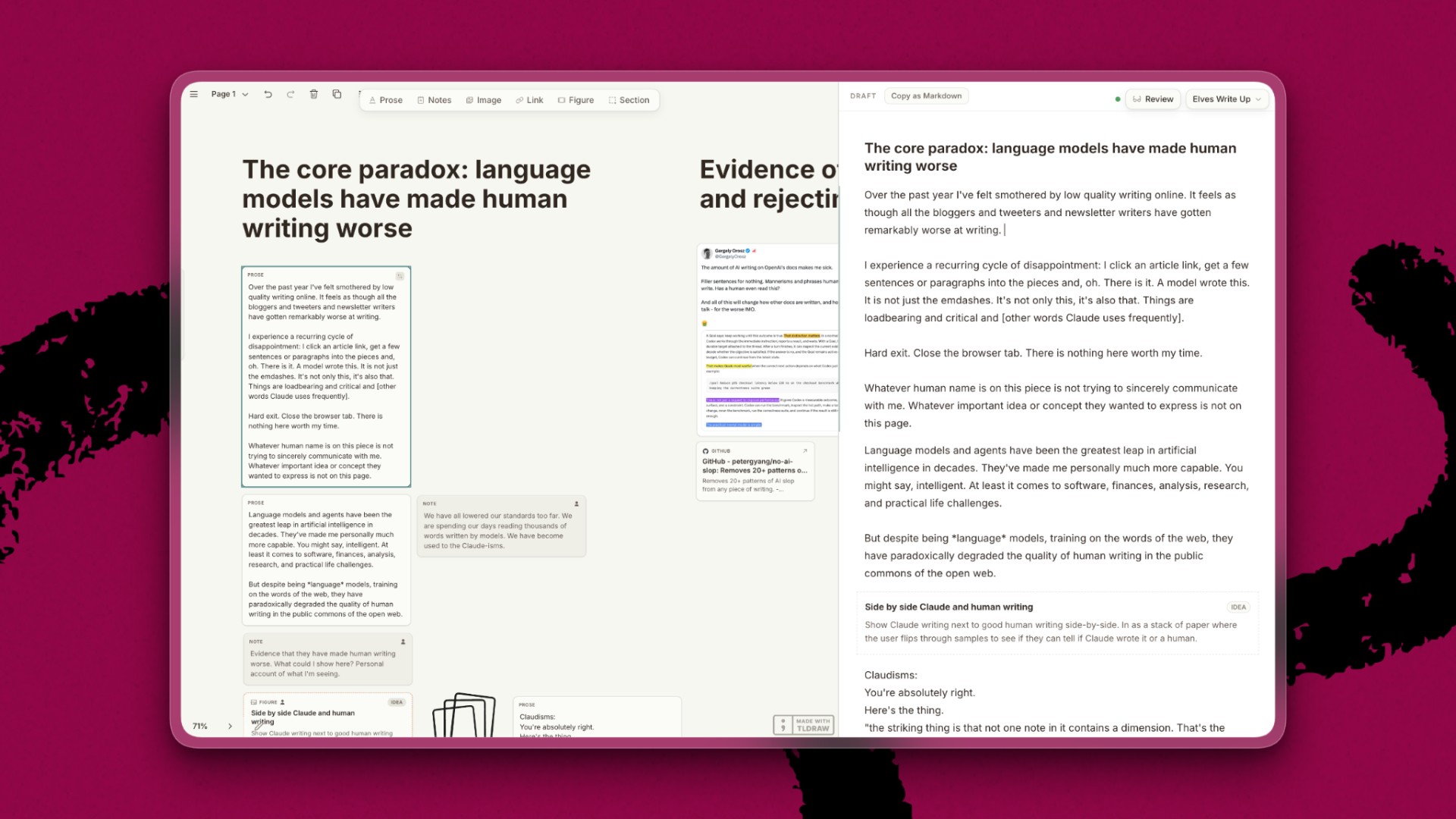
This visual breadth, paired with card-by-card modularity, makes sprawling pieces feel manageable enough to finish. “Writing is a long, hard process for me, no matter how I go about it,” she says. “What I’m hopeful agents can do—and what I feel they’re helping me do with this tool—is make it slightly less painful.”
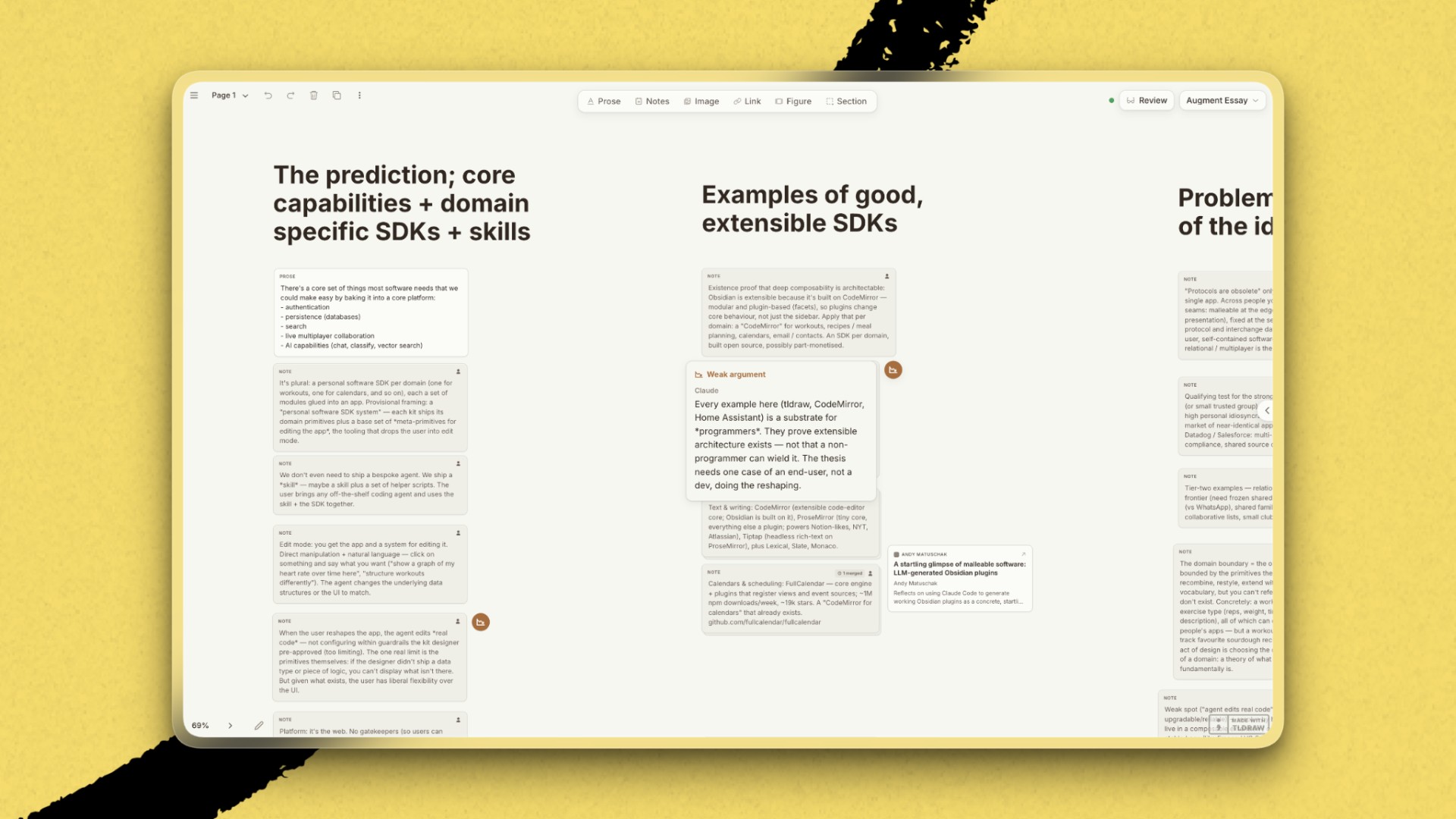
Appleton still struggles to determine the narrative arc and decide what material to cut. “It comes back to the fact that agents don’t have the same taste we do. The people who make models bake taste into them. Claude is very opinionated, and ChatGPT models also have a certain opinion to them, but it’s not my opinion,” she says. “I always end up having to figure it out.”
Roose has come to a similar conclusion. AI is good at chronology, turning his sprawling notebook into a “mega-timeline” organized by company. “That was enormously helpful for unscattering the information and putting it all in one place,” he says.
But he found AI “alarmingly bad” at subjective editorial calls. Requests for advice on improving structure or pace were regularly met with “stupid things like, ‘You might want to do a cliffhanger ending on this.’ I’m like, ‘But it’s the fifth paragraph. Why would I end with a cliffhanger there?’” he says.
Fed up, Roose worked out the book’s narrative arc on a wall-sized whiteboard in his office. “That’s the part where I feel I’m much stronger than AI right now,” he says, “so I did it.”
Once Roose understands a chapter’s shape, AI becomes useful again. He can ask his agents to pull everything his sources had said about the pretraining of GPT-4, for example, and, like GPT-powered magic, they will.
I also don’t like to invite AI into the planning process—seeing what it suggests alters my conception of what the piece is about and what information is most important. I generally create my own outline from fragments of ideas and sections of interview transcripts, and dictate my thoughts about each section based on the existing material.
This gets me to a rough draft faster, which, in its earliest stages, consists of block quotes framed and connected by my ideas on what they mean and how they relate to the piece’s overarching narrative or argument.
Models can write well, but they require supervision and revision
Writing is the part of the process many writers say they refuse to allow AI to touch, even if the technology is integrated into the steps that come before and after. “AI does none of my writing,” Samuel says. “It is always a sounding board for me.”
Every CEO Dan Shipper is an exception. A prolific writer, he publicly and enthusiastically uses AI to generate (gasp) actual sentences. (The public part might be what sets him apart—most writers use AI, Dan contends, even if they don’t admit to it.) AI’s suggestions give him something to react to: He identifies what he likes, explains what isn’t working, and rewrites the output until the text says what he means. Even an unsuccessful attempt by the model can help him figure out what, exactly, that is. In practice, that process unfolds in three steps:
Getting back into a draft
When we spoke, Dan was writing a longform reported feature on OpenAI. Before he tackles a new section, he needs to ground himself in the thousands of words he’s already written.
So he has Codex turn his existing draft into a podcast. That way, when he wakes up, he can listen while he brushes his teeth or takes a walk, reacquainting himself with the material before sitting down to write.
Diagnosing what isn’t working
A recent session shows how Dan uses AI to improve the writing itself. Unsatisfied with his latest paragraph—“Code rarely runs on a new computer without preparation. The right software dependencies, permissions, and settings must be installed first.”—he asked Codex to suggest ways to improve it.
The model correctly identified that the passage failed to answer the preceding question: Despite being popular inside OpenAI, why had Codex initially struggled to attract external users?
Rewriting through reaction
It proposed a fix, but the language left him uninspired: “Codex’s computer is not your computer.” It’s a line that “sounds good” at first, Dan says, “but when you think about it, you realize you have no idea what it means.”
He pressed the model for more clarity, and it returned a revised version. He responded with what he disliked; it tried again. After a few more exchanges, much of the final paragraph came from the model.
“This is typical of how I write,” he says. “It bushwhacks and makes a path, and then I can follow the path.”
On rare occasions, the model hands him exactly what he wants. Most of the time, the process is painstakingly incremental—but so is writing. For Dan, “writing is the act of taking something as complicated as reality and putting it down word by word. It’s an act of thinking.”
“It sucks,” he continues. “And it’s valuable.” AI helps him more precisely identify what he wants to say from the universe of possibilities.
Appleton occasionally works in the opposite direction from Dan to get to the same result: She uploads an imperfect sentence to Claude and asks for several clearer or more concise alternatives. Because the suggestions are anchored to her words, they can bring her closer to what she means. “In those cases, the sentence still doesn’t feel like an AI sentence,” she says.
Beyond that, Appleton draws a clear line around writing the words herself. As a reader, she expects words to come from a human; if she suspects Claude wrote them, her reaction is “Close tab, no thank you.”
Much of her reluctance stems from AI’s limitations. “When I’ve tried to have agents write final prose for me, the thing they say is never the thing I actually mean,” she says. She fed her agents samples of her writing to create custom writing skills and found herself nodding along to their assessments: Her writing is personal, conversational, and a little dry, and she does position herself as a learner, not an expert. But none of it helped.
“How would an agent ever write the words I would write? How would an agent ever say the exact thing I’m trying to say?” she says. “Even if it sees my notes, it doesn’t really understand the thing I’m trying to say, because I haven’t said it yet.”
Roose also did not use AI to write his book, primarily because he believes he owes readers his human thoughts. In his author’s note, he discloses he used AI tools extensively for research, transcription, and fact-checking, but established a “bright line” rule not to use it to generate any of the text in the book.
He also hasn’t found a strategy that makes AI writing any good. (He has yet to experiment with custom style guides based on his writing to see if the results are better.)
Roose has “an allergic reaction to [text generated by a large language model] on a stylistic level.” In his estimation, Claude 3.5 Sonnet set the high-water mark for AI writing. Model prose, at least at the sentence level, has degraded with recent releases.
During his year working on the book, “my trust in models for things like research and fact-checking went up, while my trust in them for structure, craft, and sentence-level construction went down,” he says.
AI feedback can be cheap, fast, and flawed
Roose did not want AI writing the book, but he did want more reviewers. “I was trying to imagine, if I had unlimited access to really smart people to help me review the book, what kinds of people would I want to gut-check it, and where might my blind spots be?” he says.
Before he sent the manuscript to his human editors, he ran each chapter through what he calls “my council of Claudes.” The council included agents modeled on a lab historian and archivist with institutional memory of the major AI companies; a technical skeptic in the mode of Yann LeCun or Gary Marcus; a “Yudkowsky-type” AI safety researcher; a machine learning researcher; a policy and compute expert; and a narrative craft reviewer looking for clichés and issues with his timeline.
I need you to plan an editing and fact-checking process for this manuscript that goes beyond looking up spellings, dates, etc. I want to get masterful, deeply researched feedback from a number of agents, working chapter by chapter, each with different areas of expertise. I want these notes to come from a place of deep knowledge, like a person who has the entire history of AI stuffed in their head. here’s a feedback note from a human reviewer i got that is the correct level of depth: [pasted note about GPT-1 pretraining and the Dai & Le / ULMFiT precursors] one agent should be an “expert” on each of the labs, one should be an AI skeptic who is still deeply knowledgeable, one should be a robert caro/water isaacson style storyteller who can analyze the story in a content-neutral way, and one should be an eliezer-type safety expert. I could use your suggestions on others. I’m thinking 5-6 agents total, each with unlimited compute budgets (up to the token limits of my account), that can confer with each other and synthesize their feedback by chapter in a single unified document. sound good?
Each reviewer supplied feedback to a master-editor agent, which returned the highest-priority items for Roose’s attention. Ninety-five percent of what the council returned “was slop,” he says—his job was to determine the 5 percent that would make the book better. “The best things the AI gave me were quite useful, but I had to sift through a lot of garbage to find them,” he says.
Samuel built her own panel of imaginary readers to broaden the range of perspectives in her book. In her initial draft, she noticed that the hypothetical examples repeatedly involved “middle-aged, menopausal, ADHD women”—in other words, herself. “I need to get out of my tunnel vision,” she recalls thinking.
She created six personas, each with a different professional biography, and placed them in a Claude Project. Talking with these imaginary readers—sometimes out loud, through Claude voice mode—helped her think up examples beyond her own experience. Few made it into the book, but even the flawed ones proved useful.
One persona was a senior professional from a Latinx background. The scenarios Claude generated repeatedly leaned on “the fiery Latino” and repeatedly emphasized his family commitments in a way it did not for other personas, which made Samuel more deeply consider the stereotypes embedded in its responses.
“The risk of using AI in any field—but perhaps particularly for those of us who write about AI—is losing sight of its limitations and biases,” she says. “Anything that breaks the AI is, to my mind, a useful reality check.”
Agents are good first-pass fact-checkers
A freelance journalist who runs her own business, Samuel has developed an elaborate AI fact-checking workflow for getting up to speed on unfamiliar topics. When she needs to quickly digest the available research—for example, to determine how long and at what temperature clothes moths must be frozen to die (she has an infestation)—she instructs a Claude agent to produce a memo with literature from peer-reviewed, well-regarded journals. Her process for reported articles is more manual.
Before she reads the memo and allows “my vulnerable, impressionable brain to absorb questionable information,” she runs it through a fact-checker skill. Two subagents review every factual assertion and mark it as accurate, false, or ambiguous based on the cited literature. If they disagree, a third agent is called in to break the tie.
The skill compiles its findings into a CSV, then produces a corrected memo.
You are a professor of journalism and the chair of your university’s research ethics board. A research centre at the university has used AI to produce the brief below for a client organization (with their knowledge). You have been charged with determining whether it meets the university’s standards for rigor, accuracy, and evidence-based research.
Your assessment standard is based on:
Fidelity to source material. Is each assertion in the brief verifiably based on an external source? If so, you should be able to identify a verbatim quote or passage in the source material that says what the brief says it says. Fidelity means fidelity to both the letter and the spirit of the original — i.e., no cherry-picking a parenthetical quote that posits a theory or argument the source article then goes on to disprove.
Credibility of source material. Are the sources high caliber? Top caliber means a highly cited (50+ citations) work in a top-tier peer-reviewed journal within the past decade. Acceptable caliber is fewer citations (but not less than 5) in a peer-reviewed journal, or publication in a major newspaper or media outlet, or from a major consulting firm or company known for its thought leadership (Deloitte, Gartner, IBM, etc.). Unacceptable is: invalidated research subsequently retracted; minor or fringe outlet; low-caliber journal with no citations; a marketing report or study from a non-credible company or just a 1–2 page news release.
Recency/currency of source material. Do the sources and ensuing findings reflect the current state of knowledge and understanding? When using material older than 5 years (and especially if older than 10), look for recent citations of that material to determine whether it is still relevant or has been superseded by more recent research.
Completeness, coherence, and consistency of interpretation. Does the resulting brief coherently reflect the breadth of material reviewed? Was the source material broadly reflective of the field as a whole, or does it represent a particular and non-representative subset of the research? Are the brief’s findings (and if applicable, recommendations) consistent with the current state of the research in the field?
Your inputs: Draft research memos or information files.
Your outputs:
A memo listing every fact in the input memo, with an evaluation of accuracy next to each one (based on the assessment standards above) and recommended changes. This memo should include a table that lists every fact in the source memo, with each one marked in the “verdict” column as CLEARLY FALSE, AMBIGUOUS, UNSUPPORTED or CONFIRMED. Add a “notes” column for your comments, and a “verbatim source” column with the specific citation(s) and an exact quote used to evaluate the claim.
An annotated copy of the original brief, showing all suggested changes.
A revised copy of the original brief, with all suggested changes implemented.
Note that the client is aware these are AI-generated memos, so it is acceptable to flag assertions as concerning, unverified, etc. without necessarily deleting them.
Your process:
Break out every single factual assertion in the source brief: each name, date, quote, finding, statistic, etc.
Work through each fact one at a time. Look at the original source (if provided/cited); if no source is provided, look for your own sources (high or acceptable caliber). Find a specific quote in the source that validates or contradicts the assertion, and add this verbatim quote to the “verbatim source” column.
As you work through each assertion, mark each fact as CONFIRMED (with a source citation), UNVERIFIED (no source can be confirmed), or FALSE (verified incorrect).
Do not skip any fact. If you can’t find anything to support or disprove a fact, mark it UNVERIFIED.
Any questions? You should be doing DEEP RESEARCH and THINK HARD.
[Paste the research brief here.]
Roose relied heavily on AI as a first-pass fact-checker. Extracting every claim about every person in his book and sending it to them to review could have taken weeks. Instead, Claude created individualized fact-checking documents and formatted them as emails so sources could respond to or clarify each item. “It was basically a one-shot,” he says.
He also had subagents compare a near-final draft against his research notebooks and search the web. They caught inconsistencies involving people’s ages—“You refer to this person as a 30-year-old AI researcher, but in the summer of 2017, they would have been 31”—titles, and the dates they joined company boards. Some findings were false positives or negatives, “but it was a good start,” Roose says. A human fact-checker paid for by the publisher took over from there.
Every writer needs their own AI workflow
Just as there is no single way to write, there is no single way to write with AI. Writing is a personal act that consists of thousands of choices—about audience, angle, style, tone, and framing, some conscious and many not—that add up to a finished piece. AI adds another layer: what to delegate, what to do yourself, and what to tackle alongside the machine.
These choices can be exhilarating—or paralyzing. Every staff writer Katie Parrott uses her Compound Writing plugin to bring AI into the entire writing process, from developing an idea to sentence-level edits. She tests her work with multiple AI reviewers, decides which feedback to incorporate or reject, and saves useful lessons to inform AI’s approach to her next piece—a framework for efficiently creating high-quality, distinctive drafts that say what she means. (To try Katie’s approach, check out her Compound Writing plugin.)
Meanwhile, I find AI’s ability to argue either side of any decision from countless personas overwhelming. For me, AI’s clearest use case is its ability to store and pull from all the context that goes into writing an article. For this piece, I uploaded the initial pitch, interview transcripts, and relevant articles in a single Codex thread. When I needed to fact-check a claim or clarify language, Codex referenced the original transcript or supporting article to improve the piece—or at least outline possible solutions.
Each professional I spoke with has their own detailed, idiosyncratic, and still-evolving recipe for transforming ideas from their heads and research from the world into words on a page—or 448 pages. As AI tools evolve, the choices available to writers will expand, too.
“There’s room for artisanal writing and journalism, and there’s room for journalism that is assisted by all of the tools available to us, including AI,” Roose says. “Something that works for me may not work for someone else, and that’s totally fine.”
Laura Entis is a staff writer at Every. To read more essays like this, subscribe to Every, and follow us on X at @every and on LinkedIn.
Everyone’s a builder now. Every All Access gets you the full membership plus the Builder Pack—$9,000+ in credits for the tools we build with.