

Hello, and happy Sunday! This week we published “After Automation,” Dan Shipper’s argument that even when you automate as much as we have, there’s always a new frame for humans to hand to the models. COO Brandon Gell and new head of marketing Douglas Brundage tested the idea by moving their agent work into public internal Slack channels and watching the lurkers gather. Anthropic’s reported $300 million acquisition of developer-tools startup Stainless rides on the same bet—that an agent can’t use a company’s API unless a human has first made it easy to use, which is what Dan and CEO Alex Rattray talked through on AI & I months before the deal.
Scroll down for two takes from the ground at Google I/O—Jack Cheng on why Google is aiming at everyday users, not the AI crowd, and Alex Duffy on Demis Hassabis’s claim that AGI is a few years out—and what Google’s been doing to take us there. Plus, a mini-Vibe Check on Gas City from head of tech consulting Mike Taylor and a Grok-based “banger classifier” Katie Parrott is running her X drafts through, and Katie’s playbook for new grads facing AI-driven entry-level cuts at Meta and beyond—copy-paste career-coach prompt included. We’re off Monday for U.S. Memorial Day and back in your inbox on Tuesday.—Kate Lee
Was this newsletter forwarded to you? Sign up to get it in your inbox.
Knowledge base
“After Automation” by Dan Shipper: We’ve automated as much as possible at Every—agents write the code, draft emails, and compile the newsletter—and yet there’s more human work to do than ever. Dan’s new report traces what happens when cheap competence floods the market and argues there’s always a new frame for humans to hand the models. Read this for the case that progress expands human work rather than ending it.
“Google I/O: Agents, Agents, Agents” by Jack Cheng/Context Window: Google’s I/O keynote rebuilt search and assistants around agents—a default AI Mode, the 24/7 Gemini Spark, and a Universal Cart co-built with Amazon, Meta, and Microsoft—all on Gemini 3.5 Flash, pitched as Opus 4.7-level intelligence at four times the speed and half the cost. Read Jack Cheng’s report from the field for why Google’s I/O bets on distribution over benchmarks.
“Notes From the Foothills of the Singularity” by Alex Duffy/Playtesting: At Google I/O, Demis Hassabis placed AGI “just a few years” out and put its total impact at 10 times the Industrial Revolution. Alex Duffy frames the other side of the story through his Uber driver back from Mountain View: a 54-year-old construction worker who knows the city by heart and is worried his job is next. Read this for the tension between Google’s compute-at-scale ambitions and the workers whose ground it’s reshaping.
“Inside the 100-agent Software Factory” by Katie Parrott/Context Window: Mike Taylor previewed Gas City, the successor to Steve Yegge’s viral Gas Town—an orchestration toolkit where a persistent “mayor” agent dispatches anonymous “polecat” workers. Read this for the multi-agent engineering ideas worth internalizing even without the tool.
“How to Start a Career When AI Is Doing Your Entry-level Job” by Katie Parrott/Working Overtime: As Meta and other companies announce job cuts citing AI, Stanford’s Digital Economy Lab finds employment for 22-to-25-year-olds in AI-vulnerable jobs is down 13 percent since late 2022, while older workers have held steady. Katie Parrott offers four moves for new grads navigating an entry-level rung that’s getting kicked out. Read this for a copy-paste career-coach prompt and the case for protecting one craft from AI.
Log on
We host camps and workshops on topics like compound engineering and writing with AI to share what we’ve learned from training teams at companies like the New York Times and leading hedge funds, and by using and experimenting with AI every day ourselves.
Upcoming event
- Executive AI Sessions: On June 2, head of consulting Natalia Quintero hosts a live webinar introducing Every Consulting’s new offering for leadership teams navigating AI adoption—built on the playbook we’ve been running with executive clients for months. Learn more and register.
In New York City
- Every 🤝 IRL: Join us at the Every brownstone in Brooklyn on June 3 during New York Tech Week for a subscriber-only meetup celebrating the Every community over drinks and conversation. Learn more and RSVP.
Alignment
Think boom, not doom. At an obesity conference in Istanbul last week, two words seemed to be on everyone’s lips: GLP-1s and AI. It is hard to think of two more important technologies arriving in healthcare at the same time. GLP-1s are changing what we know about biology, and AI is changing the distribution of knowledge. I can’t even begin to imagine what the world is going to look like in the next five, 10, or 10 years.
Even so, a recurring question was this: What happens to the doctor-patient relationship when medical knowledge becomes abundant?
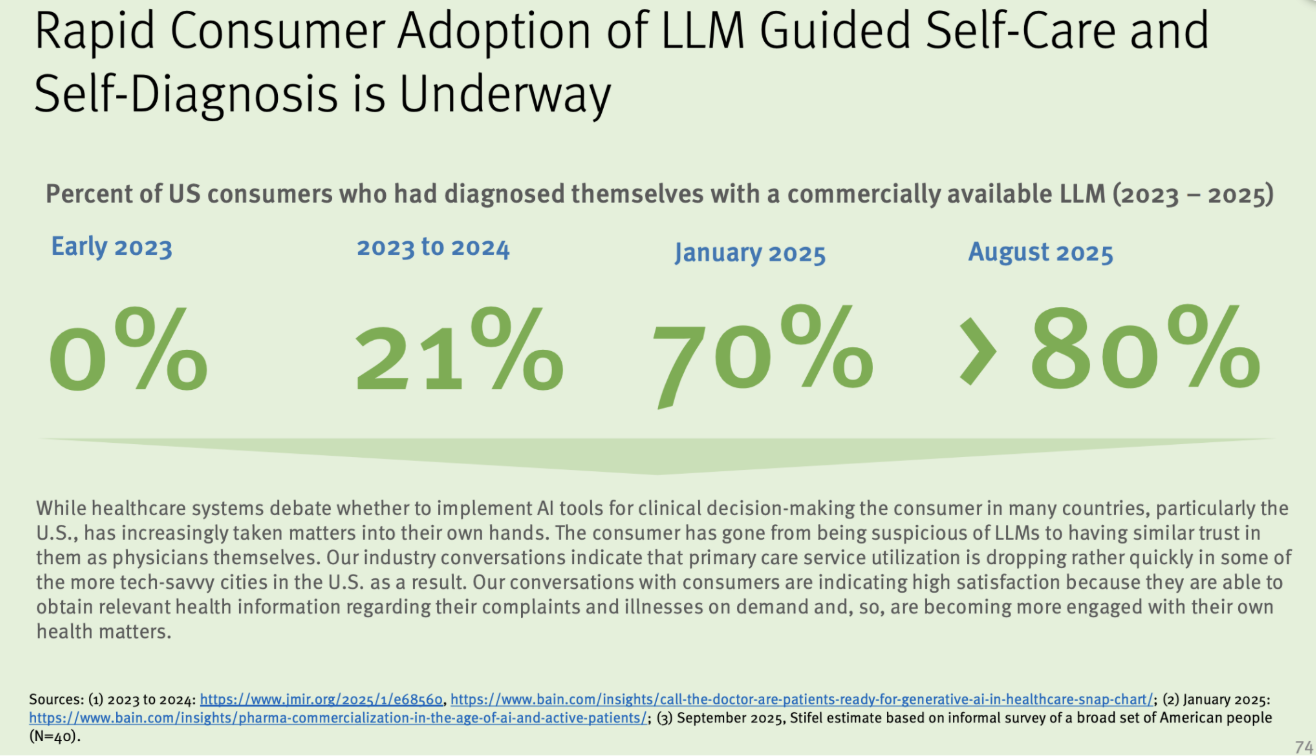
A growing number of patients are taking their health data, quite literally, into their own hands. They wear an Oura ring and get blood work through companies like Function Health or Superpower. They upload lab results, medical history, symptoms, medications, and sometimes even genetic data into ChatGPT or Claude. With enough context and persistence, they can generate a reasonably sophisticated view of their own health risks, possible diagnoses, or whatever else they might want to know about their biology.
Two things will change about how medicine will be practiced in the next few years.
First, there may be fewer people utilizing primary care, especially among younger, tech-savvy patients in cities like San Francisco, New York, and Austin. Some visits that used to be driven by uncertainty may be replaced by AI-guided reassurance, self-triage, or more targeted use of labs, telehealth, and specialists. The result will be fewer low-information visits, which could be beneficial if it frees capacity for people who need in-person care most.
Second, when patients do see doctors, they will not come empty-handed, waiting for the physician to be the sole authority. They’ll be armed with much sharper questions. This is where Dan’s point about cheap competence becomes so important. As models commoditize medical knowledge, the value of situated judgment rises. The scarce skill becomes knowing what to do next for this particular person.
I am optimistic. AI does not make physicians irrelevant. It just makes excellent physicians more valuable.—Ashwin Sharma
That’s all for this week! Be sure to follow Every on X at @every and on LinkedIn.
We build AI tools for readers like you. Write brilliantly with Spiral. Organize files automatically with Sparkle. Deliver yourself from email with Cora. Dictate effortlessly with Monologue. Work on documents with AI agents using Proof.
For sponsorship opportunities, reach out to sponsorships@every.to.