

Was this newsletter forwarded to you? Sign up to get it in your inbox.
My first job out of college was as a copywriter at a little crowdfunding website based in Columbus, Ohio, called Fundable.com. The company had no money, so they didn’t care that I had no experience. I had no experience, so I didn’t care that the job didn’t pay at first.
The offer was simple: Create a profile for your startup, and we’ll connect you with investors. Most founders didn’t want to write their own profiles, so my job was to take whatever strange, half-formed thing a founder was building and translate it into investor-speak. The profiles were so templatized I can still recite the format: problem, solution, traction, team, business model, revenue projections, competitive landscape, funding terms.
I’ve been thinking about that job lately because AI could now produce one of those profiles in two minutes. At 23, I would have heard that and thought: “Thank God.” At 36, I think: “Thank God it couldn’t.” Without that job, I would have never learned how to take a company apart and put it back together as a story, or how to organize information for an audience that wasn’t being paid to read my stuff like my professors in undergrad.
This year’s crop of recent graduates has it harder than mine did. AI, which can perform many entry-level tasks, is replacing those early experiences faster than employers can figure out what’s going on. Researchers at Stanford’s Digital Economy Lab found that employment for 22-to-25-year-olds in the jobs most vulnerable to AI has dropped 13 percent since late 2022, even as older workers in the same roles held steady.
I think about the 22-year-old version of myself, if I were sending out applications right now into the void of LinkedIn. What would she think about the headlines about AI and job displacement? Would she be scared?
Yeah, probably. She was scared of much less.
So with full awareness that no one born this millennium wants career advice from someone born before the fall of the Berlin Wall, here’s what I’d do if I were starting over today, knowing what I know about work, AI, and how one is shaping the other.
You’ve been meaning to start outbound for six months.
You know who to reach. You’ve got the messaging in your head. You just don’t have the hours to build the list, find the right contacts, write the sequences, and do it again next week. And the week after that. Lightfield’s outbound agents run on your CRM. They score accounts against your real won deals. Draft sequences from the language your customers actually use. Surface warm intro paths from your team’s network. You see every campaign before it ships.
You set the strategy. The agents build the list, run the sequences, and escalate the replies that need you.
There’s good news, and there’s bad news
The paradox facing today’s entry-level workers is as old as the entry-level job itself: In many cases, in order to get a job, you need experience, but in order to get experience, you need a job. And while employers requiring experience in AI when the technology barely existed when you picked your major may feel like a cosmic joke, employers have long asked for five years of experience with brand-new technologies.
All that is small comfort to the recent grad with a near-empty resumé. And there are qualitative differences in what AI is doing to entry-level work.
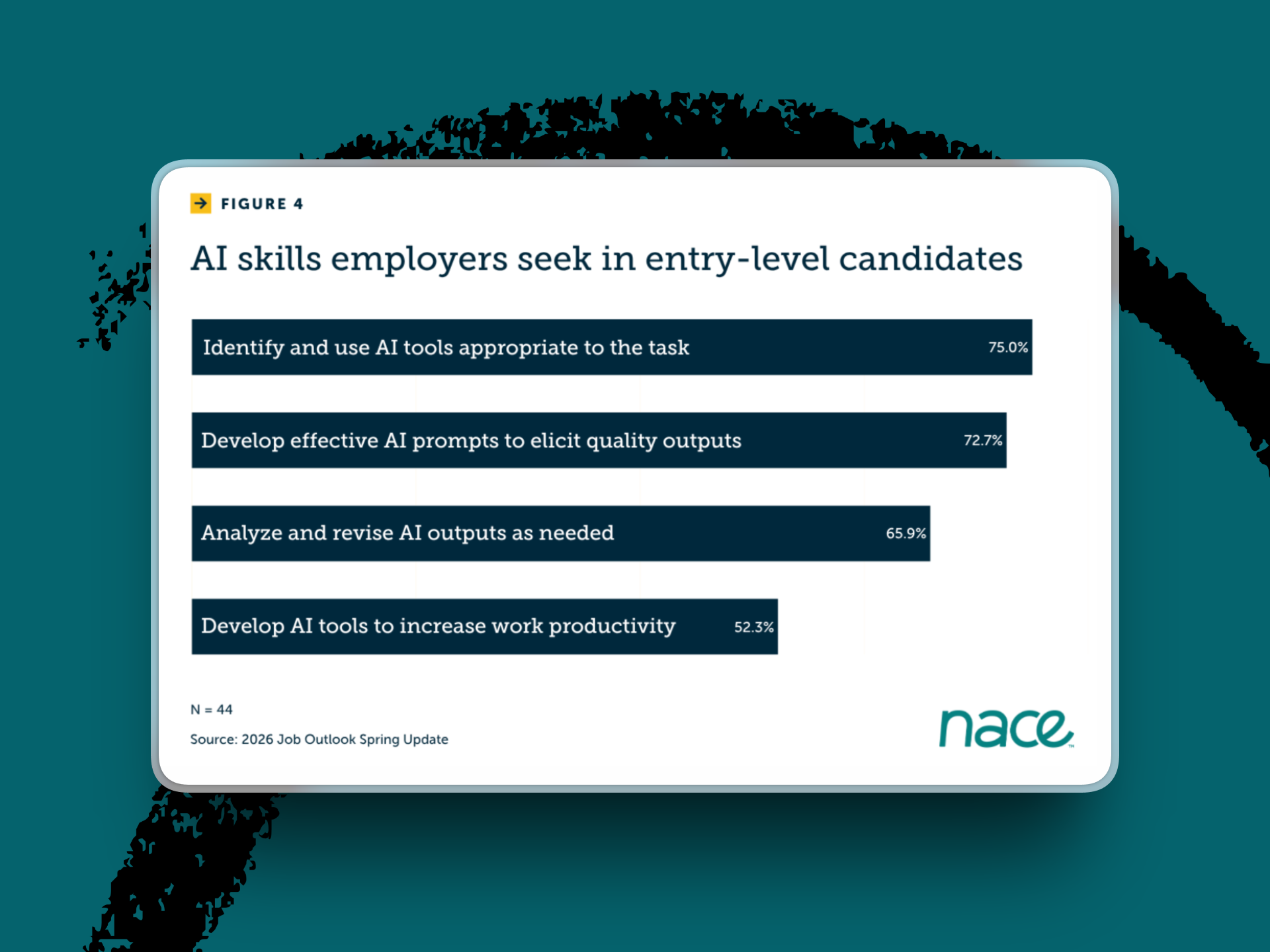
For one thing, when you look at the kind of AI skills employers expect young workers to bring to the table, they want more than the ability to type a prompt into ChatGPT. They want people who can evaluate tools, review outputs, and figure out how to improve those outputs, whether it be with better prompting or fixing the work themselves.
They’re looking for judgment, which is something that you can really only build through experience. When I was writing those funding profiles, I learned how to tell good work from bad. The first 50 that I wrote were so bad that at one point, a client said I should be taken out back and shot. With AI in the mix, the bad ones wouldn’t have been bad enough to teach me anything.
The other way today’s job market is more intense for entry-level workers is that employers are expecting competence in a technology that won’t stand still long enough for anyone to completely grasp. Agentic tools are changing functions in months, rather than years. There’s no canon to study or senior teammate to apprentice under. Everyone in the org chart is figuring it out on the fly, and you’re expected to figure it out with them while learning how to navigate office politics and pay your taxes.
What to do about it?
Chase problems, not professions
When you’re a kid and an adult asks what you want to be when you grow up, the answer is always a job title. A firefighter. A doctor. A YouTube creator. We carry that habit of thinking into the years when we start to look for jobs. We pick a title, and we go after it.
The problem is that job titles aren’t as sure a target as they used to be. The role you’re chasing today might exist 18 months from now.
Pick a problem you want to help work on—something happening in the world that you find yourself thinking about, even when nobody is paying you to. The role of “content marketer” or “data analyst” may shrink, split, or even vanish, but the problem behind those titles—how to get a stranger to pay attention to something they didn’t know they cared about, how to make sense of a pile of messy numbers—will still be there, and somebody will still be paid to solve it.
I’ve been bad at taking this advice myself. I spent a decade chasing the title “copywriter” and then “content marketer” across a handful of industries that had nothing in common—oncology advertising, personal finance, even, God help me, crypto—without asking whether I cared about any of them. I had the high-school overachiever’s mindset: You didn’t have to be passionate about the subject to get an A. I’d been getting A’s in classes I had no feelings about for 16 years. Why would jobs be any different?
That strategy doesn’t work as well when AI can do the entry-level tasks. Your value to whomever hired you is whatever you bring on top of that—usually a deeper understanding of the problem than the model has. That kind of understanding is hard to build in a field you don’t care about.
Choose one discipline to protect
Once you’ve picked your problem, pick your craft, whether it’s writing, building, researching, designing, strategizing, or operating.
You’ve probably heard the truism that it takes 10,000 hours to gain mastery of a skill. The actual research is more complicated than the popularized version, but the underlying idea is right. You don’t get any good at anything until you’ve done it many, many times.
If you want to write for a living, write your own sentences. If you want to be an engineer, write your own code.
Protect this craft from AI at all costs. AI can find resources, explain things, quiz you, and point out where your reasoning has gaps. But if you let it write your sentences or do your research, you won’t get the hours of doing things badly that you need in order to do them well.
It’s easy for me to say this when I’m writing this with AI open in another tab. Claude wrote the first draft of half the sentences in this section. I rewrote them. That rewriting is what the discipline is for—noticing when something doesn’t pass muster. The reason I can do that is that I’ve been writing sentences for 10 years.
I know all too well how tempting cutting corners gets when the shortcut is right there in another tab. Don’t take it, and in five years you’ll be running circles around the people who did.
Make things before anyone asks you to
When I was first applying to jobs out of college, my resume said almost nothing about what I could do in the “real world,” unless the employer happened to be looking for someone with an undergraduate’s grasp of the themes of Wuthering Heights.
A thin resume is less of a disadvantage than it used to be, particularly since employers are increasingly shifting to skills-based hiring—screening candidates by what they can do rather than where they’ve been.
What you need to do in that environment is make something, and that can be anything—a small tool you wished existed, a piece of writing on a question nobody is paying you to think about. Pick the thing you’d want to use yourself, and make it.
Once your work gets you in the door, the conversation that follows is going to be about how you made it. What you used AI for, and where you decided not to—the moments where you looked at the model’s first answer and thought, “No, that’s not right.” Being able to walk someone through those decisions is the second skill you’re building, alongside the work itself. That’s the judgement that I mentioned before.
Build the career coach you wish you had
The last time I was job hunting, I built a career coach in ChatGPT and used it to land the job I have now. It was a project with my resume, a few examples of writing I was proud of, and a long prompt telling the model how to talk to me. I checked in with it most weekdays for about a month. What it did, more than anything, was give me somewhere to put my thinking. Instead of running the same anxious loop in my head, I could lay the question out and have the model suggest specific next steps, like a writing sample worth developing, or questions I could ask on that networking call that it encouraged me to seek out. By the end of that month, I had a job.
If I could hop in a time machine and travel back to talk to my 22-year-old self, I’d suggest that she make one too. It’s not even that hard:
- Pick a tool. ChatGPT and Claude both have a project feature that holds context, files, and conversation history across sessions. Either works. Free tiers are good enough to start.
- Create a project and give it a name. “Apprenticeship Coach,” “Career Stuff,” your friend’s nickname for you.
- Load it with context. Add examples of work you’re proud of and examples you wish were better—the model needs to see what you’re aiming at and where you’re starting from. Paste in a few job postings for roles you’d want, even if they might be too senior for you. Write a paragraph on the problem you care about and why.
- Tell it how to behave. In your instructions, describe to the model how you want it to deliver feedback. If you want a tough critic, say so. If you’re prone to self-doubt, give it more of a cheerleader vibe. One thing to look out for: Models are infamous for sycophancy—telling you what you want to hear—so guard against that in your instructions, and even then, maintain a healthy skepticism of the outputs. It’s good practice for when you’re asked to work with AI in the workplace.
Here’s a starting template. Fill in the bracketed sections, adapt the feedback line to match your preference, and add it to the custom instructions in your project:
I want you to act as my career coach. My goal is to use AI to get feedback, build judgment, and create visible proof of skill, while still doing the central work myself.
Here is my context:
- Problem I care about: [Examples: climate, education, public policy, media, health care, local business, creator economy]
- The kind of work that addresses it: [Examples: writing, building software, running operations, teaching, designing, researching]
- My background: [College major, jobs or internships, projects, communities, life experience]
- Skills I’m most confident in: [List 3-5]
- Skills I’m least confident in: [List 3-5]
- My current technical fluency: [Beginner/comfortable with common AI tools/can code a little/technical but not expert/highly technical]
- The core practice I want to develop: [The specific thing the work above requires—writing sentences, writing code, reading sources, designing experiments, etc.]
- The parts of that practice I want to keep doing manually: [The reps I want to protect from automation, and why]
- How I want you to deliver feedback: [Warm and encouraging/rigorous and direct/strategic and pragmatic/Socratic and question-led/blunt but constructive]
Important: Be honest. Push back when my plan is vague, my reasoning is thin, or my project doesn’t teach me the practice I said I want. Ask me a clarifying question rather than guessing.
Design an apprenticeship plan that includes:
- The tasks I should practice manually (the things I shouldn’t outsource yet)
- How I should use AI as a coach, critic, tutor, and research assistant
- Readings, people to follow, tools to try, and projects to build
- Feedback loops I can use to improve
- Portfolio artifacts or public outputs I should create
- Mistakes and shortcuts I should watch for
After giving me the plan, narrow it down: What is one concrete thing I can do this week to move toward this goal?
The beginner’s advantage
When I was an undergraduate, my strategy for dealing with the uncertainty of what came next was to pretend it wasn’t happening. I paid for that in the form of angst and existential dread. So if I could give one piece of advice to the class of 2026, it would be this: Don’t wait. AI is reshaping the workforce in real time, and no amount of pretending otherwise will slow it down.
I’d love to tell you that the senior people in your field are going to wake up tomorrow and remember that someone once trained them, too. That employers will realize, en masse, that the entry-level folks they don’t hire today are the senior-level folks they won’t have 10 years out. But the market doesn’t reorganize itself around what you wish it would do, and you don’t get a career by waiting for it to.
The things AI rewards happen to be the things young people have in surplus, like curiosity, willingness to ask why something is done a certain way, and a little bit of idealism about what work could look like if you weren’t bound by the “best practices” of a time before ChatGPT was a glimmer in Sam Altman’s eye.
I don’t know exactly what work is going to look like by the time you’re my age. Nobody does. But if I had to bet on anyone, it’d be the people who are curious about what’s possible. That’s most of you, whether you know it yet or not.
Katie Parrott is a staff writer at Every. You can read more of her work in her newsletter. To read more essays like this, subscribe to Every, and follow us on X at @every and on LinkedIn.
For sponsorship opportunities, reach out to sponsorships@every.to.
Help us scale the only subscription you need to stay at the edge of AI. Explore open roles at Every.