

Was this newsletter forwarded to you? Sign up to get it in your inbox.
Inside Every
In which Dan plots to clone us all
For years, Every CEO Dan Shipper’s goal was to automate editor in chief Kate Lee’s editorial judgment. The data was there—he had more than 30,000 of her historical edits—but the models weren’t good enough to create a copyediting agent that approached her abilities.
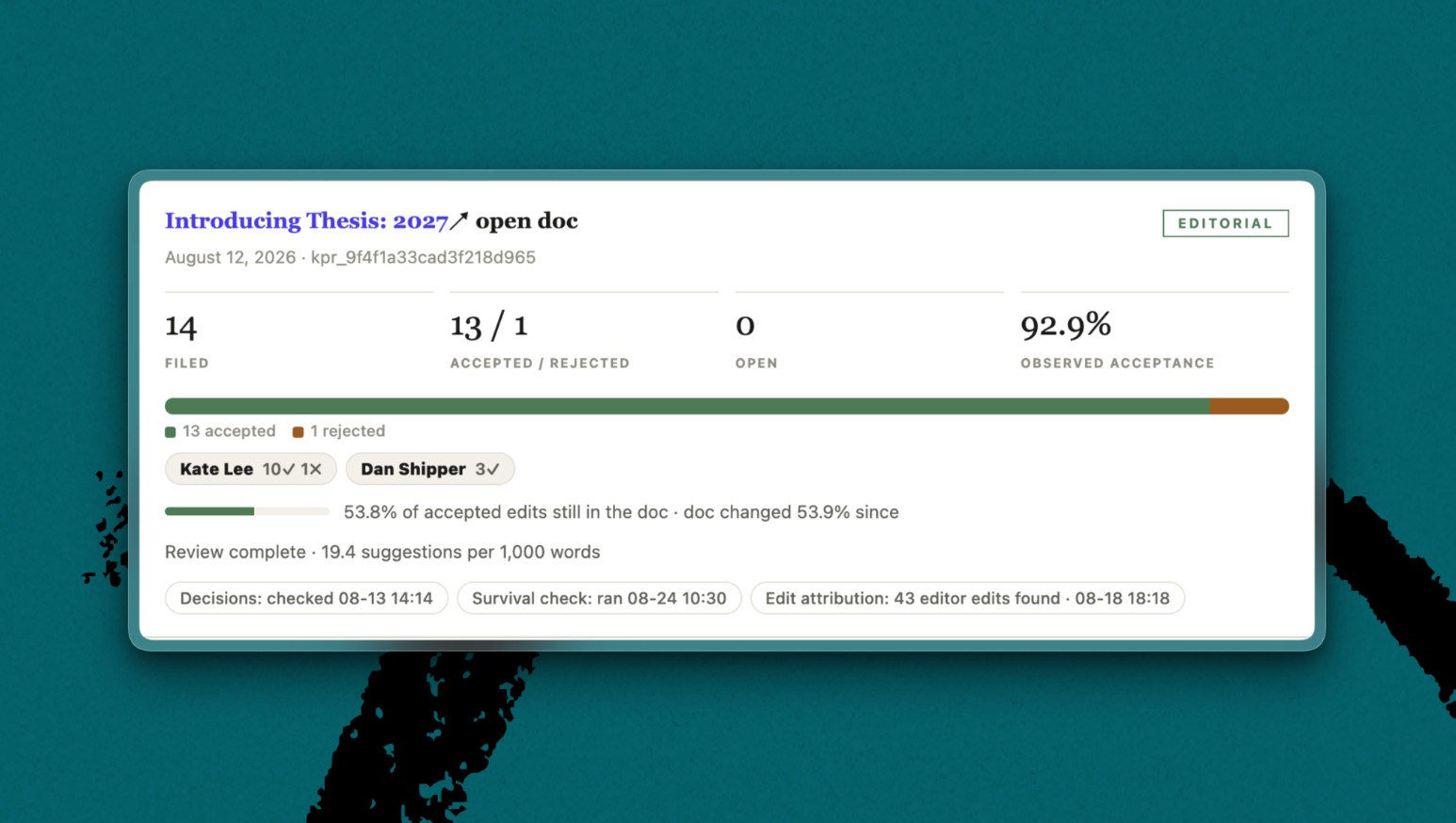
That changed with the launch of GPT-5.6. Now, before I file an article, I run it through KateBench, a skill that copyedits based on Kate’s historical edits. Only then does human Kate review the piece, accepting, modifying, or rejecting the agent’s suggestions. Tracked changes in Google Docs catalog those decisions and any additional edits she makes, then Codex rewrites the skill so it compounds. (For more on how KateBench works, read staff writer Katie Parrott’s writeup on how engineer Jannik Jung incorporates feedback to improve its performance.)
KateBench takes work off Kate’s plate. It also democratizes her expertise—anyone on the team can get a Kate-level quality pass for anything they’ve written. “It’s weirdly hard and specific to copyedit that well,” Dan says. “She’s the only one who can do it at her level, and now that’s not true anymore.”
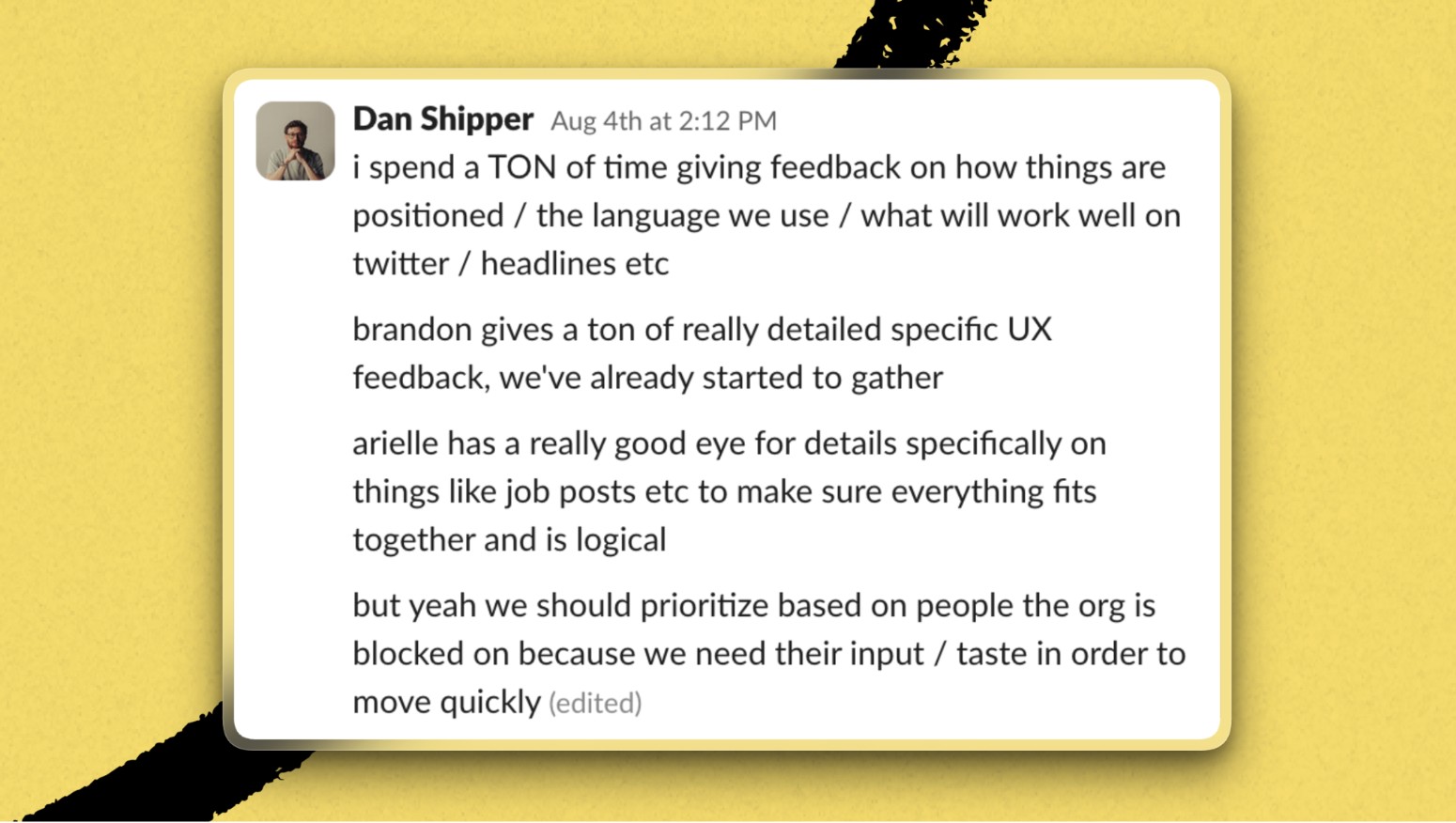
The obvious next step—at least if you’re Dan—is to build a version of KateBench for everyone at the company. That way, COO Brandon Gell’s sharp user experience (UX) feedback, head of operations Arielle Shipper’s logistical brain, and head of social Becky Isjwara’s finger-on-the-pulse social positioning can be packaged and made accessible to the rest of us. Meanwhile, Brandon, Arielle, and Becky are free to focus on the higher-leverage projects that can get crowded out by requests from colleagues.
But UX decisions make for a messier dataset than copyedits: “One big thing we’re going to explore over the next couple months is which kinds of work can be treated this way,” Dan says.
The first test: Mike Taylor, who is now head of our evals practice, is building DanLens, a skill that clones and compounds Dan’s marketing instincts and knowledge of Every’s customers so we can apply those insights without clogging his calendar.

Your next teammate has its own computer
Scout handles research. Olivia reads every contract. Talent Scout screens new creators before you’ve had coffee. They aren’t apps you open, they’re Bots you text, each one responsible for a specific job. Grok Bot, from the team behind SpaceXAI, gives every Bot its own computer in the cloud, already logged into the tools it needs and still working when your laptop is closed. You build the team once, then message it the way you’d message a coworker.
Discuss
“AI is a fact of modern life. People will use it to assist in their work and their writing, including with research, checking grammar, editing and more.”—Paul Gigot, opinion editor at the Wall Street Journal, in a statement.
On Tuesday, billionaire investor Stanley Druckenmiller confirmed that “of course I used AI” to write his latest opinion column in the Wall Street Journal, which criticized Treasury Secretary Scott Bessent’s bond buybacks.
“I was a B student in English, but an A+ in economics,” he told the Journal. “These are my ideas and I’ve been speaking about them for over 15 years, as anyone who knows me knows. Would I prefer that I was a great writer? Yes, but that’s not who I am.”
In contrast to other news outlets like the Financial Times, which has publicly banned its columnists from using AI, the Wall Street Journal came to Druckenmiller’s defense. “The question for us is whether what we publish from contributors reflects an author’s original argument, and if the author has the standing and credibility to make it,” Gigot’s statement continued. “In Stan Druckenmiller’s case, we have had a relationship with him for many years, and nobody can doubt that his op-ed is his genuine opinion.”
The entire spectacle caused a minor firestorm on X over whether a byline certifies authorship or simply ownership of an opinion. For Mike, what matters is whether the idea is any good, not whether it was written by AI.
If you ban people with Druckenmiller’s experience and expertise from using LLMs, “we might not get that post, and then we don’t know what he thinks,” he says. “So many interesting things happen to people who can’t write.”
Skill share
Compound your Codex use
These days, Arielle works almost exclusively in Codex. When the agent makes a mistake, she 1) fixes the immediate problem and 2) prevents it from happening again with a custom self-improve skill.
Whenever Codex returns an incorrect result, Arielle supplies Codex with feedback about where it fell short and what a better response would have been. After it has all the necessary context, she runs the skill, which reviews the initial output, interrogates what went wrong, and suggests a targeted edit to Codex’s instructions so the issue is less likely to repeat.
Say Codex drafts a Slack message that doesn’t sound like her. The self-improve skill might suggest updating Codex’s operating rules to state:
Before writing or sending a Slack message, always read the context of prior messages in the thread or DM so that responses are contextual and acknowledge what came before it.
She treats such missteps as data to funnel back into the agent: “Why didn’t that work? And what can that teach me about working with these tools?” she says.
Download Arielle’s self-improve skill to build the same feedback loop into your own Codex setup.
Thesis Statements
Last week, we launched Thesis Statements, a collection of specific, contestable claims from builders and thinkers on the future of great human work with AI.
Today, we have seven more predictions from people operating at the frontier:
- To work with AI, we’ll grow new senses by Alice Albrecht, AI researcher and founder
- The AI revolution will take so much longer than anyone is predicting by Gagan Biyani, cofounder and CEO of Maven
- The best businesses will use AI to revolutionize their companies, not automate them by Sam Gerstenzang, partner at Boulton and Watt
- The best leaders will focus on the messy work of unpredictable humans by Kit Krugman, chief people officer at Altana
- Offline devices will be like going to the gym for your brain by Craig Mod, writer and photographer
- Your AI tools will feel like part of your body by Yohei Nakajima, cofounder and general partner of Untapped Capital
- The minimum viable product will be for one person—or even one agent by Matt Van Horn, CEO and cofounder of June
If you want to help move these ideas from arguments into action, join us at our inaugural Thesis: 2027 conference on November 5, 2026.
Signal
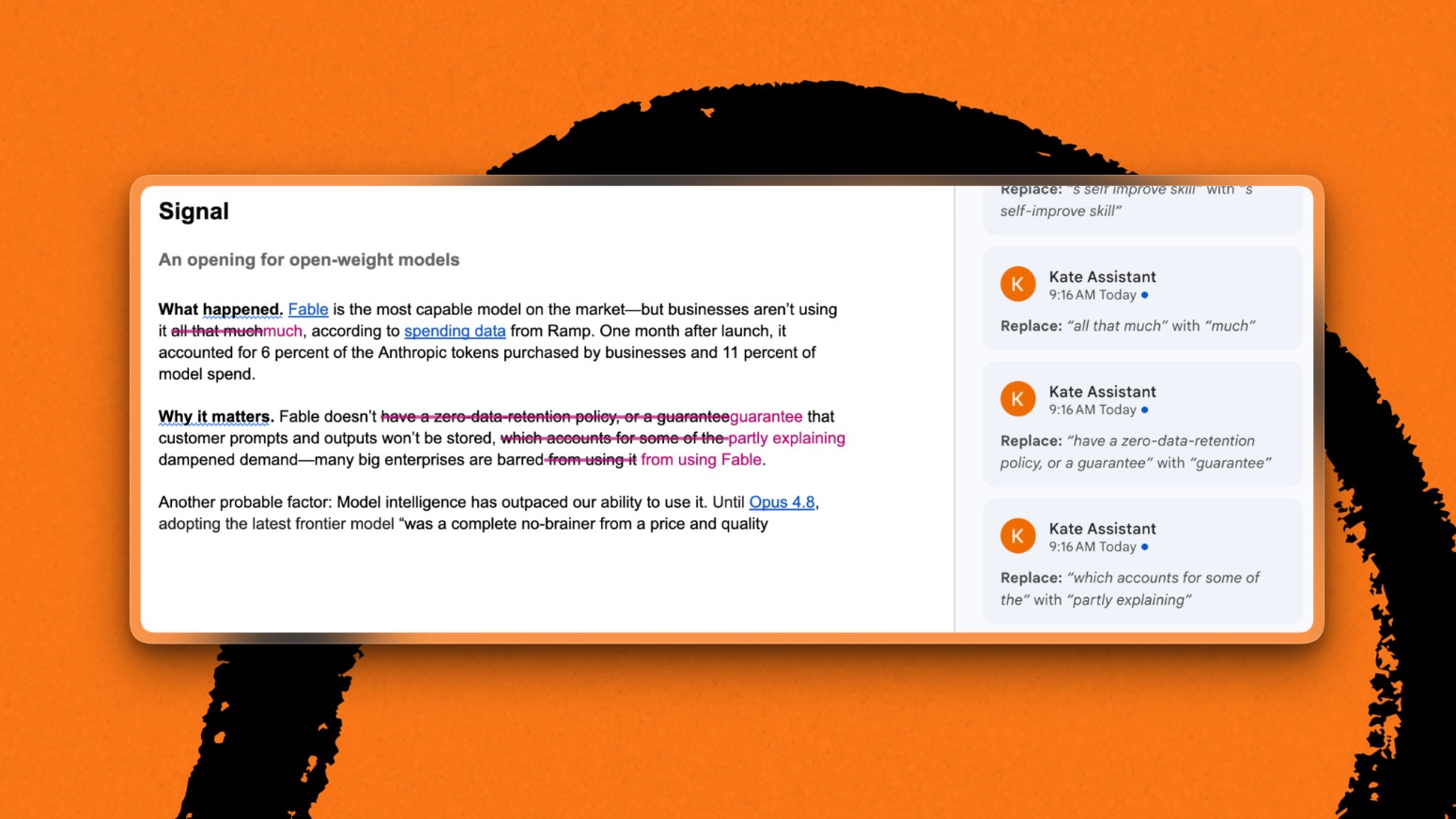
An opening for open-weight models
What happened: A popular narrative is emerging that we’ve hit diminishing returns on model intelligence for many tasks. Case in point: Fable is the most capable model on the market,but businesses aren’t using it much, according to spending data from Ramp. One month after launch, it accounted for 6 percent of the Anthropic tokens purchased by businesses and 11 percent of model spend.
Why it matters: Fable doesn’t guarantee that customer prompts and outputs won’t be stored. Because of that security risk, many big enterprises are barred from using Fable, partly explaining the dampened demand.
Another probable factor: Model intelligence has outpaced our ability to use it. Adopting the latest frontier model “was a complete no-brainer from a price and quality perspective,” Mike says—until Opus 4.8. For $70 an hour at full API rates, Fable broke that trend.
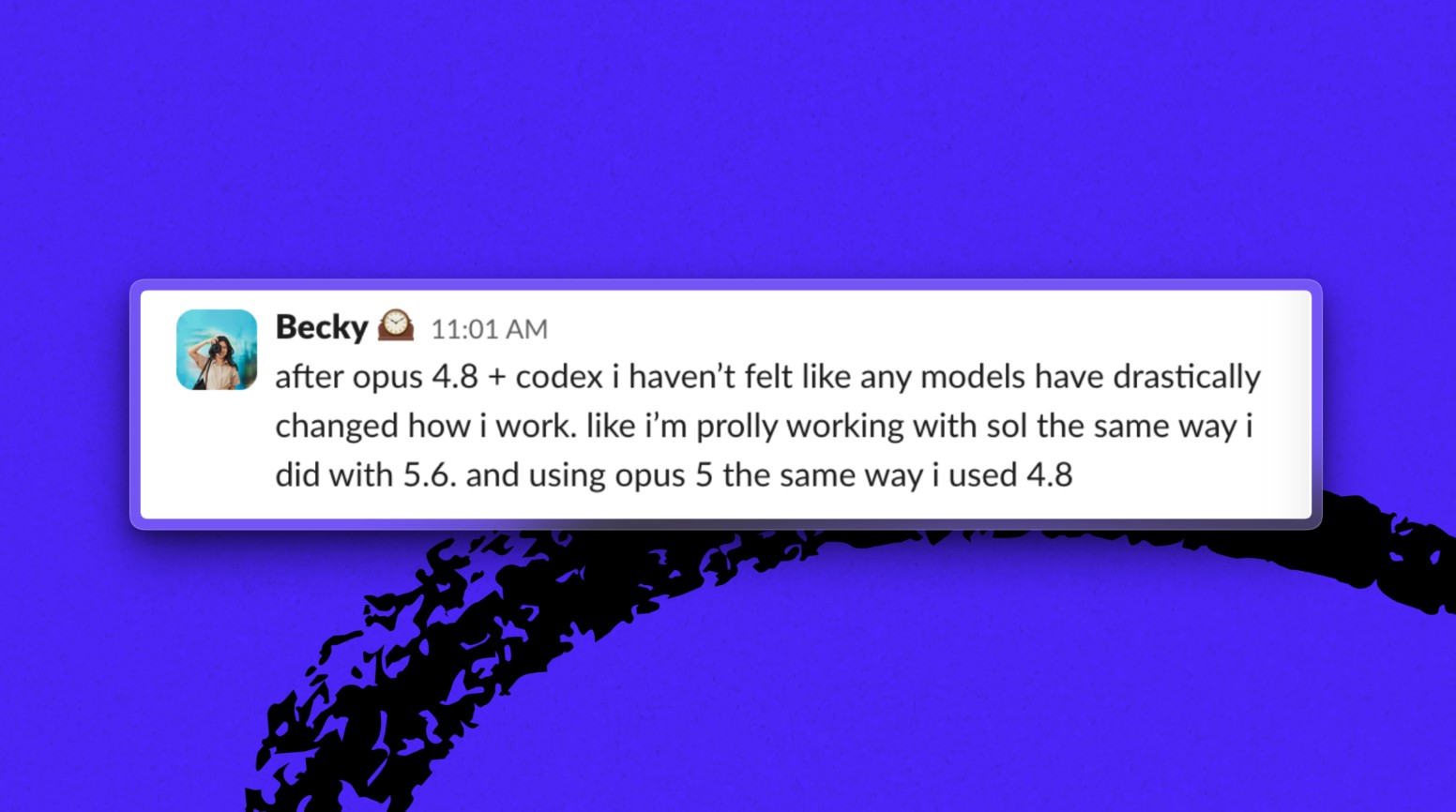
Fable is still the obvious choice for ambitious projects—Dan used it over the weekend to build an end-to-end app that lets remote agents control his computer autonomously. But most of his work requires far less intelligence. “I get no relative gain from Fable on 80 percent of my knowledge work tasks—it’s slower and more expensive without being better,” he says.
What it means. This creates an opening for open-weight models, which processed 29 percent of the tokens routed through Vercel’s AI Gateway in June, up from 11 percent in April. The volume accounted for less than 4 percent of spend, a sign companies are already routing high-volume work to cheaper models.
If most people don’t need frontier capabilities, open-weight AI developers can focus on training a competent, user-friendly model “and people will start using it because it’s going to be 90 percent cheaper than Fable,” Mike says.
AI & I: Inside the $10 billion hedge fund where AI fluency is a job requirement
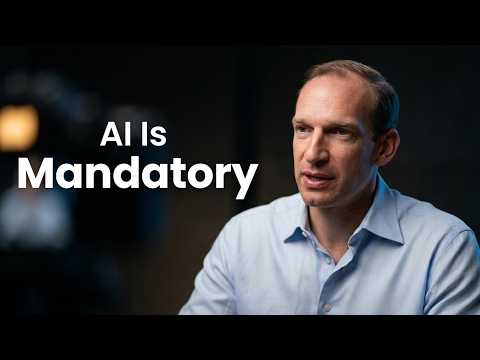
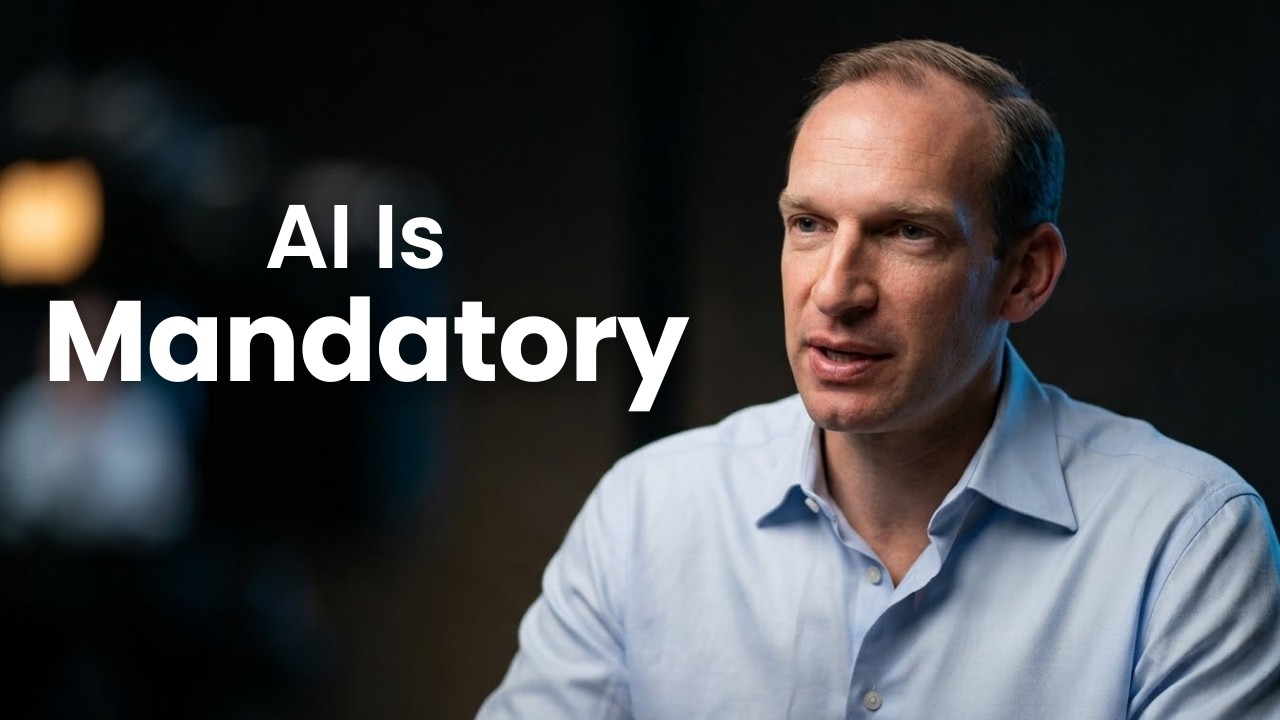
Hedge funds live and die on having an edge. AI provides one, so its use is mandatory for all 400 employees at the $10 billion hedge fund Walleye Capital.
On this episode of AI & I, we’re revisiting our conversation with the fund’s CEO and chief investment officer Will England. An AI maximalist, England foresaw how the technology would absorb operational tasks, freeing up knowledge workers to focus on bigger-picture, often more abstract problems and decisions.
Watch on X or YouTube, or listen on Spotify or Apple Podcasts. You can also read the transcript.
Here are the highlights:
- England has wanted to automate his job since the GPT-3 days. Back in March 2023, England watched one of his analysts demonstrate how AI allowed him to get more done more quickly. From that moment England knew AI would fundamentally reshape work for anyone who “think[s] for a living,” starting with himself. “If you can have a tool that makes you more effective, it’s the same thing as hiring someone to replace part of what you were doing so that you can move on to the next task,” he says. “Your context level shifts up.”
- He views AI as non-negotiable. Eschewing it is like refusing to use the internet in 1995 because it wasn’t perfect. “That’s just dumb and something I can’t understand,” he says. “As a hedge fund, we should be ashamed to leave money on the table by ignoring tools that make us faster, smarter, and more effective.” And as the models improve, the pile of money compounds.
- Results > effort. England sent out a firm-wide email that opened with, “I used ChatGPT to write this email, you should be using it too, and be proud of it.” His larger point: AI speeds up and simplifies many necessary tasks, allowing him to focus on risk evaluations, data strategies, and other big-picture questions affecting fund performance. “People have this insecurity that if I didn’t put my blood, sweat, and tears into it that somehow it’s not real,” he says. “But at the end of the day, results are what matter.”
Miss an episode? Catch up on Dan’s recent conversations with Anthropic head of product Mike Krieger; the team that built Claude Code, Cat Wu and Boris Cherny; the team that built Codex, Thibault Sottiaux and Andrew Ambrosino; Vercel cofounder Guillermo Rauch; podcaster Dwarkesh Patel; and others to learn how they use AI to think, create, and relate.—Miriam Partington

The daily driver
The models the team is using this week
- Andrey Galko, engineering lead: GPT-5.6 Sol for quick tasks, Opus 5 for everything else. “It’s pretty reliable on extra-high/max reasoning and costs much less in usage limits.”
- Becky Isjwara, head of social: Opus 5 and GPT-5.6 Sol (high) for strategy and social analytics, with Sol delegating tasks to Terra. Recently, she’s switched more work back to Opus 5. “I’ve been finding GPT-5.6 Sol has gotten a bit more verbose and slow.”
- Tyler Nishida, engineer: Grok 4.6 for most things as he finds it strikes the best balance between execution and cost. “Fable and GPT-5.6 Sol in headless mode have been enough to save me when Grok 4.6 gets confused.”
- Arielle: GPT-5.6 Sol (medium) for most tasks, toggling to high for more analytical work.
- Dan: Yet-to-be-released models from Anthropic and OpenAI that he’s testing, alongside Fable and GPT-5.6 Sol.
- Willie Williams, head of platform: A mix of Fable, GPT-5.6 Sol (extra-high and medium), and Grok 4.6.
Laura Entis is a staff writer at Every. You can follow her on LinkedIn. To read more essays like this, subscribe to Every, and follow us on X at @every and on LinkedIn.
Everyone’s a builder now. Every All Access gets you the full membership plus the Builder Pack—$9,000+ in credits for the tools we build with.