
Was this newsletter forwarded to you? Sign up to get it in your inbox.
Not every language model is destined to be a chatbot. Companies need fast, cheap, reliable AI workflows for processes that run in the background: deciding where to route a customer service request, checking that invoices match a purchase order, or classifying transactions as potential fraud.
Today, TypeSafe—a new AI lab—launched Jev, its new model designed to produce structured answers that your code can use directly. You pose questions in plain English—even fuzzy or subjective queries—and it returns probabilities for yes/no answers or any other categories you define.
Think of it as a smart if-then statement that determines what happens next when you’re automating a workflow. Say you’re building software that prioritizes customer service requests, and you write code that asks the model, “Does this customer sound angry?” Jev might answer 0.9, which means there’s an estimated 90 percent probability that the answer is yes based on what the model learned in training. You could also provide categories you define, like “annoyed,” “irritated,” “offended,” “furious,” and “enraged,” and learn that the customer was 60 percent likely to be classified as furious, with only a 10 percent probability of being enraged.
With an answer of 0.9 (very likely to be angry), the software might automatically proceed to escalate the customer concern to a manager, or if it answers 0.1 (not likely to be angry) that request might be deprioritized. However, chatbots are trained to respond with flowery text—like, “You’re absolutely right, this customer does sound very angry. Would you like me to compose a draft email response in a friendly, supportive tone?”—not numbers. This text response would cause the program you’re building to crash because it was expecting a number between 0 and 1, not an essay. Historically I’ve used DSPy, a Python framework for programming models, to coax LLMs into following instructions on what types of outputs to return, but Jev does all that work natively, which makes it insanely fast and cheap. Just how well it gets the job done is still an open question.
Trained to make decisions
TypeSafe’s approach is to train its model to produce structured answers that software needs to make decisions. The goal is for the model’s confidence to match how often it’s right: If it flags 100 customer messages as having a 90 percent chance of expressing anger, about 90 should express anger. The model returns answers that fit the right format, with well-informed probabilities your program can check when routing to the next action in the chain. TypeSafe calls the training approach Reinforcement Learning for Calibrated Decisions (RLCD).
Although solutions like DSPy can help developers make LLMs more reliable for enterprise use cases, you’re still trying to coerce text output into behaving like structured code. “The problem is the text itself,” TypeSafe cofounder Diogo Almeida told me as the motivation for pursuing a different kind of language model. At OpenAI, Almeida coauthored the 2022 InstructGPT paper, which showed how human feedback could help language models follow instructions more reliably—work that helped pave the way for ChatGPT later that year. Now he’s making AI models that are easier to build reliable workflows on top of, with a speed and cost that work at large scale in production. As they say at TypeSafe, “We’re building prod, not God.”
Due to the System One architecture Almeida and team developed and trained using RLCD, Jev isn’t slowed down by generating an answer token by token or word by word like a traditional LLM. It can answer multiple questions in parallel in fractions of a second, and for a fraction of the cost of most LLM queries—Jev is priced at $42 per billion tokens, whereas most LLMs are priced per million. TypeSafe doesn’t even charge for output tokens; they’re “too cheap to meter,” according to Almeida.
What I tested
The first thing I tried was giving Jev the text from all 27 of my Every articles, alongside 10 deliberately AI-styled counterparts. Then I asked the same 21 questions concurrently across all articles to check for AI tells. The list of questions was derived from the skill we created to root out common AI tells in our writing including, “Does the text repeat an idea without adding evidence?” “Force a symmetrical ‘both sides’ argument?” “Overexplain a straightforward point?”
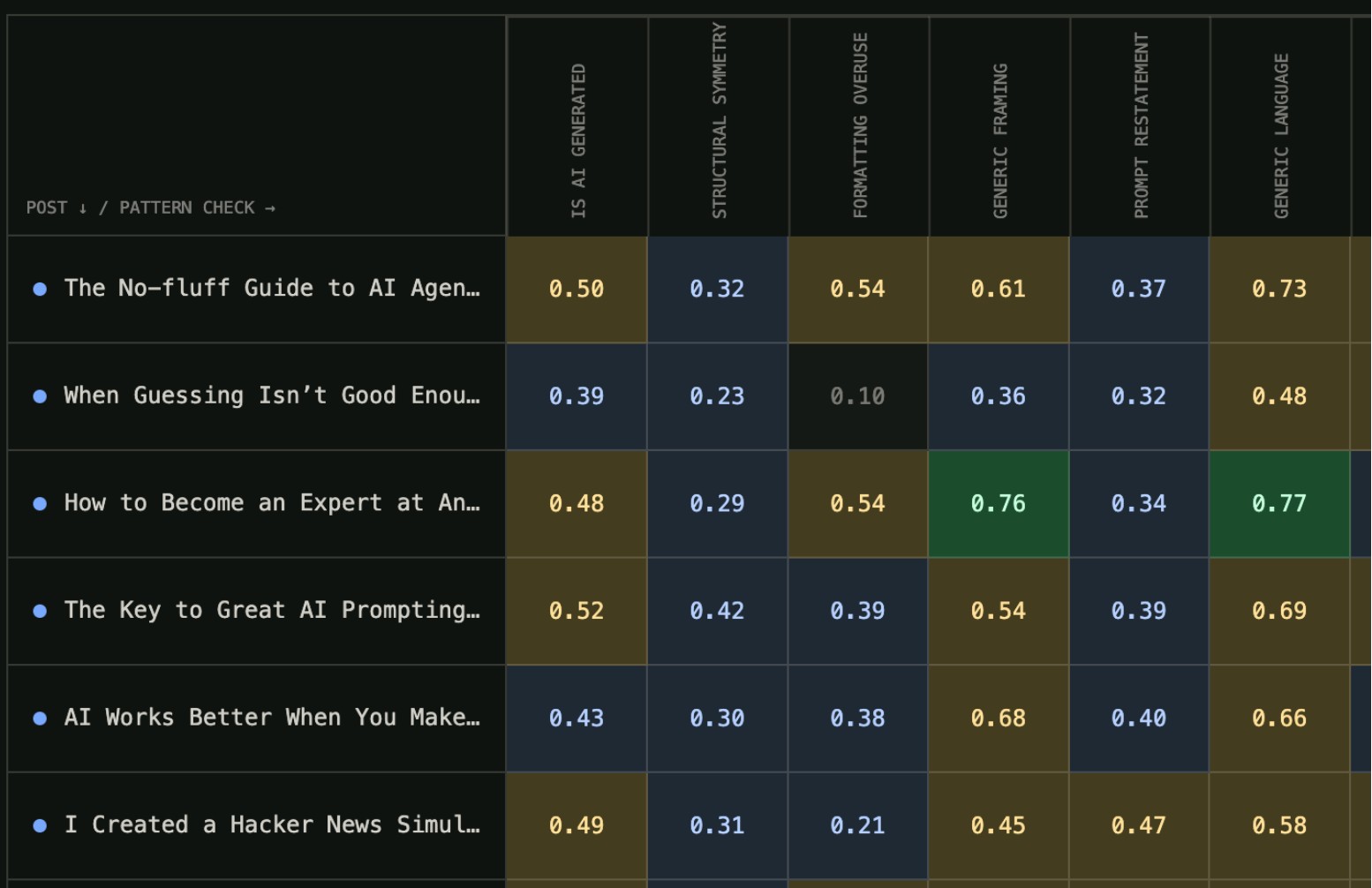
In less than 0.7 seconds, Jev “read” all 37 documents and answered all 21 questions for each, returning 777 judgments, for an estimated quarter of a cent. That’s fast and cheap enough to “AI check” everything everyone at your company has ever written and get the results back in an instant. Whether you’d trust those results is another question—when I browsed the articles it classified, Jev correctly flagged pieces of mine that leaned more on AI, but I’d want a more thorough accuracy check before putting it into production. Even with that caveat, it’s useful as an early warning system: The alternative is not checking at all.
In total I ran 11 experiments to explore different use cases (here’s a more detailed explainer), such as:
- Finding context: Find the right code file; help an agent navigate a codebase; retrieve the company policy that answers a question.
- Checking work: Grade customer-support replies; flag risky actions an agent proposes; check my writing for AI tells.
- Making decisions: Sort startup pitches; prioritize customers who need help; identify decisions that need the CEO; decide which emails need a reply today; ask 100 simulated people which ad they would click.
Across the suite of experiments, TypeSafe made 1,709 judgments for an estimated total cost of less than a cent. I created the scenarios using GPT-6 Astra in Codex, which understood the TypeSafe documentation without needing any guidance from me—traditional LLMs are good at knowing how to write queries and use structured outputs.
A code linter for knowledge work
In software development, a code linter is a tool that analyzes your work and almost instantly flags syntax errors, catches bugs, spots bad patterns, and enforces stylistic consistency. TypeSafe’s model is so fast at turning fuzzy tasks into clear, structured answers that it could act as a kind of code linter for knowledge work. Give Codex or Claude access to Jev and a list of questions, and it can quickly check its own work for problems you’ve told it to avoid.
At Every, I’m building a personal benchmark for everyone at the company, and someone has to grade it—so I’m constantly using AI to review the output of other AI models. We take five to 10 tasks you regularly do, save examples, and turn your preferences into individual pass-or-fail checks. Checking for subjective measures like “Is this PowerPoint on brand?”, “Does this social media copy have a good hook?”, or “Did the model recommend the same thing I would?”, we compare the results with your judgment and refine the checks until the scores are useful in deciding what models or skills you should use for work. TypeSafe is so fast and cheap we could run checks multiple times while the work is being done, not just once later for the handful of tasks that make it into your benchmark.
Every CEO Dan Shipper tested the code linter idea more directly. He gave Jev and Fable 5.1 the same four writing checks across 12 synthetic passages he generated for the purposes of this test: six clear versions and six with deliberately introduced problems. The checks asked whether an action was unexplained, a reasoning link was missing, a mechanism had replaced the intended outcome, or a claim distorted its source.
Jev took a median of 0.35 seconds per passage, versus 8.83 seconds for Fable 5.1 at high effort—roughly 25 times faster. Its estimated cost was about 580 times lower than Fable’s. But Jev caught six of the seven intended defects; Fable caught all seven. One passage proposed “a shared appointment calendar that parents and staff teach together.” What does teaching a calendar mean? Fable caught the unexplained action. Jev missed it in all three runs, but six out of seven isn’t bad for pennies on the dollar.
Just like Astra being good at computer use has changed the way we work, this new class of model will open up new opportunities. Imagine giving Codex or Claude these checks to run after it writes each paragraph. Jev could flag a possible problem, and then the writing model could inspect the passage and decide whether to revise it before moving on. You get a final draft that passes all your checks, so you don’t have to spend so much time in the loop.
Who should try it
If you’re building with AI, look for a judgment you already need to make repeatedly as a good first test for Jev. Mine are whether the agent found the right context for a task and whether its output meets my standards. TypeSafe’s speed and cost make it plausible to ask those questions multiple times while the task is in progress, rather than waiting for you to catch the issues at the end. If you haven’t had much experience in workflow automation, you’ll have to get creative with this new type of model. But Jev is worth testing in any scenario where it would be useful to ask fuzzy questions and get structured answers.
It’s not often we get a new type of model to play with, and new applications that weren’t feasible to build before will now be possible. Look for ideas you couldn’t build because existing LLMs couldn’t classify things quickly or cheaply enough. Compare the model’s accuracy to existing LLMs, and make sure it’s accurate enough for your use case. The ultimate test is whether acting on the answers makes the work better.
Mike Taylor is the head of evals at Every. To read more essays like this, subscribe to Every, and follow us on X at @every and on LinkedIn.
Everyone’s a builder now. Every All Access gets you the full membership plus the Builder Pack—$9,000+ in credits for the tools we build with.