
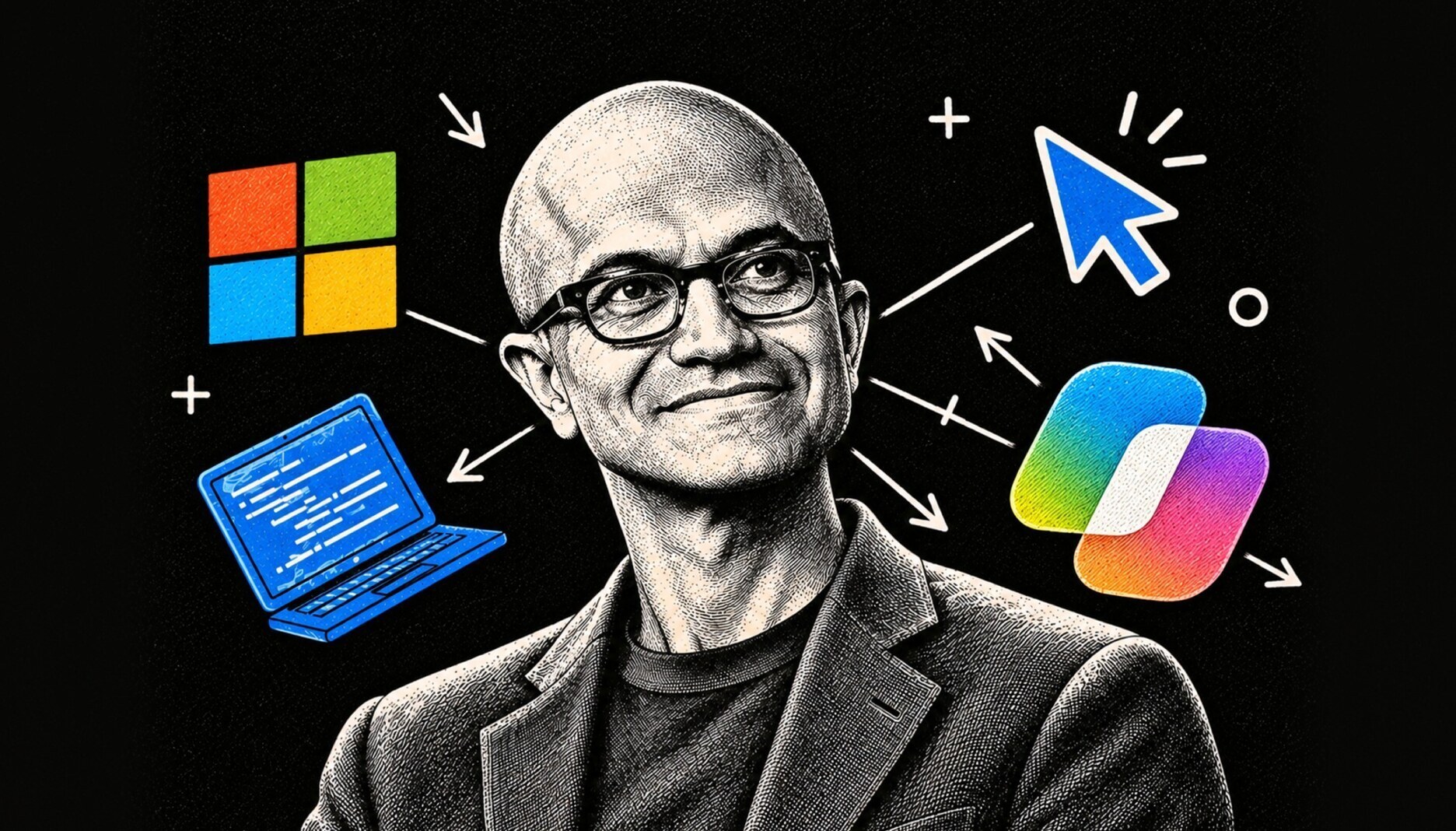
At Microsoft Ignite on Tuesday, I sat in on a roundtable where Microsoft CEO Satya Nadella told a room of reporters and creators that yes, he’s AGI-pilled now. We break down what that looks like for a company the size of Microsoft. Don’t miss it: We’re re-vibe checking Astra 6.2 and Sol 6.2 live today at 3 p.m. ET, after some back-and-forth about differences between the build our frontier team tested and the public release. The whole team will rerun its process on air so viewers can see how we test and what, if anything, has changed. Join the livestream here. —Grant Harvey
Was this newsletter forwarded to you? Sign up to get it in your inbox.
Signal
Satya Nadella is AGI-pilled now
What happened: At a roundtable after his Ignite keynote on Tuesday, Nadella said he is “AGI pilled,” though not in the usual sense of betting on superintelligence. What matters to him is how the political economy will be organized around a model with “no limits”—one that could become a health care or financial services company, or even “take over the government.”
Why it matters: Microsoft is making its case against Anthropic taking over everything. Asked whether Anthropic can still be caught once its models start improving themselves, Nadella said a world that runs on one firm structurally won’t happen because the world will demand more than one firm. He made the same point in his keynote: Intelligence needs to be broadly distributed for multiple firms to thrive, which means there should be “as many models as firms.”
What it means: Microsoft is rebuilding its model business, its product, and its own teams around that bet.
- Customers make models their own. Nadella says he’s trying to convert the model business into a “database business.” Microsoft will let enterprise customers license its MAI model weights, run them in their own Azure environments, fine-tune them on proprietary data, and decide when to upgrade. AT&T has already tried it: Its custom MAI model outperformed Sol 6.1 on standard 5G network tasks at one-fiftieth of the cost, according to Microsoft. Monologue, Every’s dictation app, runs on a similar idea: Its two-person team replaced a roughly 1-trillion-parameter model with one they fine-tuned themselves, and it’s faster and far cheaper.
- Copilot goes multiplayer. As head of evals Mike Taylor wrote in August, Claude Code’s bottom-up surge eventually pushed Microsoft to break its exclusivity with OpenAI and bring Claude into Copilot. Now, Microsoft’s latest moves, like the launch of Autopilot (Microsoft’s answer to products like Dots and Duet), suggest the company has to build a better Claude desktop before Claude builds a better Office suite. Copilot used to be a sidebar inside Office. Now the full Office apps run inside Copilot, and Copilot Workspaces lets people and their agents collaborate using shared context.
- The firm changes, too. Nadella says Microsoft’s ideal team stack now includes full-stack builders, infrastructure people, and scientists, and former team leads are becoming individual contributors who manage agents. (As Ryan Sloan reported for us in September, Microsoft has put Copilot’s agents on the org chart.) Nadella says those contributors will get a token budget, and yes, their pay should go up as an incentive. Most importantly, he stressed that everyone (including him) needs to relearn how work happens from first principles. “We turn our two hundred thousand people into a scale benefit, but it has to transform and work like any AI native startup.”
Monologue, the dictation app running on its own fine-tuned model, is included in your Every subscription. Try it here.
What else is going on
What we’re talking about
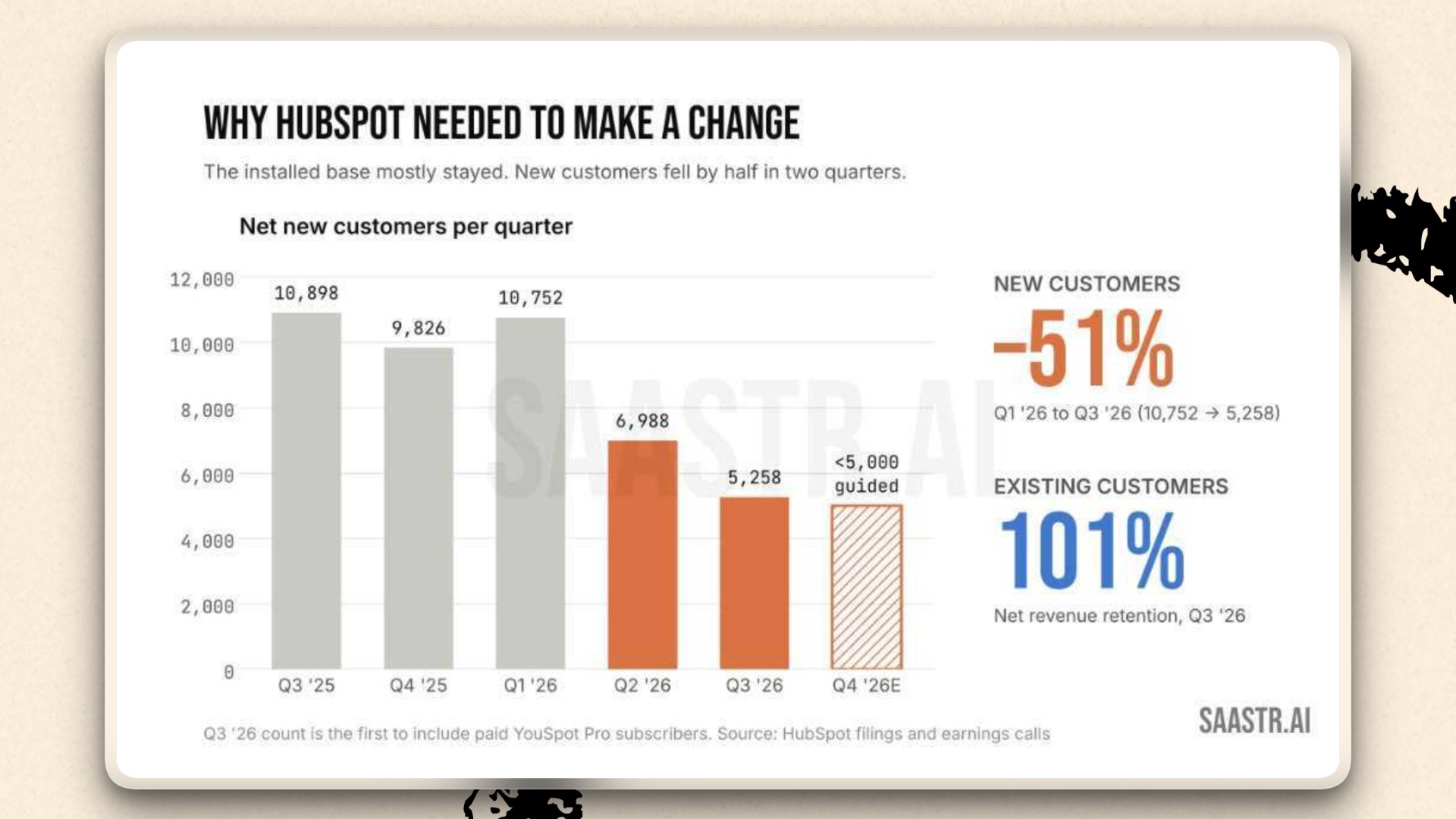
- The SaaSpocalypse might really be a SaaS slowdown. Check out Jason Lemkin’s chart, which shows net new customers down for HubSpot while retention stays high (Monday’s net new customers are also down). Mike thinks the “Saaspocalypse” is a slowdown in buying, not a wave of customers leaving to vibe code their own tools. As in hiring, where there are few layoffs but fewer new hires, existing SaaS customers are staying while new ones dry up. AI has made the slowdown worse by wiping out the SEO engine that companies like HubSpot grew on.
- Claude Code’s Code Mode batches tool calls. A new experimental Code Mode setting has Claude write one script that makes all its tool calls at once, instead of one call per round trip. Try it: Run one multistep task with Code Mode off, then on, and compare /cost.
- Gemini is the ultimate Rosetta stone now. fofr’s demo of using Gemini as a decoder to transcribe 15th-century Renaissance ciphers had Dan Shipper picturing “me asking gemini to read my handwritten journals.” Try it on your own notebooks.
New from Every
- Vibe Check: GPT-6.2: Katie Parrott and the frontier team found Astra and Sol handle bounded tasks well but fall short on work that needs judgment and follow-through. Join us at 3 p.m. ET for a live vibe check on the public version to see what (if anything) has changed.
Outside Every
- Nvidia’s record quarter didn’t stick. In its first report since Jensen Huang resigned, Nvidia posted $115.8 billion in revenue, up 103 percent, and guided to $130 billion, but the gain faded soon after the open.
- Anthropic’s suppliers are buying in. Anthropic prices its IPO tonight, likely above range, and seven compute suppliers, Nvidia among them, are putting in $26 billion at the IPO price in a private deal. The stock is expected to formally list tomorrow.
The daily driver
The models the team is using this week:
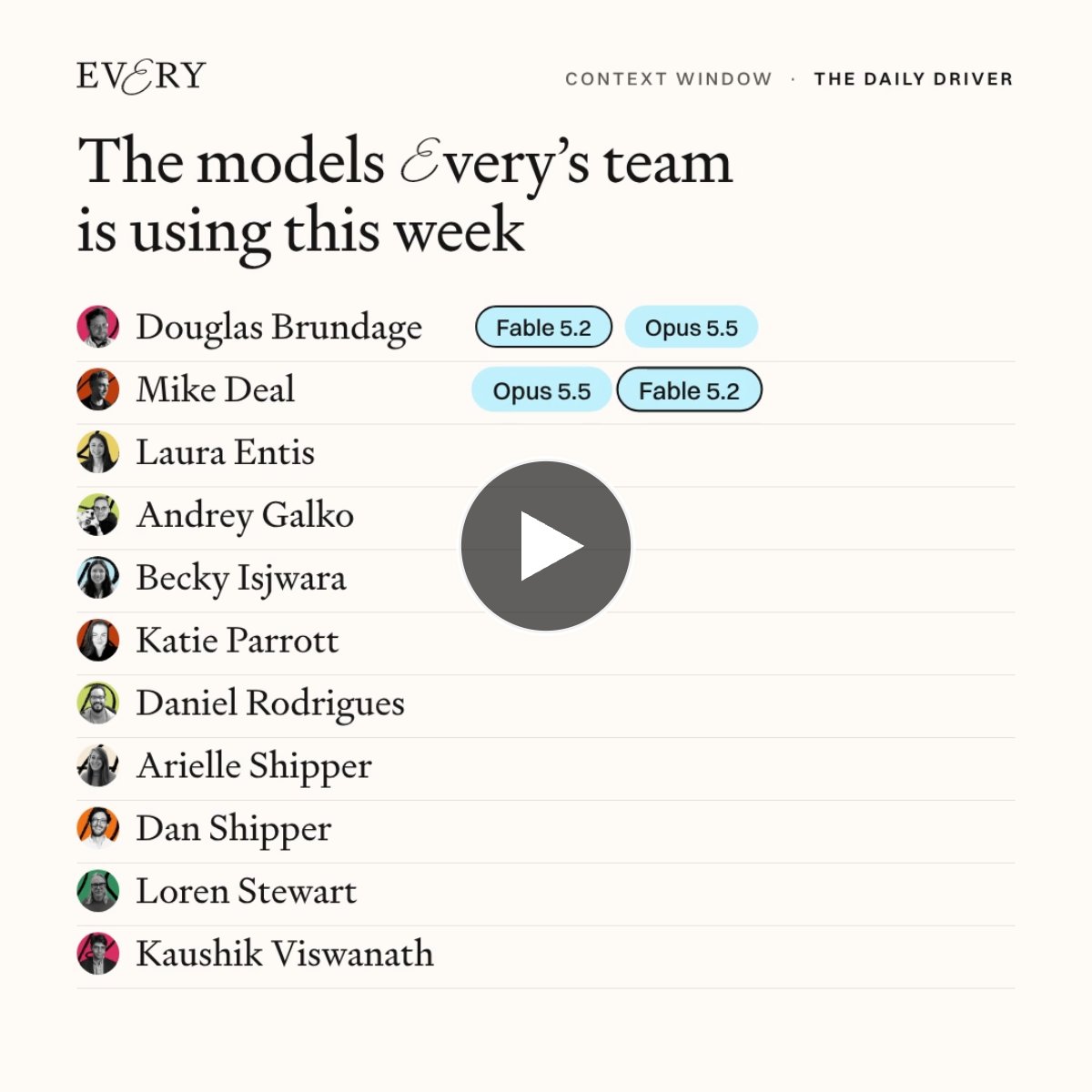
The models Every's team is using this week.
- Douglas Brundage, head of marketing—“I’m in Fable 5.2 now a lot,” plus Opus 5.5.
- Mike Deal, designer—Opus 5.5 “as workhorse,” Fable 5.2 “for when higher-level judgement needed (like planning a project).”
- Laura Entis, staff writer—Opus 5.5 and Argon, switching between them for writing and editing.
- Andrey Galko, engineering lead—Opus 5.5 and Fable 5.2. “I forgot how Codex looks.”
- Becky Isjwara, head of social—Opus 5.5 “for writing/video storyboarding/etc. and sol 6.1 med for everything else.”
- Katie Parrott, staff writer—Mostly Fable 5.2 this week, which she calls “just new-model limerence” (the giddy early stage of a crush): “I’m settling back into Opus for most things.” Her Dot handles administrative work.
- Daniel Rodrigues, senior designer—Fable 5.2 and Opus 5.5, “but I keep using Dot.”
- Arielle Shipper, head of operations—Sol 6.1 (medium) for most things, Opus 5.5 for writing and decks. She “built a thing with Fable 5.2 this week and it was incredible.”
- Dan Shipper, CEO—Gemini Argon and Hydrogen in Antigravity for writing, Fable 5.2 and Opus 5.5 “for thinking and building, and my dot for everything else (like ops type stuff).”
- Loren Stewart, software engineer—Opus 5.5 and Sol 6.1 for dev work, Fable 5.2 “for the most difficult work.”
- Kaushik Viswanath, managing editor—“Dot for most things nowadays.” He used Opus 5.5 to make an Every-themed crossword for the team to solve.
‘The Every Podcast’: Notion’s CEO on when and when not to build your own tools
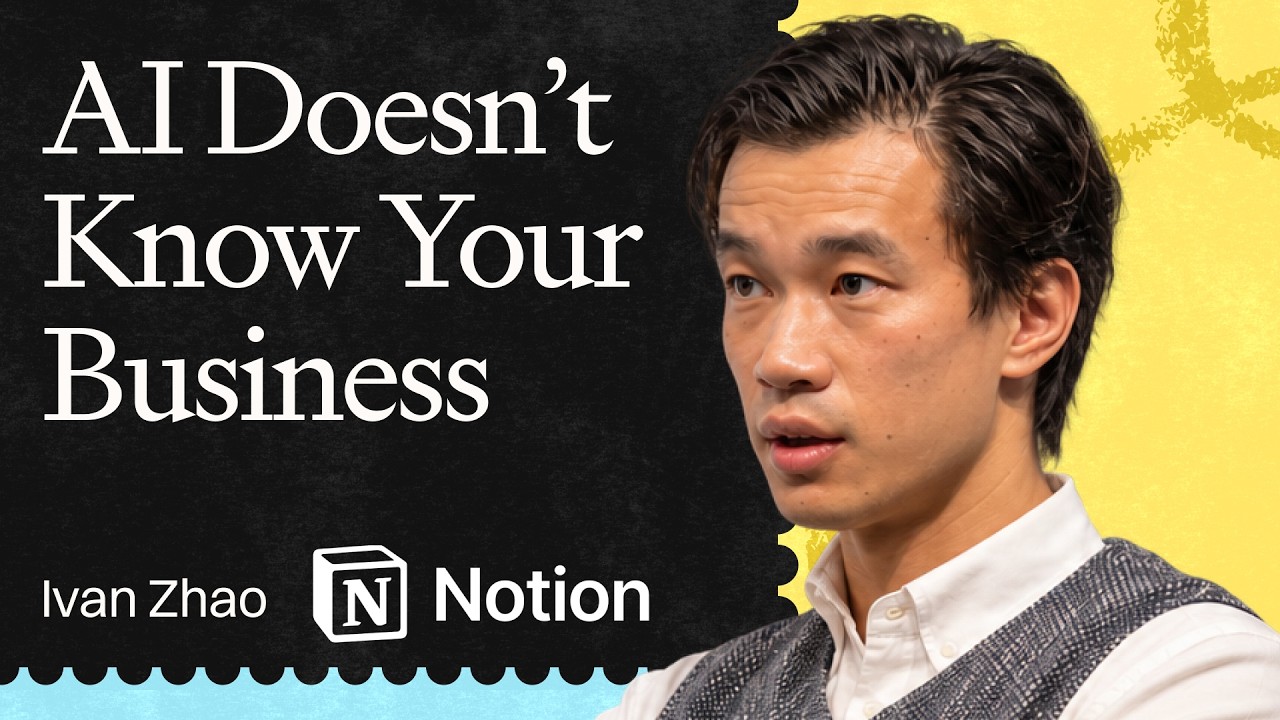

Ivan Zhao started Notion 13 years ago to give nontechnical people the building blocks to make software without learning to code. AI has made that easier, and Zhao is still a believer. At Thesis: 2027, he told Dan where he draws the line.
On this week’s episode of The Every Podcast, we’re sharing Zhao’s conversation with Dan on which tools are worth building yourself, why your data matters more than the interface, and how to keep track of what your agents build.
Watch on X or YouTube, or listen on Spotify or Apple Podcasts. You can also read the transcript.
Here are the highlights:
- Build the tools you want to tinker with. Zhao sorts software into three buckets. Build the tools you use every day and want to customize. Buy the ones you would rather someone else got right, along with the systems your company depends on for security and would struggle to maintain. Notion’s business depends on the last two. Zhao compares it to eating out: “Yes, you can cook yourself, but oftentimes you like to go to a restaurant as well.”
- Organize the data your agents need. Agents can write a workflow or spin up an interface, but they still need access to what your team knows. That’s why Zhao sees Notion as a keeper of company data. Teams can give their preferred agents access while keeping controls on what people can see and edit. He also thinks well-organized data could save money by helping agents spend fewer tokens piecing together what the company already knows.
- Keep track of what your agents build. Give agents a sizable codebase, Zhao says, and within a week “you sort of don’t understand what’s going on.” He wants toolmakers to give people better ways to see how the pieces fit together. At Notion, one answer turned out to be the dreaded kanban board. The thing “everybody hate[s]” gave the team a way to see what its agents were working on.
This is a must-watch for anyone wanting to build with AI without losing track of what they’ve built.
Miss an episode? Catch up on recent conversations with Sam Altman; tech journalist Kevin Roose; Emmy-winning TV writer Fred Graver; Hugging Face’s first investor, Matt Hartman; Granola founder Chris Pedregal; writer Craig Mod; Anthropic head of product Mike Krieger; and others to learn how they use AI to think, create, and relate.
Zhao’s conversation is one of 25 Thesis: 2027 sessions on Every TV, included with a paid Every subscription.
Grant Harvey is a staff writer at Every. To read more essays like this, subscribe to Every and follow us on X at @every and on LinkedIn.
Everyone’s a builder now. Every All Access gets you the full membership plus the Builder Pack—$9,000+ in credits for the tools we build with.