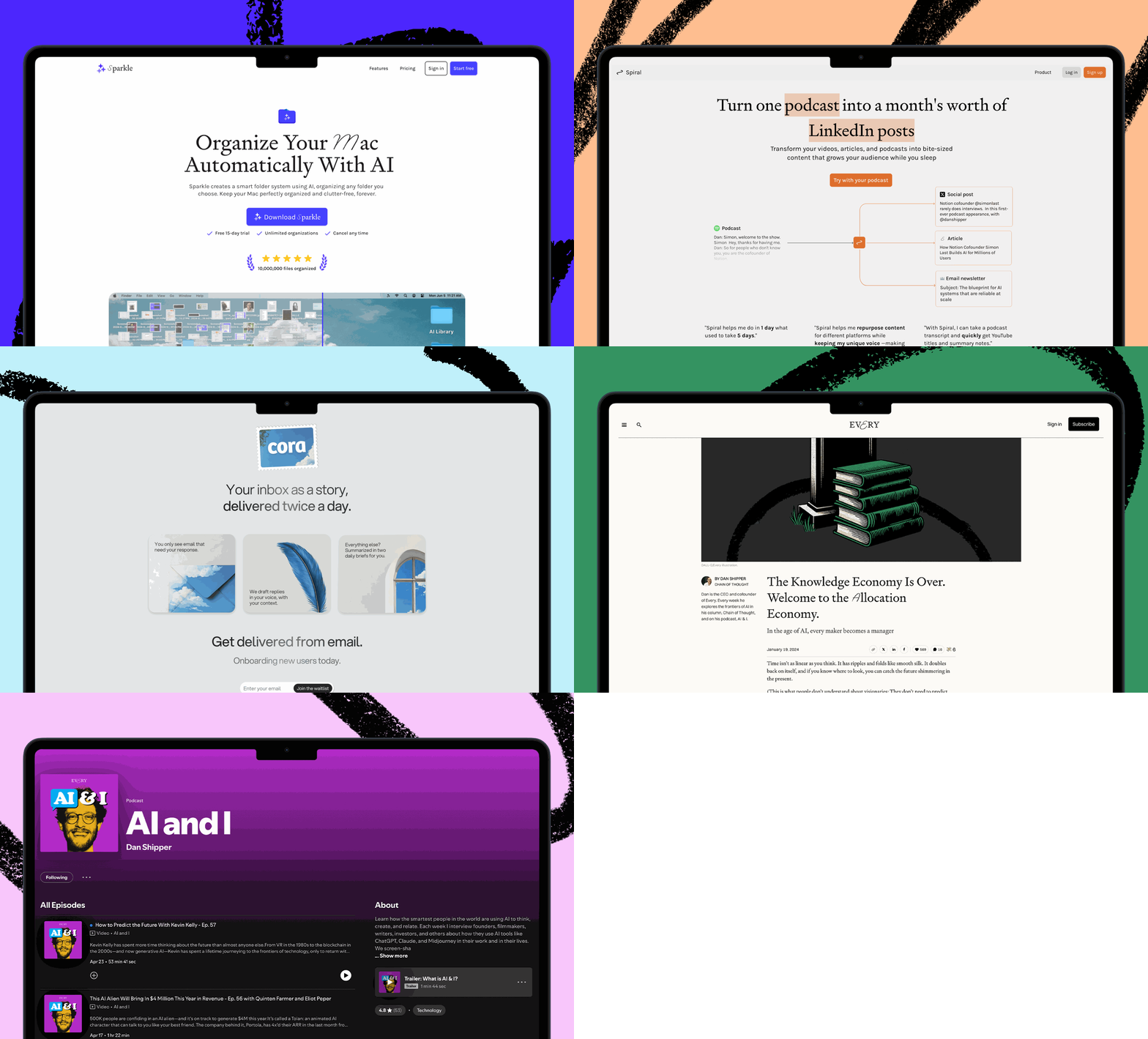

Hello, and happy Sunday. We launched the Every Agent this week, an AI coworker in Slack that your whole company shares. Your team can give it work in a thread, and when a workflow is successful, you can ask it to save the workflow as a skill anyone on the team can run. Also: The Thesis: 2027 after-party on November 5 at Pioneer Works in Red Hook, Brooklyn, is free for Every subscribers—RSVP to reserve your spot. Lastly, we’re off Monday for the U.S. holiday of Indigenous Peoples’ Day and will be back in your inbox on Tuesday.—Kate Lee
Was this newsletter forwarded to you? Sign up to get it in your inbox.
The Every Agent, explained
“Introducing the Every Agent” by Dan Shipper/On Every: The Every Agent does its work in public Slack threads, so your colleagues see both the request and the corrections. It replaces Plus One, which we launched in March to give each of us our own agent, after Dan noticed that people learned the most from watching someone else’s agent at work. Head of evals Mike Taylor built a skill that resets his priorities every Monday, and engineer Nityesh Agarwal runs it every week, too. Each person on your team gets $15 in free credits to try it, with 0 percent markup on tokens: What we pay is what you pay.
🖥 🎧 “Why Every Traded Personal Agents for One Company Agent” by Laura Entis/The Every Podcast: Willie Williams, Every’s head of platform, joined Dan to explain why the personal bots our team built in January mostly died off: They were hard to maintain, and no one could remember which one did what. This is a must-watch or must-listen for anyone deciding whether to give every employee a personal agent or build one shared agent for the whole company. 🖥 🎧 Listen on Spotify or Apple Podcasts, watch on X or YouTube, or read the transcript.
“Why We Handed Our Agent’s Infrastructure to Anthropic” by Paridhi Agarwal/Source Code: Paridhi Agarwal, an engineer on the Every Agent, explains in her first piece for Every why we stopped hosting our own agents and moved to Anthropic’s Claude Managed Agents: Keeping the servers running took time we wanted to spend on the agent itself. The trade-offs are that the service runs only Claude models and can’t offer the zero-data-retention option some companies require. 🖥 Watch Dan and Willieexplain how we built the agent on Claude Managed Agents in a video we shot with Claude.
“Building a More Efficient Agent” by Laura Entis/Context Window: The team first tried routing the Every Agent’s tasks through a cheaper model, and costs went up because many requests ended up running on a more advanced model as well. Paridhi went looking for waste in the agent’s own code, and a model upgrade plus a handful of small fixes cut token costs across 11 common tasks by more than 80 percent. Also in the edition: her four-step workflow, with prompts, for finding waste in your own software, the models the team is using this week, and Willie on managing engineers with AI.
Knowledge base
“When Trying to Make AI Better Makes It Worse” by Katie Parrott/Working Overtime: The Germans have a word for what Katie did to her AI setup in September: Verschlimmbesserung, or making something worse by trying to improve it. She kept adding rules to the files that tell her AI how to write until one essay took 127 drafts, so she archived the whole thing and rebuilt a setup a fraction of the size. Her advice: Try taking something away before you add another instruction.
“You Already Signed This Off (In the Simulation)” by Mike Taylor/Also True for Humans: “Don’t freak out, I cloned you,” Mike told his then-boss Natalia Quintero after feeding a year of her Slack messages to an AI so it could approve his client emails on her behalf. He built clones of GitHub’s chief operating officer and of Dan, too, and while each one learned its person’s rules, they didn’t learn when to set them aside: Natalia’s clone took 73 rounds to turn his email into something that read like a lawyer drafted it. Mike compares them to a Waymo stuck in traffic while a New York cabbie gets you home in half the time.
This week’s seven Thesis Statements—a collection of specific, contestable claims about the future of great human work with AI—all come from the Every team.
- The arguments we hid behind shared vocabulary will become explicit by Alex Duffy, cofounder and CEO of Good Start Labs
- Managing decision fatigue will become part of making great work by Laura Entis, staff writer at Every
- You’ll give your Legos away to agents by Brandon Gell, chief operating officer at Every
- Nothing will go wrong twice by Kieran Klaassen, creator of Compound Engineering and member of the frontier team at Every
- Describing a problem will be enough to begin solving it by Naveen Naidu, general manager of Monologue
- Your expertise will belong to your employer—unless you can make it portable by Kaushik Viswanath, managing editor at Every
- History will be rendered, not read by Willie Williams, head of platform at Every
Our inaugural Thesis: 2027 conference is on November 5, 2026. Every subscribers can RSVP for the after-party that evening for free.
Work at Every
We’re hiring a product manager for Checks at Every. Checks is our personal benchmarking product: You turn examples from your own work into yes-or-no checks and find out which AI models clear your bar. We’re looking for someone technical to lead it, with instincts for both product and platform. Learn more and apply. See the rest of our open roles on the careers page.
Alignment
Spot treatment. I spent about six years at medical school before I could write prescriptions for patients. Doing so rarely felt like I was participating in a technological revolution, but watching a machine being allowed to do it very much does.
Utah recently authorized Nolla Health to test an AI system that can diagnose mild to moderate acne and write prescriptions for topical acne treatments through its app. Initially, two physicians must review and approve every prescription, but if the system meets the pilot’s safety requirements, the state can allow it to operate with progressively less human oversight.
Nolla Health is building the evidence for an AI doctor to handle the entire clinical journey, from diagnosis to follow-up care, for relatively simple conditions. If AI can safely manage the entire pathway, patient volume can grow without increasing clinical headcount at the same rate, thus unlocking the potential for huge scale. That would potentially lower the cost of providing treatment and make it viable to serve people who are currently priced out or poorly served.
But the efficiency gains have to hold across the entire course of care because what matters TK is whether patients achieve good outcomes with less total clinical work, including follow-up, escalations and appointments elsewhere when treatment fails. Those healthcare costs will still count, even if they do land outside the app.
Nolla and others like it are putting that model of care to the test in a narrow setting, and if the results support it, there is a case for testing other conditions, like urinary tract infections or tonsillitis. Even a modest list could add up to a substantial amount of care.—Ashwin Sharma
That’s all for this week. Follow Every on X at @every and on LinkedIn.
Stop explaining AI to your team and start showing them. The Every Agent does the work in Slack, where everyone can see it, so one good workflow quickly becomes the whole team’s.
For sponsorship opportunities, reach out to sponsorships@every.to.