


Today, Every engineering co-lead Andrey Galko explores what happens when AI gets better at the work people have built their lives around. First, though, head of enterprise AI adoption Natalia Quintero sits down with each member of our frontier team, the small crew whose job is to keep pace with AI advancements so the rest of us can focus on our jobs; head of operations Arielle Shipper shares a code-review skill for non-coders, and eight new Thesis Statements.
Was this newsletter forwarded to you? Sign up to get it in your inbox.
‘The Every Podcast’: Why every company needs a frontier team
Every company right now faces the same dilemma: Do you try to keep up with the latest in AI or focus on getting your work done? You could ignore the frontier, but you risk getting suddenly disrupted by “some agent-native version of your product you didn’t see coming,” says Dan Shipper. Or, you could stay on top of the latest model capabilities by tinkering with every new tool but never build anything that lasts.
Every solves this dilemma with a frontier team: a small group whose job is to get their hands on each new model, figure out what it means for our products and workflows, and turn useful experiments into articles, products, and tools for the rest of the company, which stays focused on the roadmap. We’ve been running it for a couple of months, and Dan calls it “kind of transformative.”
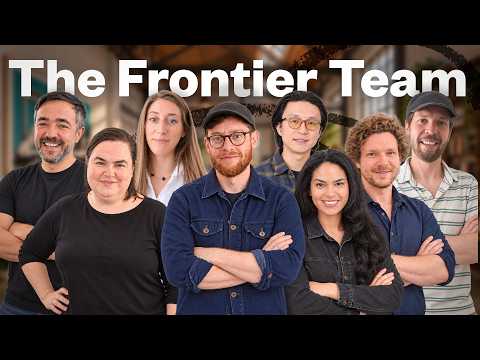
On this week’s episode of The Every Podcast, Natalia Quintero, Every’s head of enterprise AI adoption, sits down with each member of the frontier team: Dan, a self-described “pirate” who wants to try a billion things in a couple of days; head of evals Mike Taylor; head of operations Arielle Shipper; senior editor Jack Cheng; staff writer Katie Parrott; engineer Jannik Jung; and Cora general manager Kieran Klaassen. Each one demos a recent experiment and shares what they’re excited about building next.
Watch on X or YouTube, or listen on Spotify or Apple Podcasts. You can also read the transcript.
Here are the highlights:
- Making ideas “digestible” is now part of the job. Working with AI helps Mike generate a flood of new ideas—he admits he’s regularly accused of saturating every Slack channel with them. He now realizes part of his job is summarizing his experiments so colleagues don’t have to follow every update. To explain Checks, the personal benchmark product he’s building, he used Opus to have hundreds of agents review his Slack messages and Granola meeting notes to boil the product down to 12 sentences and create an explainer video with annotated screenshots and a voiceover. Now the rest of the team can get up to speed without reading back through Slack.
- Building with AI is also about restraint. New models let Jack build interactive experiences and video games, but they also make it tempting to try a million things at once. “I’ve never felt such a strain on my ability to focus,” he says. That’s why he built a tabless browser to reduce context-switching and help him stay with one task. AI allows for all manner of creative experimentation, but Jack wants to do more than just tinker. He wants AI to help him focus long enough to write and build things that matter to him.
- Sometimes it’s easier to build the tool than describe it. Katie tests the latest models and writes Every’s Vibe Checks, but she’s also a builder. Right now, she’s adding an audience file to her Compound Writing plugin, which guides writers from first idea to final draft. The file defines the intended reader, helping the plugin flag passages that might lose them. She’s also a “crash test dummy” for EveryType, Kieran’s bid to get the company off Google Docs, and promises to be “very annoying” in her feedback. Her latest move is to build her own word processor on the side, so she can show Kieran what she wants rather than trying to explain it to him.
This is a must-read or listen for anyone who wants to keep up with AI without straying too far from work.
Miss an episode? Catch up on Dan’s recent conversations with Sam Altman; Anthropic head of product Mike Krieger; the team that built Claude Code, Cat Wu and Boris Cherny; the team that built Codex, Thibault Sottiaux and Andrew Ambrosino; Vercel cofounder Guillermo Rauch; and others to learn how they use AI to think, create, and relate.—Miriam Partington
Signal
The agents on Every’s Railway response team
What happened: On Wednesday, development platform Railway said hackers may have obtained decrypted API keys (the secret codes apps use to access services like ChatGPT), database passwords, and other credentials customers stored on its platform. Stolen API keys could let hackers run up charges, access private data, or disrupt services.
Railway urged customers to replace credentials stored on its platform while it determined who was affected but paused app updates needed to use new ones. This left customers with a difficult choice: Disable the old keys and risk breaking their apps, or keep them active and risk hackers using them.
Why it matters: Every is a Railway customer, so we had to identify potentially exposed credentials across our Railway projects, figure out which apps still depended on them, and coordinate replacements.
To attack the problem, head of platform Willie Williams used Codex to make a shared list of passwords and API keys Every had stored on Railway, with a likely owner for each one. Then he had the Every Agent review the list every hour and post how many entries each person still had to resolve.
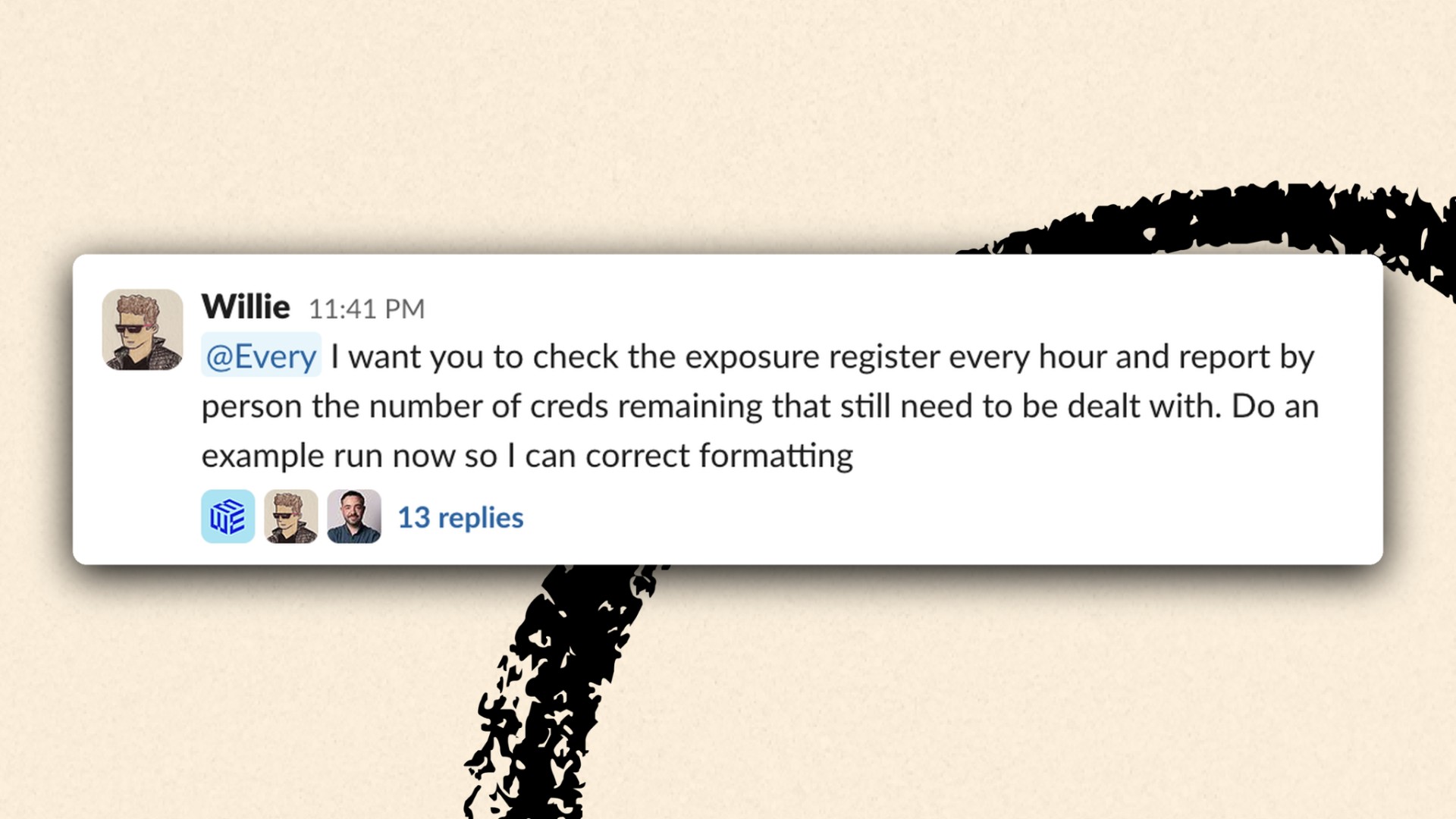
What it means: AI can help hackers step up their attacks, but it can also help teams respond. When a security breach like the Railway cyberattack occurs, you need to know which credentials might have been exposed and keep that information up to date as people replace them. Before AI, Willie estimates it would have taken a few hours to make a list of compromised credentials. From there, a dedicated person would have had to keep track of people’s progress across time zones, likely working into the night.
Instead, Codex compiled the list, and the Every Agent monitored the team’s progress. “This incident would have been insane for us without AI,” Willie says.
Skill share
Ask your coding agent to check your app’s architecture
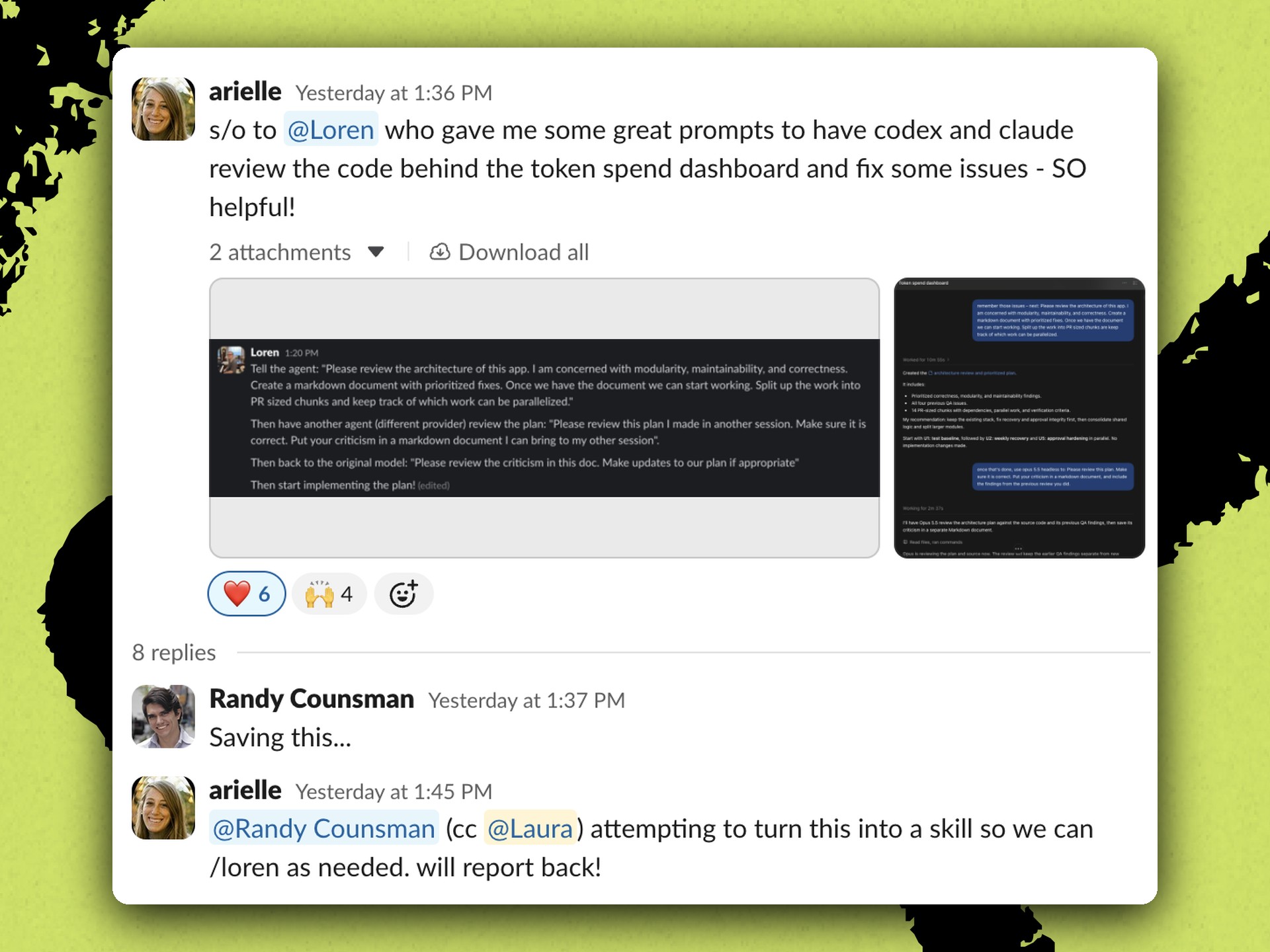
Everyone is a builder at Every. But head of operations Arielle ships, building a remarkable number of internal apps with Codex. These help her move fast, but because she isn’t an engineer, sometimes the code gets ahead of what she can confidently review herself.
Recently, a dashboard she built to track Every’s AI token usage costs across models kept breaking. Engineer Loren Stewart stepped in with an elegant solution: Have one coding agent review the app as a whole and write a prioritized plan to fix it. Give that plan to an agent from a different model company for a second opinion, then bring its criticism back to the first agent to revise the plan before updating the code. Here are his three prompts to fix a buggy app.
Step 1: Ask your coding agent to review the app.
Step 2: Give its plan to an agent from a different provider.
Step 3: Bring the critique back to the first agent.
Arielle, being Arielle, turned the sequence into a skill the whole team can reuse. The skill’s name? /loren, naturally.
Discuss
“I hate when people use these agents to write to me instead of writing to me.”—Andrey Galko, engineering co-lead
Agents are active participants in our Slack. There are the Every Agent, colleagues’ personal agents, and messages sent through Codex. All these agents accelerate what we can do, but they also create a new etiquette problem: A DM from someone’s agent can leave you wondering whether the sender read it before asking you to. “When you use a tool to talk to someone, you make them a tool too,” Andrey says.
Thesis Statements
In Thesis Statements, builders, operators, and thinkers predict the future of great human work with AI. This week, we have eight new predictions:
- Building things will stop being a game of telephone by Curtis Anderson, founder , and CEO of Nursa
- The next IQ will be MQ: materials intelligence by Sonal Chokshi, editor in chief of a16z crypto
- Most software will be disposable by Anurag Goel, founder , and CEO of Render
- AI will eat the middle of advertising—and no one will miss it by Alasdair Lloyd-Jones, founder of Think Better Play
- The machine’s gaze will reward us for sameness by Marcus Moretti, general manager of Spiral
- We’ll install each other’s expertise by Katie Parrott, staff writer at Every
- Your wage will depend on if AI takes the easy or hard part of your job by Neil Thompson, director of FutureTech and principal research scientist at MIT CSAIL
- Solo founding will be the default by Julian Weisser, founder , and CEO of Solo Founders
Our inaugural Thesis: 2027 conference is on November 5, 2026. Every subscribers can RSVP for the after-party that evening for free.
Connections
After engineers
This past summer, Vladimir Putin held a roundtable-like event with his loyal soldiers—the cannon fodder of his war in Ukraine. At one point, he recounted a question someone had asked him: “What are we even going to do after the war ends?” Before he could finish the sentence, he began laughing.
The question was, of course, rhetorical. In Putin’s world, he is the war, and the war is him. He is Russia, and Russia is him. An end to the war would mean confronting what remains when the source of his power and purpose disappears. He has every reason to ensure that “after” never arrives.
On the other side of the world, in sunny Silicon Valley, investors are scrambling up the foothills of the singularity, racing to create artificial general intelligence (AGI). Unlike Putin, they declared a clear endgame: achieving AGI. The brightest minds of our generation are determined to get there at all costs. I wonder if they’ve stopped to ask themselves, in earnest, a similar question: What are we even going to do after?
A war of aggression and a technological project are not morally equivalent, but with AI being on every second (and every first in Silicon Valley) billboard, app, and poster, it’s hard to blame anyone for feeling like AI is invading their lives in a quite aggressive way. For a regular person, the main question sounds more like “Is there even an ‘after’ for me?” and “What am I going to do if I get replaced?” Are AI engineers asking themselves the same questions?
If they are, I have a few ideas: Maybe they could take up woodworking and surfing. Or they could have children and try to raise them to be good people for the future. But then again, why raise people for the future if AI agents are supposed to replace everyone and everything? An existential dilemma, no less.
For me, this isn’t an abstract thought experiment. A small version of that “after”—I’d call it a developer preview version of “after”—has already arrived. I started programming when I was around 11 years old. I was getting paid to do it before I had even finished high school. Over the past few years, though, I went from more or less doing what I was doing as an adolescent to mainly writing plain-text prompts—or writing plain-text loops so I don’t have to write prompts. Most programming work is not mathematics but linguistics and creativity. Programming languages are, after all, languages. And today literal English has become my programming language.
Would I be a programmer if I’d started now? I’m not so sure. Companies are hiring fewer software engineers. Gone are the days of coming out of college or an eight-week coding boot
camp to a high salary and lots of DMs from recruiters on LinkedIn. It seems to get your foot in the door these days, you have to price yourself below a million tokens. Junior engineers require a lot of supervision and training while producing relatively little. But without first being a junior engineer, you can’t really become a mid-level engineer, a senior engineer, or a lead engineer. Who, then, are the AI labs going to hire to develop new models, and smarter models, and build all the software wrappers around those models in order to feed the kraken? On quiet weekend evenings, I sometimes ask myself: Did Anthropic’s engineers imagine that the product of their PhDs and years of work would render their younger selves useless?
It’s unfair to say that their work is done in vain, because there is another side of the story that Dan outlined in “After Automation”: With AI writing all the code—and writing it fast—we can ship much more. That means more products, more apps, more subscriptions and in-app purchases, more dreaming big dreams, and more jobs prompting all of it into existence.
We don’t know how many apps 8 billion people need before the market becomes saturated and nobody wants another one—if it can become saturated. Besides, judging from my own elder relatives, only about half of those people really know what apps are, and even fewer believe they need an app to live a happy life. Though of course, there is an app for that, probably vibe coded.
Until (and if) that day comes, we engineers can start planning our retreat paths. Learning to cook, for example, is a great option: AI can’t yet make you a good pasta or pizza—though it’s getting better at pouring coffee. AI can’t build you an heirloom chest of drawers, and it can’t replace the release of oxytocin from touching another human (unless AI helps us come up with the “O” injections).
So perhaps the cool, well-paying jobs of the future involve real people doing things only real people can do.
Hey, Claude, could you find me some cooking classes nearby?—Andrey Galko
Laura Entis is a staff writer at Every. To read more essays like this, subscribe to Every, and follow us on X at @every and on LinkedIn.
Stop explaining AI to your team and start showing them. Every Agent does the work in Slack, where everyone can see it, so one good workflow quickly becomes the whole team’s.