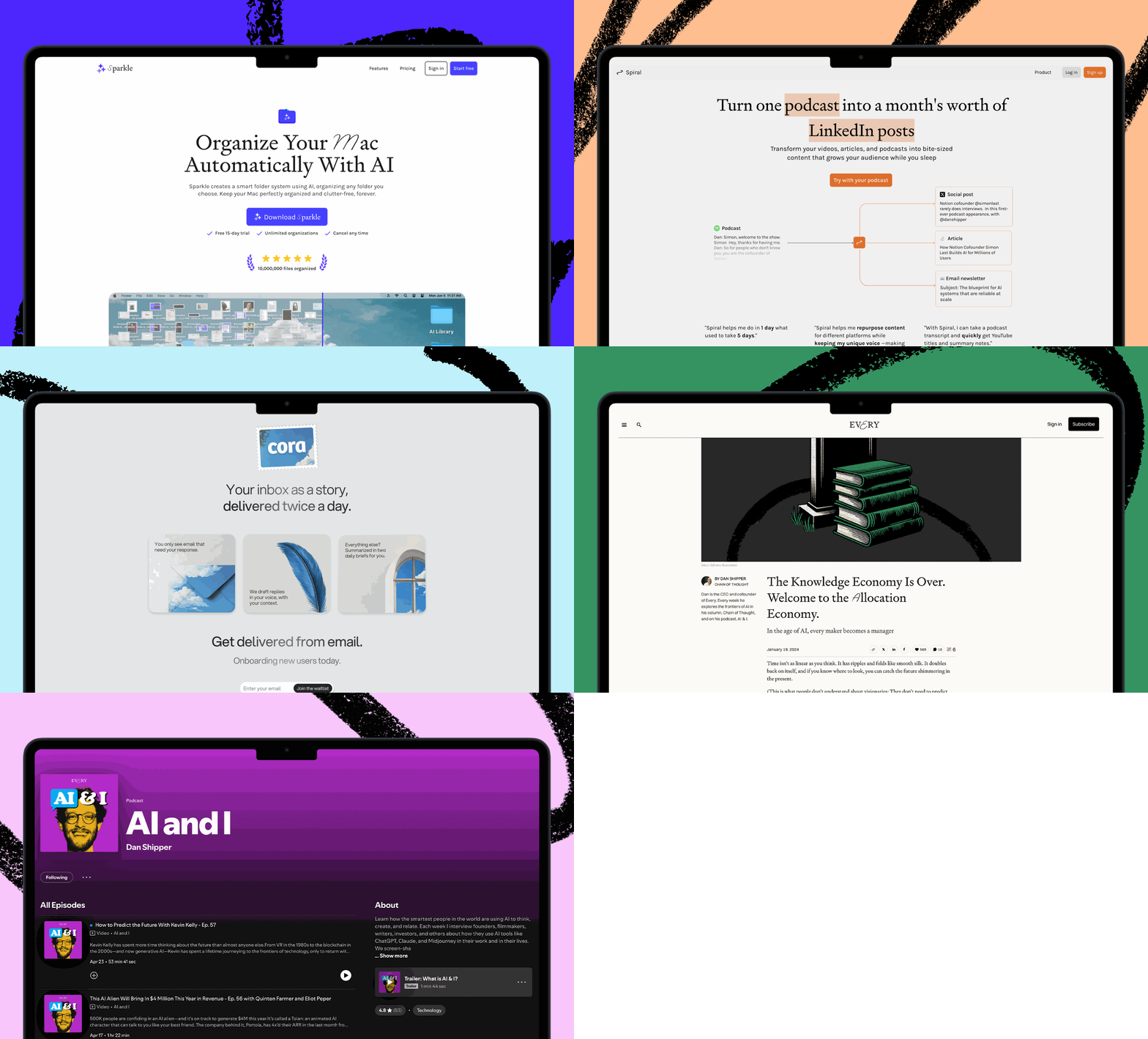

Hello, and happy Sunday. After nearly three years and 108 episodes, AI & I has a new name: The Every Podcast. (It’s the show’s second rename; it started life as How Do You Use ChatGPT?) Dan Shipper taped the first episode on site at OpenAI’s DevDay with Sam Altman. A reminder: Thesis: 2027 is down to its last tickets, and the price goes up on October 15.—Kate Lee
Was this newsletter forwarded to you? Sign up to get it in your inbox.
Vibe Checks
Two from OpenAI’s DevDay and one from Anthropic—here’s where we came out on each.
“Vibe Check: OpenAI DevDay 2026” by Dan Shipper/Vibe Check: OpenAI wants ChatGPT to become your operating system for work, and Dan sorted its 22 DevDay releases by how much each one advances that goal. The five most important ones: Dots, an always-on agent, and Space, native documents the agent can edit, are the workspace itself. Plugin extensions
and a subscription you can use in 16 partner apps let other software connect to ChatGPT. Decisions API is OpenAI’s answer to Jev, and Dan thinks it could be the biggest release of the day if it’s cheap. His verdict after a week: The ambition is big, the execution isn’t there yet, and even a power user has a lot to figure out.
🔏“Vibe Check: Dots—Always-on Agents in ChatGPT” by Dan Shipper/Vibe Check: Dots has become the main way Dan uses ChatGPT. His Dot, Boo, caught that a flight he was rebooking clashed with a meeting proposed in a Slack thread he hadn’t read. But his Dot also drops messages, loses its connection to his computer, and makes him log in to every service twice. Dan’s verdict: Try it if you live in ChatGPT. If you already use Grok Bots, Muse, or Instinct, stay put for a week or two.
“Vibe Check: Sonnet 5.5 Finds Its Place in Claude’s Crowded Family” by Katie Parrott/Vibe Check: In July, Katie and the team couldn’t find a use case for Sonnet 5. But Sonnet 5.5 has one: It is the model you steer—brainstorming, prototyping, design, outlining—at half the price of Opus 5.5, while Opus takes the long, unsupervised runs. Kieran Klaassen works that way now. Sonnet 5.5 writes plainly and edits well but needs clear limits.
Protocols
Five prompts from this week’s how-to on using AI to get better at AI, by Arielle Shipper.
Let your agent coach you
- Ask where you stand. Arielle gave Codex our “Eight Levels of AI Adoption” guide and asked it to grade her from their past sessions, and it put her at 5.5. The prompt
- Ask what would move you up. She asked what would take her to the next level, and Codex redrew a Stripe data pull she had already finished as a team of specialist agents. The prompt
- Make it explain the jargon. When Codex told her to use a schema mapper and a tax-logic verifier, she asked what that meant in practice and how to run it on her own work. The prompt
- Put the review on a schedule. A weekly task scans her sessions and sends a graded report every Friday afternoon, which has moved her up more than two levels since June. The prompt
- Save the solution, not just the correction. After Codex wrote Slack messages in a voice she would never use, she had it diagnose the failure and write the rule into her instructions, the start of her Self Improve skill. The prompt
Knowledge base
🖥🎧“How Sam Altman Uses Dots to Take Back His Time” by Laura Entis/The Every Podcast: The OpenAI CEO talked to Dan about how he uses Dots and more. Altman’s Dot now triages his mornings, so he gets that time back for thinking or for his kids. He leaves his Dot voice notes before bed; the agent builds features overnight for him to review the next day. Altman pays eight times the standard rate to prompt on Ultrafast because its speed helps him think through ideas more quickly. He argues AI is ushering in another Renaissance, not turning people into cogs. 🖥🎧 Listen on Spotify or Apple Podcasts, watch on X or YouTube, or read the transcript.
“Getting Started With Open Models” by Kai Zau/Guides: Our first comprehensive guide to open models. Kai Zau, who runs millions of tokens a day through a Mac Studio, starts with an audit of your work to find the tasks that don’t need a frontier model, then walks through three steps: Choose a model, choose where to host it, and connect it to the tools you already use. Each step comes with the prompt to run it.
Thesis Statements
Read seven more predictions from frontier builders and thinkers in Thesis Statements, a collection of specific, contestable claims about the future of great human work with AI.
- Intelligence will be abundant. Organizational intelligence won’t by Stephanie Carl, vice president of member experience at Corning Credit Union
- Your agent will know what you want. That won’t mean it’s working only for you by Trevin Chow, product leader and former chief product officer at Big Cartel
- Unmeasurable work will stop being a luxury by Calum Forsyth, founder of Tanis Labs
- “Maybe someday” will become “start now” by Derek Keller, founder of Governed Work System
- Our own work will become our most valuable curriculum by Lee Knowlton, software engineer at Every
- We’ll stop designing processes around human limits by Daniele Tassone, head of AI engineering at Genie AI
- Most people will use AI to do their jobs, not reinvent them by Ryan Wright, senior director of consulting at Every
Join us at our inaugural Thesis: 2027 conference on November 5, 2026. Fewer than 35 tickets are left, and the price goes up on October 15.
Work at Every
We’re hiring an executive assistant and office manager. It’s a role for keeping our Brooklyn brownstone running day to day, from laptops to snacks to onboarding, and for being the right hand to CEO Dan Shipper on calendars, travel, and correspondence. We’re looking for someone detail-oriented who already uses tools like Codex and wants to build automations that cut down on recurring manual work—and then write about them for Every. Know someone who’d be great? Learn more and apply. See the rest of our open roles on the careers page.
Alignment
Self-driving labs. One of the factors slowing AI’s progress in drug discovery is how long it takes to find out whether the model’s predictions are any good. A biological AI model can suggest a molecule that might become a useful medicine, but humans still need to test those ideas against real cells to verify the prediction. The results can then help improve the model’s next suggestion.
Much of this feedback loop depends on humans
doing physical labor like moving pipettes, preparing samples, running experiments, and recording the results—which takes a lot of time and money. (Unfortunately, humans also need to sleep.)
The financial incentives to hyper-speed this feedback loop are so enormous that we’re likely heading toward a future where self-driving labs will automate away many of the time- and resource-consuming tasks a human does now. The human will become more of a tastemaker, using their lab experience to direct and guide the AI toward interesting findings.
Companies are already working on building that future. In January, Nvidia and Thermo Fisher, which makes laboratory equipment, announced a partnership to connect AI with scientific instruments and automate more laboratory work. We can expect more collaborations like this, and a wave of spending from pharma companies and biotech firms to upgrade the equipment, software, and processes inside their labs.—Ashwin Sharma
That’s all for this week. Follow Every on X at @every and on LinkedIn.
Thanks to Eleanor Wikstrom for editorial support.
Everyone’s a builder now. Every All Access gets you the full membership plus the Builder Pack—$9,000+ in credits for the tools we build with.