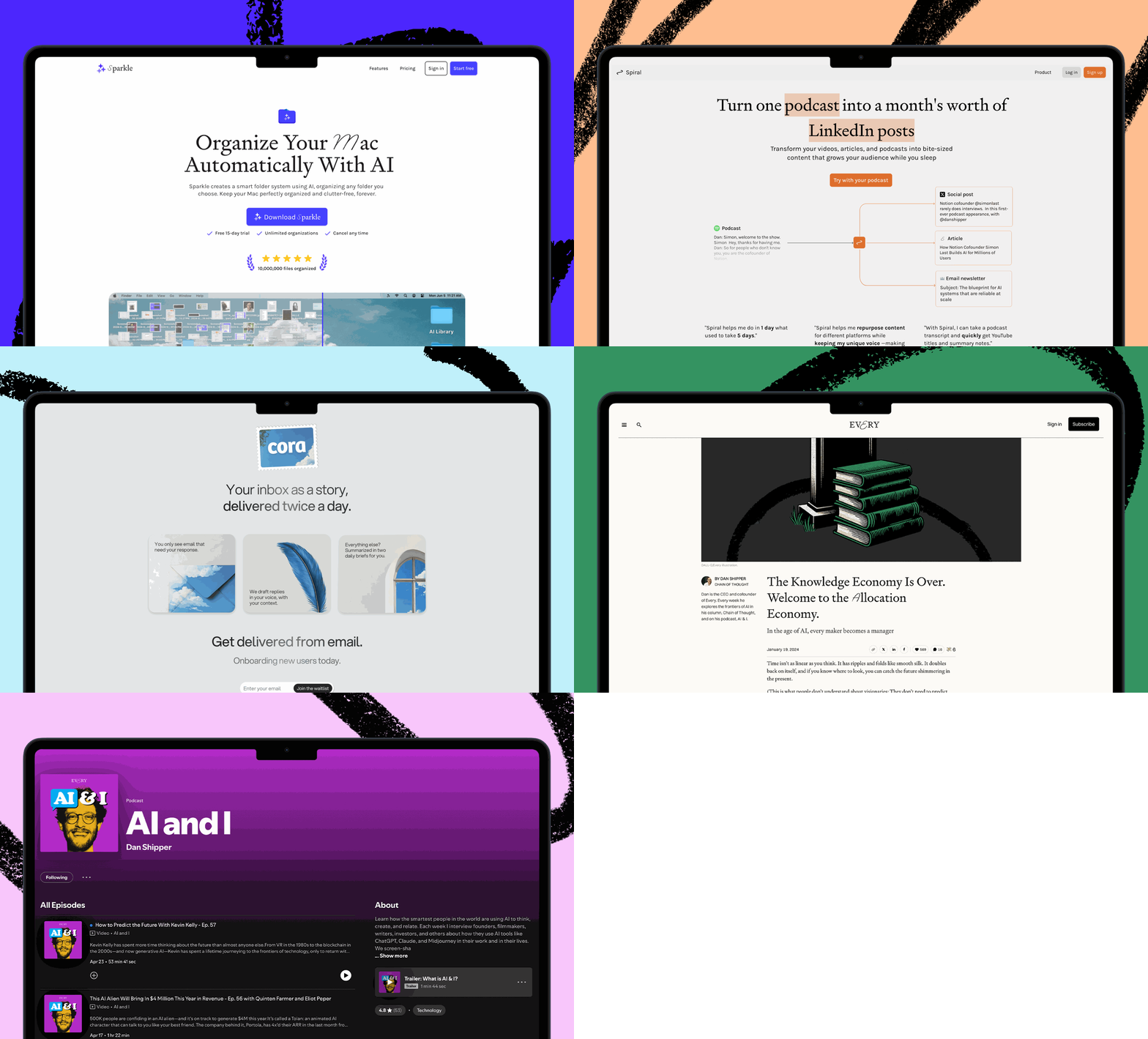

Hello, and happy Sunday. Our Builder Pack for All Access members includes two new tools: Paper Pro, a design canvas that turns your work into code, and Mobbin Team, a library of more than 600,000 screens from shipped products. Both plug into Codex, Claude Code, and Cursor, and bring the Builder Pack to more than $9,000 in value. Last Friday we ran our first office hours for All Access subscribers, where we showed how we use the pack inside Every and worked through member projects live. This week paid subscribers also unlocked 14 voice-to-text workflows from the Every team, a Codex-to-Codex handoff, and a skill audit from Kieran Klaassen.—Kate Lee
Was this newsletter forwarded to you? Sign up to get it in your inbox.
Knowledge base
“Inside OpenAI’s Race to Reinvent Software Development for the Agent Era” by Laura Entis: Laura spoke with six members of OpenAI’s infrastructure team—including its vice president of applied infrastructure engineering—about three converging pressures: an overwhelming surge of AI-generated code, software-development infrastructure pushed toward its limits, and a fundamental redesign of how code gets reviewed and kept reliable. Read this to see what every software organization is about to face before it does.
🔏 “Build Faster With Voice” by Naveen Naidu and Laura Entis/Guides: Our definitive guide to working by voice. Paired with an agent, speech removes the translation step, so you can act on a customer call or a half-formed idea without writing it up first. Monologue general manager Naveen Naidu walks through the five-step loop every voice workflow follows. Paid subscribers get a library of 14 workflows from the Every team—including head of growth Austin Tedesco turning an all-hands into a recap, Kieran polishing an app and storing voice notes as living memory, and Daniel Rodrigues building custom design tools out loud.
🔏 “Fable as CEO” by Laura Entis/Context Window: Our engineers have started describing Anthropic’s models as a company org chart—Fable as CEO, Opus 5 a senior engineer, Sonnet 5 a junior—as labs shift from expensive generalist models to a “mixture-of-models” structure where specialized models collaborate inside one harness, per head of platform Willie Williams. Also inside: the rise of “Claudish,” “the daily driver,” the running list of models the team is using this week; and a “steal this workflow” on how head of operations Arielle Shipper and Austin had their Codex agents hand off work to each other.
🔏 “Taming Opus 5” by Katie Parrott/Context Window: After the Opus 5 Vibe Check, the rest of the Every team spent the weekend with the model—its unruliness held up, but they found a way to tame it. Also inside: a “steal this workflow” on how Flora turns one reference image into a reusable creative system; a second workflow, “Is it the skill or the model?,” for auditing whether instructions built for an older model are hurting the new one; and why one-shot AI video-game demos flood social feeds.
“What If Slack Was Your AI Command Center” by Laura Entis/Context Window: Senior applied AI engineer Nityesh Agarwal makes the case that Slack is the best model-agnostic operating system for agent work, and shows how he built one. Also inside: a signal on Block CEO Jack Dorsey eyeing Slack as an agent surface too; a tool spotlight on “Destructive Command Guard,” a safeguard against GPT-5.6 Sol deleting things it shouldn’t; and an AI & I pull from the archive with Wired cofounder Kevin Kelly. 🎧 🖥 Listen on Spotify or Apple Podcasts, watch on X or YouTube, or read the transcript.
“Three New Habits for the Age of AI” by Xinran Ma: Product designer Xinran Ma writes the Design with AI newsletter for more than 44,000 subscribers, and left a corporate design job to work for himself. By going solo, he learned to stop waiting for certainty, forming opinions on tools secondhand, and expecting permission from above. Read this for what working for yourself teaches you about working with AI. (This is the second piece in the “unlearning” series, in partnership with Maven.)
Log on
Get hands-on with how Every uses AI. These are the live camps, workshops, and meetups where team members teach the workflows behind our work.
Upcoming camp
- Voice Mode Camp: a one-hour virtual session for paid subscribers on Friday, August 7, where the Every team demonstrates practical voice workflows for writing and agent orchestration, gets you started, and answers your questions. RSVP.
Previous camp
- All Access office hours: our first office hours for All Access members, a one-hour virtual session on Friday, July 24, where the Every team showed how it uses the Builder Pack tools inside Every and then worked through member projects live. Watch the recording.
From Every Studio
Monologue has dictated half a billion words
Monologue passed 500 million words dictated this week. When it launched last September, it was writing about 1 million words a week on the Mac alone; it now runs on Mac, iPhone, and Apple Watch, and Naveen gave it a new home this week at monologue.to.
Spiral’s final edit catches more of AI’s tells
Spiral, Every’s writing tool, runs a top edit over every draft it produces, and that pass now catches more of the ways AI gives itself away: vague authority (“studies show,” “experts agree”), inflated significance (“marks a pivotal moment”), fake-insight setups (“what most people get wrong”), flat “in conclusion” endings, and words like “streamline,” “robust,” and “paradigm shift.” As the models pick up new habits, Spiral keeps adding to what it strips out.
Alignment
Old scars. Silicon Valley has traditionally placed a premium on the outsider because those with fresh eyes see the absurdities that industry veterans have begrudgingly accepted. Occasionally, that naivety is worth billions to venture capitalists who have spent years scouting for the next Patrick and John Collisons—both programmers, not payments executives, when they started Stripe.
But AI is changing what investors need from founders. In its H1 2026 funding report, digital-health venture fund Rock Health says it has stopped describing startups as “AI-enabled” because the technology is too ubiquitous to distinguish one company from another. Investors and buyers have moved on to asking: “Who has something AI alone can’t provide?”
One answer is deep domain expertise. Rock Health found that founders who have worked inside the healthcare organizations they sell to are better able to identify solvable problems and “see through the buyer’s eyes.” This is hardly rocket science: A clinician or administrator knows which apparently ridiculous constraint cannot simply be designed away. More importantly, they know which questions are worth asking and which problems are worth spending years trying to solve.
Healthcare is making the value of expertise more visible, but I doubt that value will remain confined to this domain. Law, finance, manufacturing, and education all run on tacit knowledge that never appears in a model’s training data—and selling into them takes people who understand the unofficial workflows and the competing incentives.
While we still need people with fresh eyes, I believe the best founders will need old scars.—Ashwin Sharma
That’s all for this week. Follow Every on X at @every and on LinkedIn.
Everyone’s a builder now. Every All Access gets you the full membership plus the Builder Pack—$9,000+ in credits for the tools we build with.